




DfE publish a range of statistics about achievement at post-16. Among them, average attainment in the various A-level subjects, and the percentage of students retained at their post-16 institution.
However, many students counted as “retained” in official statistics didn’t complete all of the subjects they started. And such students are not captured in measures of attainment either.
This is the gap we’re going to look at today, by asking the question: what proportion of students who start a particular A-level actually go on to gain the qualification?
Data
To answer this, we look at the population of students who started post-16 (Year 12) at the beginning of the 2022/23 academic year in a state-funded school or in the further education (FE) sector.
We consider the qualifications students were enrolled on in October 2022 as their starting courses, which allows for a bit of chopping and changing in the first few weeks of term. We then match these starts with results achieved in either 2022/23 or 2023/24, with a bit of leeway for things like students changing to a higher or lower version of their initial qualification part way through the course. For example, a student who started A-level maths but achieved a result in AS-level maths would count as having completed A-level maths.
The completion rate for a given qualification is the number of matched results divided by the number of starts[1].
We also touch briefly on the proportion of 2022’s Key Stage 4 (KS4) cohort who were not observed at post-16 at the beginning of the 2022/23 academic year. While many of these students won’t have progressed to post-16 education at all, some may have progressed at a later date and/or at an institution outside of the state-funded system in England.
As an aside, the Department for Education used to undertake this sort of matching of starts and results for the schools sector, creating a dataset known as PLAMS (post-16 learning aims). However, as it has been discontinued we have had to do the matching ourselves. We would recommend it being reintroduced. By contrast, the data source for the FE sector (the Individualised Learner Record) has qualification-level tracking of learning aims from enrolment to achievement.
Overall completion rates
Let’s start by looking at the overall completion rate for A-levels in all subjects. We split the data by KS4 attainment, as measured by Attainment 8. We count students with an Attainment 8 score of 40 or below as low attainers, between 40 and 60 as middle, and above 60 as high.
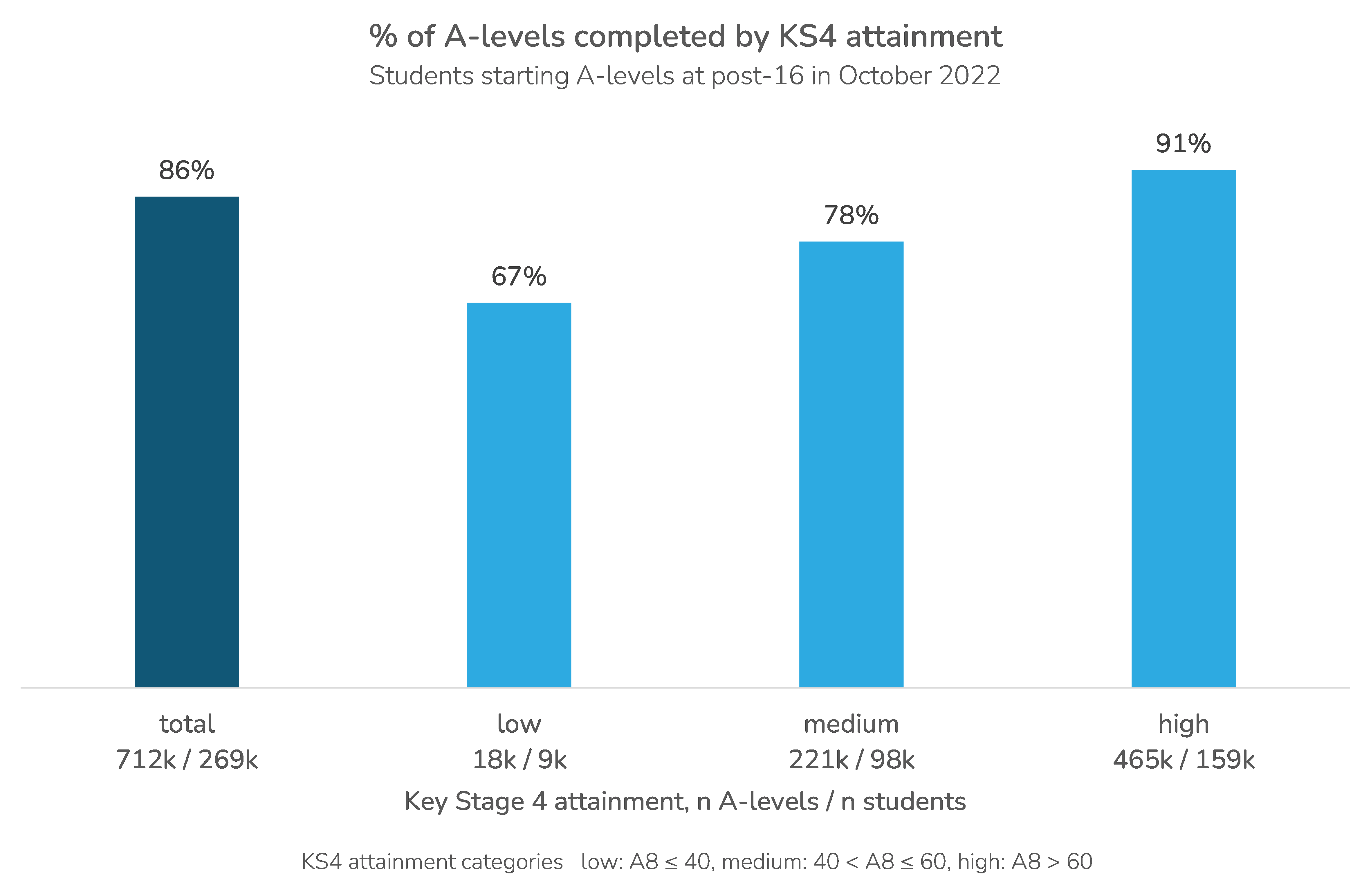
Overall, just under 86% of A-levels started in October 2022 were completed by the end of 2023/24. There was substantial variation by KS4 attainment, with 67% of A-levels started by low prior attainers resulting in a qualification, 78% of those started by middle prior attainers, and 91% of those started by high prior attainers.
It’s worth pausing here to think about what the figure for low prior attainers means. Does it mean that a pupil with an Attainment 8 score of 40 or lower picked at random on GCSE results day in 2022 would have had a 67% chance of completing an A-level? The answer is no. And the reason is that pupils with low prior attainment rarely start A-levels. In fact, they often aren’t observed at post-16 at all, as we show in the chart below.
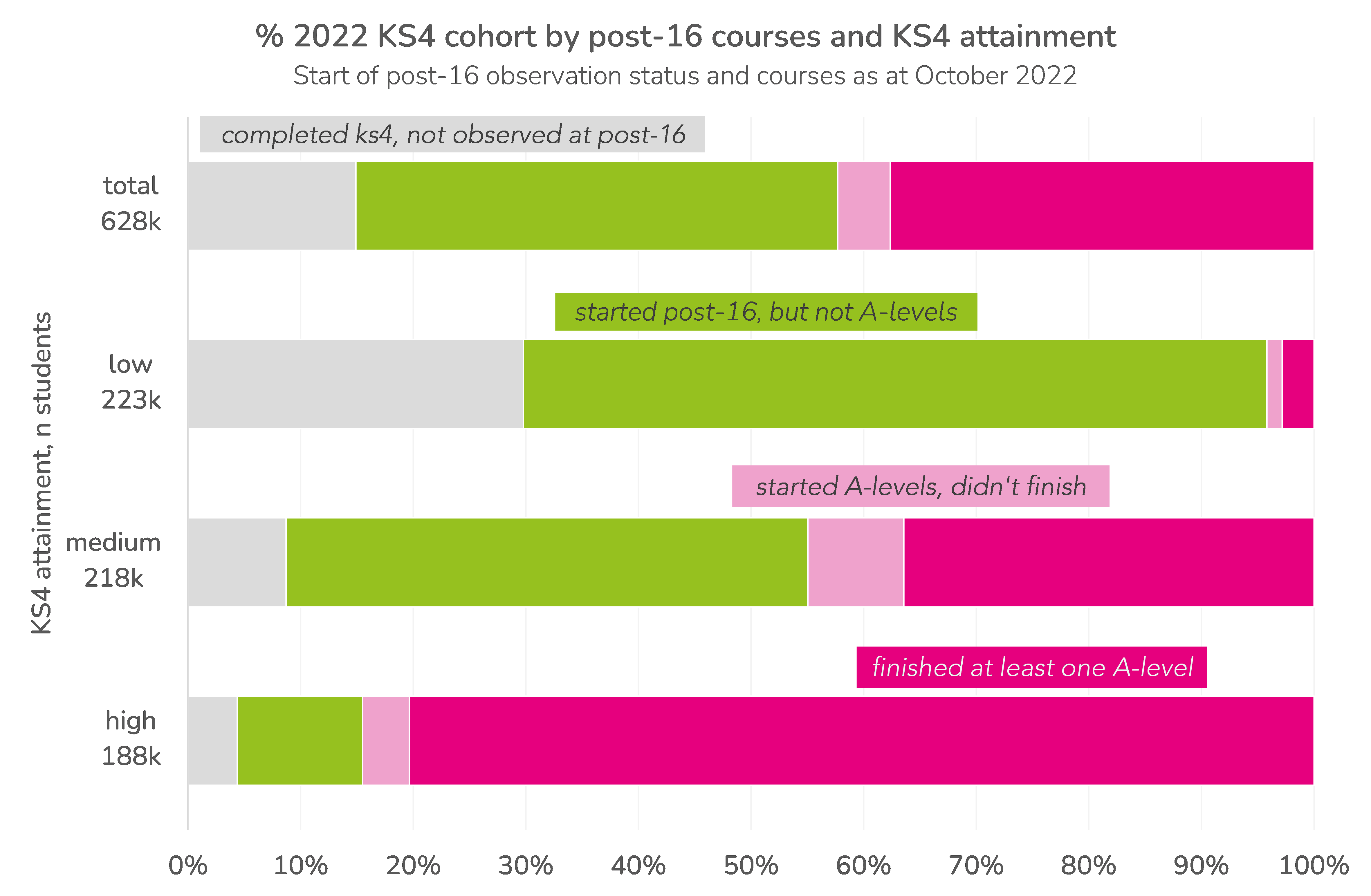
This means that pupils with low (and, to a lesser extent, medium) prior attainment who started A-levels are likely not representative of pupils with low prior attainment in general. For example, they may be pupils who underachieved in their GCSEs due to illness or other personal circumstances.
It’s important to bear this “selection effect” in mind when looking at completion rates (or any statistic relating to achievement at post-16) for groups of students who are substantially under-represented.
Completion rates by subject
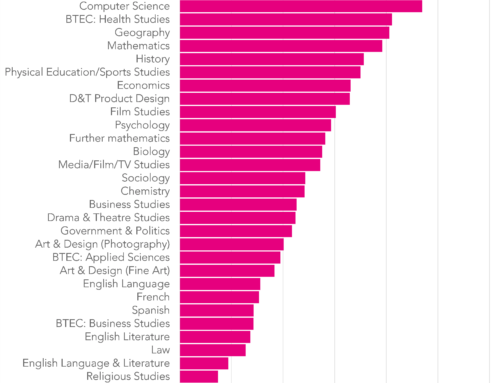
Now let’s look at completion rates for individual A-levels. Below, we plot the completion rate for each subject, overall and broken down by KS4 attainment. This time, we split KS4 attainment two ways: “high” (an Attainment 8 score greater than 60) and “other” (either no Attainment 8 score or a score of 60 and below). Alongside the chart, we add the number of students who started the qualification (“n”) and their mean Attainment 8 score (“A8”).
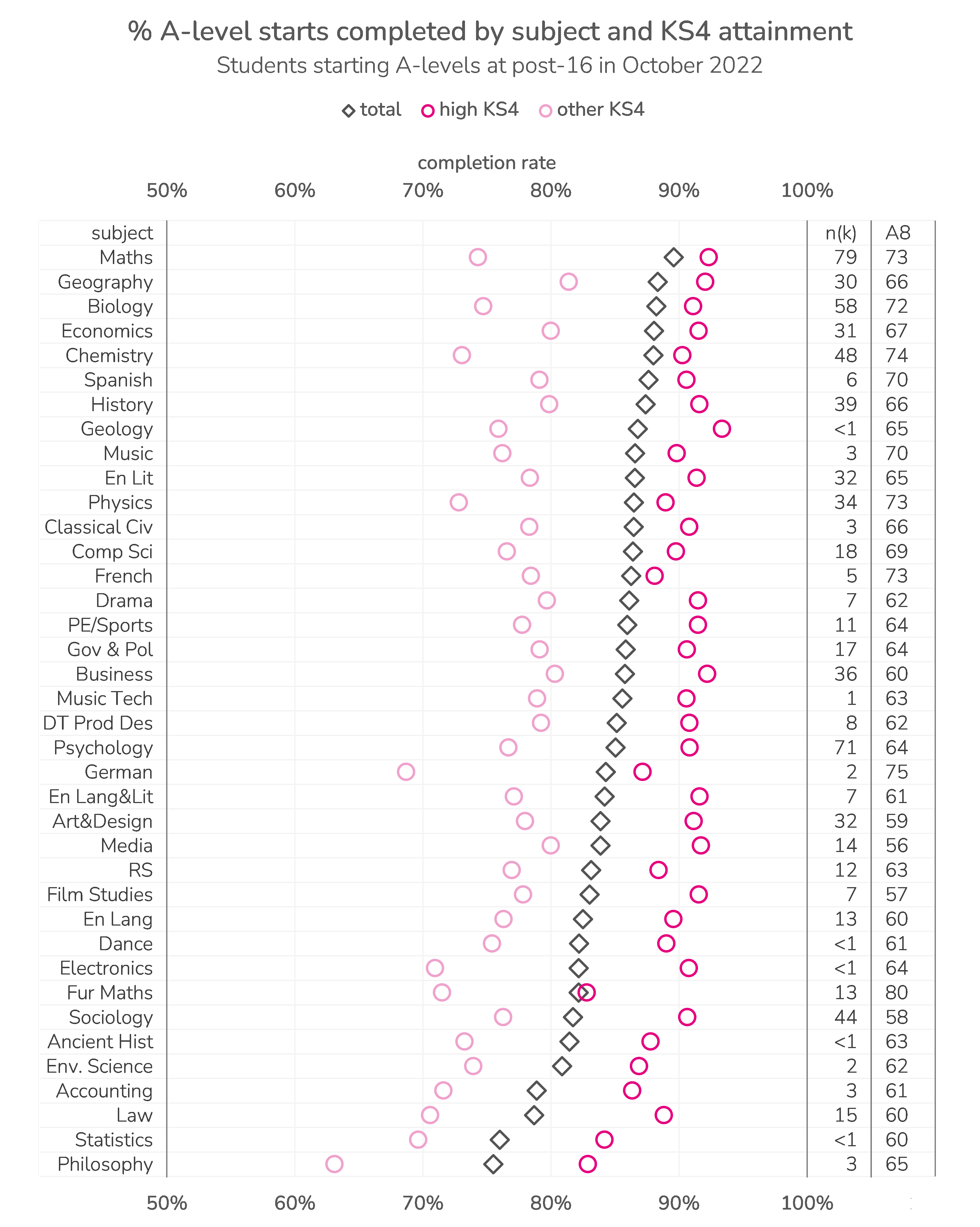
Completion rates were broadly similar across the different subjects, with the top 20 highest completion rates by subject separated by less than five percentage points. As expected, given our findings of the previous section, there is a correlation between mean Attainment 8 and completion rates: subjects with higher attaining cohorts tended to see higher completion rates than lower attaining (a correlation coefficient of 0.44 at the subject-level).
Maths was the subject with the highest completion rate, with 90% of those who started going on to achieve a qualification. It was also, however, one of the subjects with the highest gaps in completion rate by prior attainment: those with high A8 scores had a rate 18 percentage points higher than other students (92% vs 74%). The six subjects with next highest completion rates were separated by a single percentage point, from geography at 88.3% to history at 87.4%.
Other subjects with big gaps in completion rates by prior attainment include philosophy (91% vs 71%), law (89% vs 71%), chemistry (90% vs 73%), physics (89% vs 73%) and biology (91% vs 75%).
The subjects with the smallest gaps were French (88% vs 78%), geography (92% vs 81%), further maths (83% vs 72%), religious studies (88% vs 77%) and Spanish (91% vs 79%).
Further maths is also notable for being the subject with the lowest completion rate for high prior attainers, ten percentage points lower than of high prior attainers in A-level maths.
Further details
If you’d like to look at this data in more detail, we’ve put together a downloadable list of subjects and completion rates in tabular form here (xlsx).
Want to stay up-to-date with the latest research from FFT Education Datalab? Sign up to Datalab’s mailing list to get notifications about new blogposts, or to receive the team’s half-termly newsletter.

[1] The word “completion” here has no relation to the learning aim statuses which are collected in school census and ILR returns. A learning aim status of “complete” means that a student has remained on-roll and registered for a qualification for the required amount of time, thus completing the learning activities associated with the aim. See school census guidance here, and ILR guidance here. A learning aim can have a status of “complete” even if the intended qualification was not achieved (and vice versa)

Interesting to know what has caused the gap in German which is a very different profile of French and Spanish
The completion rates imply a much lower success rate (retention 0.n x pass 0.n) than the national and institutional rates published. Curious