




England’s former Gifted and Talented (GT) programme was built on a compelling idea. High-potential pupils would receive additional challenge and enrichment. The ambition was not simply to boost attainment but also to widen opportunity. It however ended back in 2010, when the coalition government came into power.
In our new academic paper we provide the first large-scale picture of how this policy played out in practice. By linking national school records to higher education and early labour market data, we followed hundreds of thousands of young people from primary school through GCSEs, university and into their mid-twenties. This is part of our broader project investigating outcomes of initially high achieving children from disadvantaged backgrounds funded by the Nuffield Foundation.
Findings
Schools were encouraged to identify approximately 5–10% of pupils as gifted and talented, focusing on a range of abilities. The identification process emphasised recognising potential, even in underachieving pupils. In the end, around 22% of pupils were identified as gifted and talented at some point between 2007 and 2010 (when they were in Year 7 to 10).
But who, exactly, was identified as “gifted and talented”?
Pupils from the most advantaged backgrounds were 19 percentage points more likely to be labelled GT than those from the least advantaged. Even after taking Key Stage 2 scores into account, the socio-economic gap remained around 6 percentage points.
After accounting for differences in prior achievement, we found that participation in the GT programme was associated with around two-thirds of a grade higher in GCSE mathematics and half a grade higher in English. (Though there may be factors we have been unable to control that could explain some of this apparent “effect”).
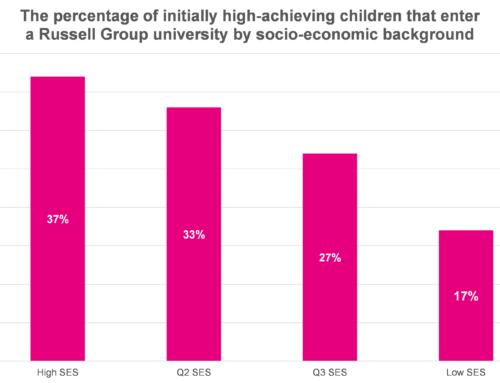
Similar patterns emerged for access to higher education. After adjusting for prior attainment, any participation in the GT scheme was associated with a 7-percentage point increase in the chances of attending a Russell Group university. A small 2-percentage point advantage even remained after differences in GCSE performance were taken into account.
However, these average “effects” conceal the fact that these potential benefits of the programme were concentrated amongst pupils from socio-economically advantaged backgrounds.
For example, among pupils from the most disadvantaged backgrounds, participation in the programme was associated with only a two-percentage point increase in the probability of attending a Russell Group university, compared to over a 10-percentage point increase amongst the most socio-economically advantaged pupils.
Moreover, little evidence emerged that any apparent educational benefits of the scheme then translated into better labour market outcomes.
Implications for education policy
The gifted and talented scheme introduced by the last Labour government was undoubtedly well intentioned. However, the programme was disproportionately accessed by – and predominately benefited – pupils from more socio-economically advantaged backgrounds. It may have thus inadvertently reinforced educational inequalities rather than mitigating them.
The current Labour government should nevertheless consider introducing a new gifted and talented scheme, particularly given that high-achieving disadvantaged pupils have received insufficient attention in recent years. But in doing so, it is crucial to learn the lessons from last time around. This means ensuring that any new GT programme is much better targeted at disadvantaged high achievers. It also means drawing on evidence by asking the Education Endowment Foundation to conduct a rapid evidence review to synthesise what works best for high-achieving disadvantaged young people. Ongoing evaluation must also sit at the core of the scheme so that its impact can be properly understood.

Leave A Comment