




The headline number of 16-24 year olds not in education, employment or training (NEET), currently hovering at around 1 million, or 1 in 8 of the population, has been prominent in education circles recently, to the extent that a “Tsar” has been appointed.
However, NEETs are not a new problem. There have been higher rates in the past.
Official statistics on NEETs are drawn from the ONS Labour Force Survey (LFS). This ran into difficulty a few years ago due to declining response rates. Recent editions have benefited from sampling and data collection improvements.
But what can administrative data sources tell us about NEETs?
In this blogpost, I’m going to use several datasets held within the National Pupil Database to look at the initial post-16 destinations of 16 year olds.
We would expect a lower rate of NEET among the 16 year old population compared to the full 16-24 year old population owing to the expectation of participation to age 18.
Defining the population
We use Key Stage 4 data for the academic year 2021/22. 648,500 pupils were included in national statistics.
The vast majority of the pupils (642,200) were born in the 2005/06 academic year. We leave to one side those born in other years. There is likely to be a similar number of pupils born in 2005/06 completing Key Stage 4 in other years.
The Key Stage 4 data includes all pupils on roll in state-funded schools or in local authority funded alternative provision. It also includes pupils in independent schools entered for approved qualifications, and any home educated pupils who enter approved qualifications at a school.
But it will be missing any home educated pupils who do not enter qualifications, any pupils living in England but going to school elsewhere (e.g. Wales, Scotland), anyone who had recently moved into England, and any other pupils not in school at the end of Key Stage 4 for whatever reason.
Initial post-16 destination
For each pupil in the population, we try to identify their activity on 6th October 2022. This was the date of the Autumn School Census.
We use three datasets for this:
- School Census, which tells us about enrolments in the state-funded school sector
- The Individualised Learner Record (ILR), which tells us about state-funded learning within the further education sector (e.g. Colleges, work-based learning providers)
- The National Client Caseload Information System (NCCIS), a month-by-month record of activity undertaken at ages 16 and 17 assembled from local authority returns
Local authorities have a duty to support 16 and 17 year olds resident in their area to engage in education and training. Each LA has a local version of NCCIS to help them track the activity of each young person. The list of activities captured by NCCIS can be seen in the technical guidance.
School and FE enrolments
First of all, we establish how many young people are observed to be attending school on 6th October from School Census, or have an active learning aim in ILR on the same date.
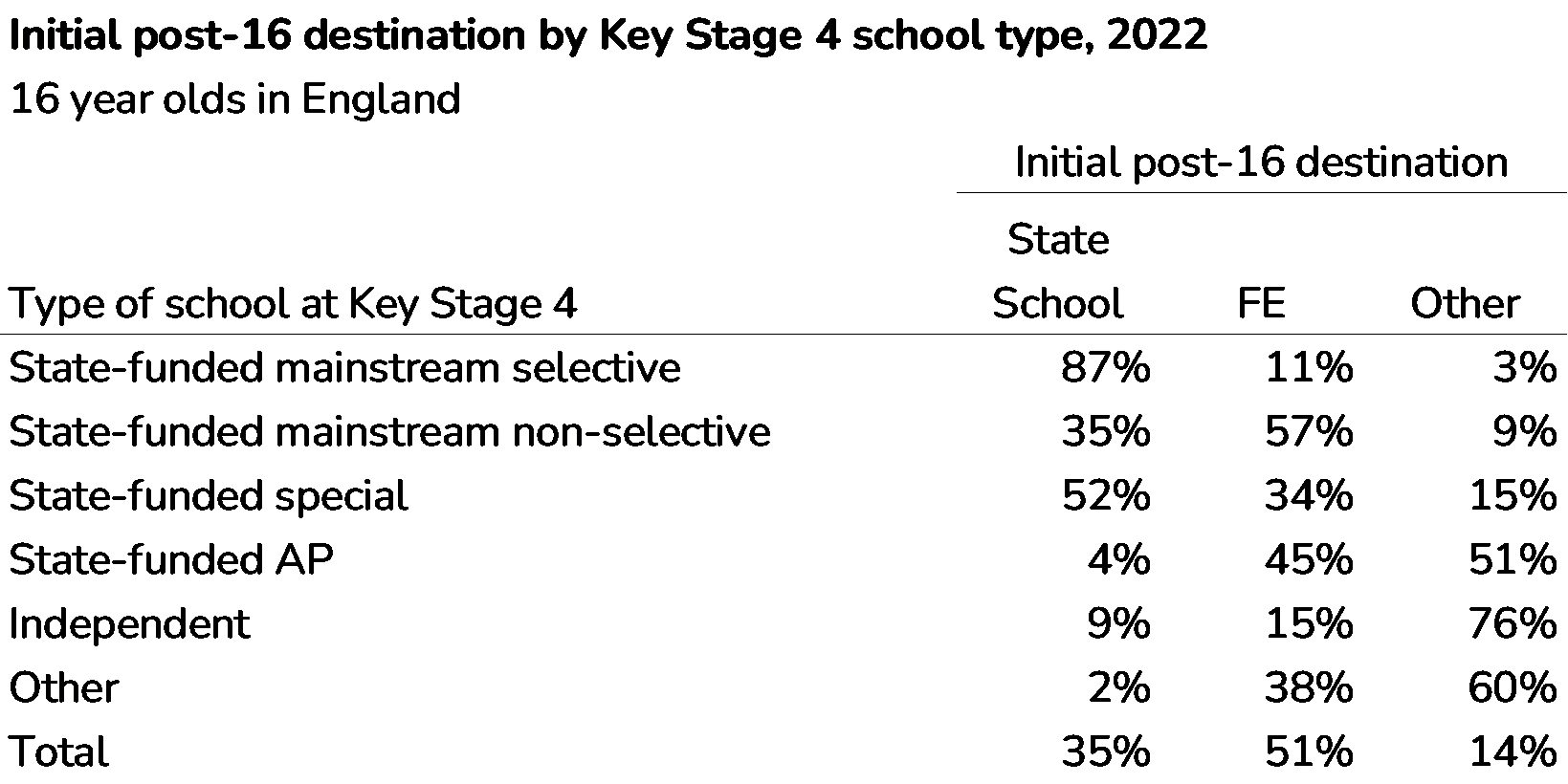
35% of the population are observed to be attending state school, 51% FE providers, leaving 14% in a residual “other” category.
The “other” category for destinations will include:
- anyone educated in the independent sector
- anyone in employment,
- anyone going to school in Wales or Scotland (or anywhere else)
- anyone who has emigrated (or, in tragic cases, died)
- anyone who is NEET.
It is therefore no surprise that the majority of those observed at an independent school at Key Stage 4 are in the “other” group.
NCCIS activity
We now take a look at the activities recorded in NCCIS for the population in October 2022, broken down by type of institution attended at the end of Key Stage 4.
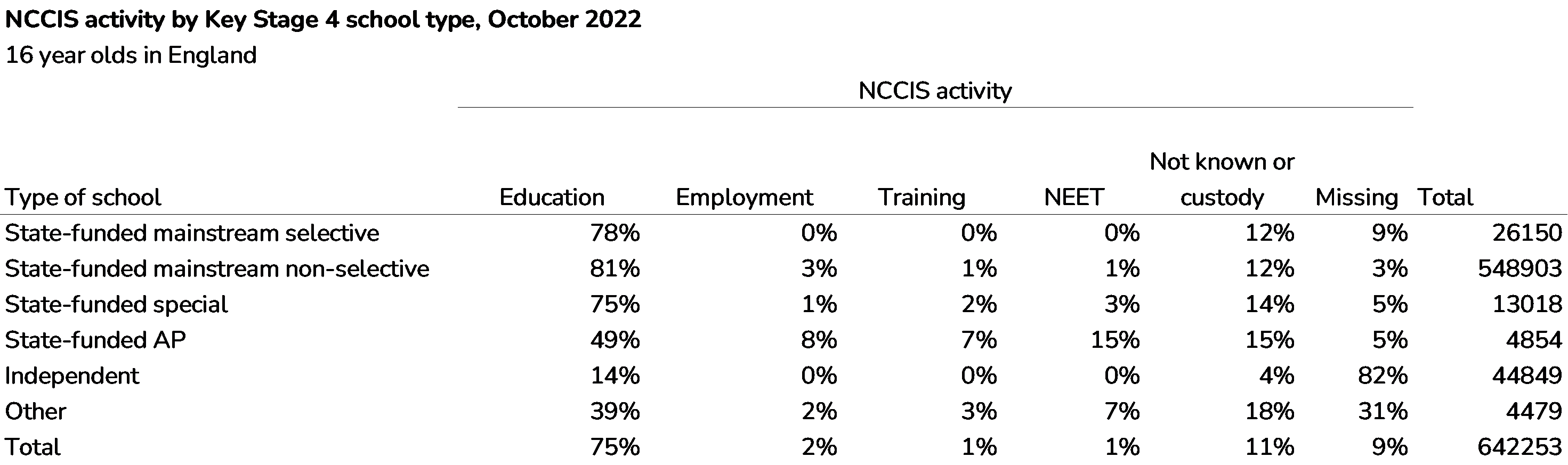
Here we see that there are substantial numbers (20%) of young people recorded as “not known” or who are missing entirely from NCCIS, including the vast majority of those who finished Key Stage 4 at an independent school.
It also gives us a known NEET rate of around 1%. In other words, young people known by local authorities to not be in education, employment or training.
Enrolments by pupil characteristics
Because of the amount of missing data, we’ll leave pupils who completed Key Stage 4 in independent schools to one side.
For the remaining pupils, we show the proportions enrolled in the school and FE sectors on 6th October 2022.

Being disadvantaged, having special educational needs, having low attainment (both at Key Stage 2 and Key Stage 4) are associated with a higher risk of not being enrolled at school or at an FE provider.
The level of agreement between datasets
Next, we reconcile each of our initial post-16 destinations with NCCIS activities for October 2022.
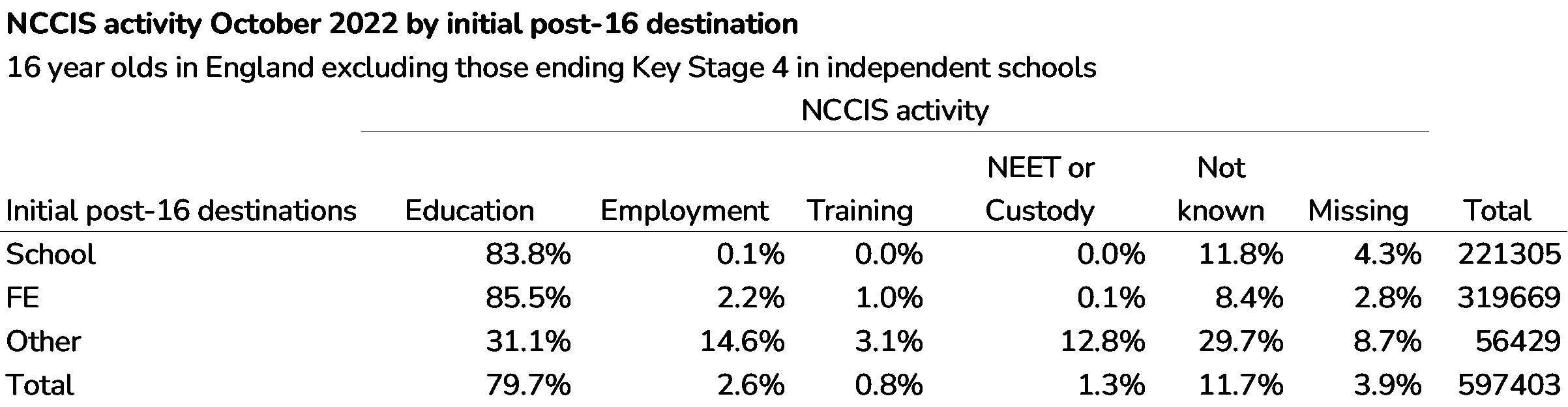
Almost all young people observed to be attending School according to School Census are recorded as being in education in NCCIS. The same is largely true for those attending FE providers although there is a small proportion listed as being in employment or training. This makes sense as anybody on an apprenticeship would be classified as in employment in NCCIS.
Almost all the known NEETs fall into the “other” initial destination category.
31% of those in the “other” initial destination category are observed to be in education according to NCCIS. These are young people for whom there are no corresponding school or FE enrolment records in NCCIS. They could have enrolled in September but dropped out, be attending schools or FE in Wales or Scotland, or be in education outside school or FE (there is a small amount of FE provision in the higher education sector, for example).
But the majority of those in the “other” category are either classified as “not known” in NCCIS or are missing entirely.
The not known and missing group
Almost 17,000 pupils in the “other” initial destination category were classified as “not known” in NCCIS on 6th October 2022.
It may have been the case that some pupils may have been in education (or employment, training etc.) on 6th October but their local authority had not yet established this.
We therefore sweep subsequent months of NCCIS using the <current_activity_start_date> column to identify any pupils observed to start an activity on or before 6th October.
This yields known activities for around half of them.
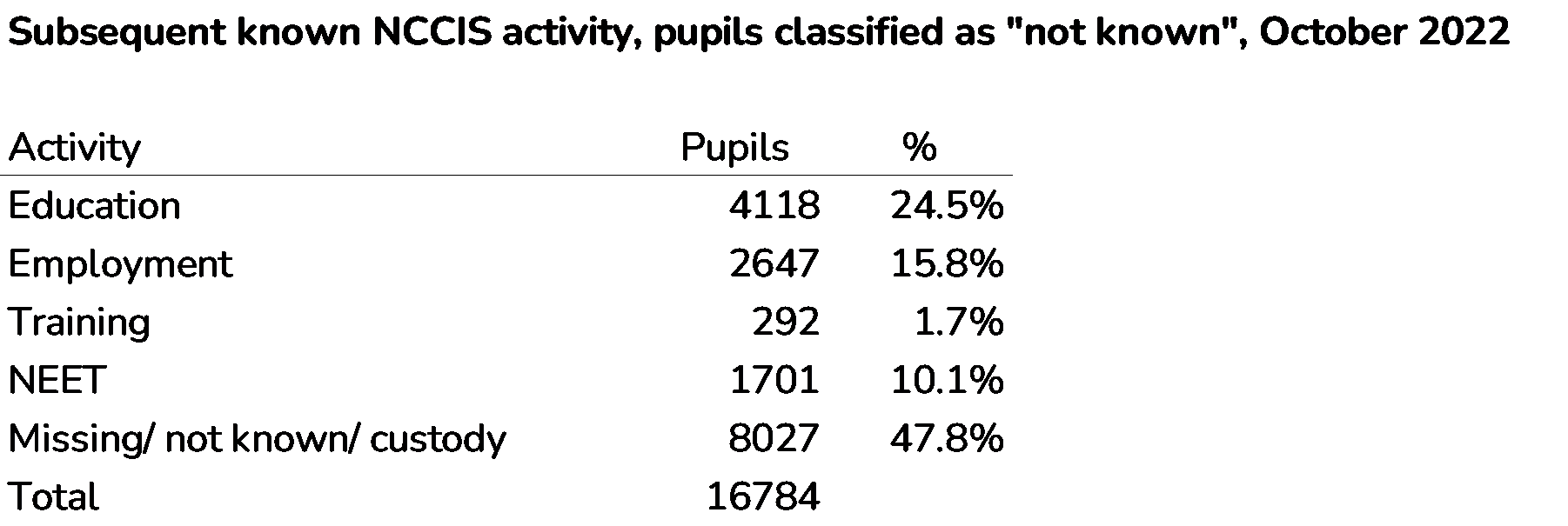
Around one in ten (1701) are recorded as being NEET on 6th October in a later NCCIS record .
How many 16 year olds were NEET on 6th October?
We can now try and bring all this together to estimate the number (and proportion) of 16 year olds known to be NEET on 6th October 2022.
We start off with 56,429 young people who were not observed to be enrolled at a school or FE provider.
We use NCCIS to establish an activity for each of them in October 2022, using later months if a pupil is recorded as “not known” that month but has a record of a known activity starting prior to 7th October 2022 in a later month.
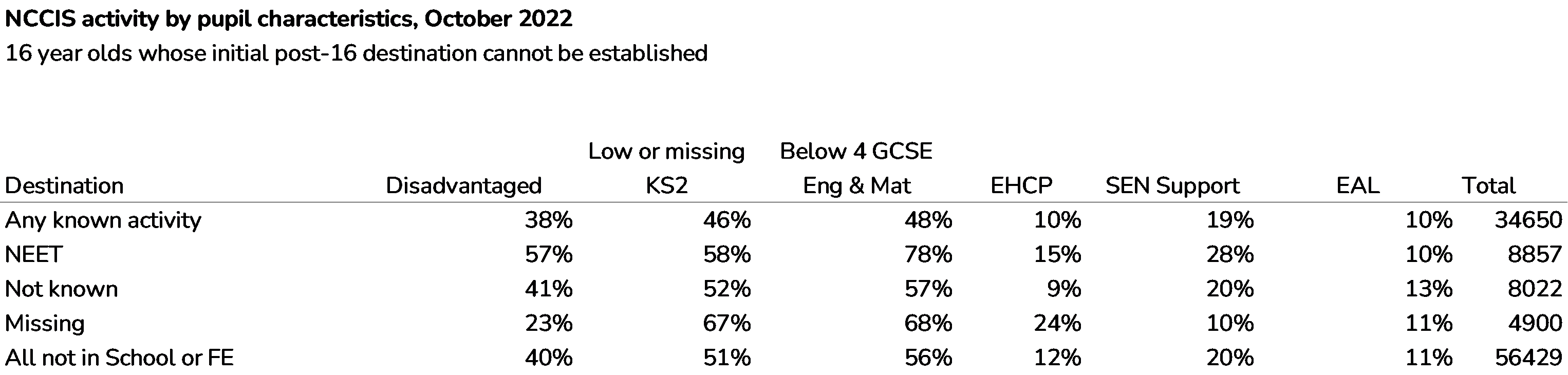
34,650 of the 56,429 young people meet our definition of a known activity in NCCIS.
This leaves a total of 21,779 potential NEETs, 3.6% of the population (excluding those who completed Key Stage 4 at independent schools)
For the next part, we invoke the spirit of Donald Rumsfeld.
Firstly, we have “known knowns”. Pupils that local authorities knew to be NEET in October 2022. There were 8,857 of them.
Secondly, we have “known unknowns”. Pupils whose activity cannot be established. There were almost 13,000 of those.
Finally, the “unknown unknowns”. Pupils who are NEET but who we have not observed in our population. We don’t know how many of those there are.
Summing up
Using administrative data sources to measure how many young people are NEET is tricky as being NEET only partially seems to be observed.
The post-16 activities of young people cannot be established, either because they are NEET, or because they have migrated or died, neither of which is recorded in the datasets we have used.
But based on our analysis of 16 year olds in October 2022, there were around 9,000 known NEETs and up to 13,000 possible NEETs, in other words between around 9,000 and 22,000 young people (1.5% to 3.6% of the population).
What is less in doubt is that low attaining and disadvantaged young people are far more likely to fall into the NEET group.
Want to stay up-to-date with the latest research from FFT Education Datalab? Sign up to Datalab’s mailing list to get notifications about new blogposts, or to receive the team’s half-termly newsletter.


As a Careers Lead, it would be handy to have data from where our students go after Year 11 on an official individual level that could come back to the school in a timely fashion to help inform summer exam reflection when it actually matters to teachers in the Autumn term. On the flipside, a national tracker of where students go after the 2 year college window would also inform what we can do further at school level.