




In previous articles in this series we’ve looked at the longer-term outcomes associated with early literacy outcomes, using end of Key Stage 1 assessments in reading and writing as a baseline measure.
In this article, we’re again going to look at a set of longer-term outcomes but this time using end of Key Stage 2 results in reading tests as a baseline.
The outcomes we look at are: end of Key Stage 4 attainment, Year 11 absence, exclusions, suspensions.
In other words, we are going to look at the journey from end of primary to end of secondary.
Data
We use data from the National Pupil Database for the cohort of pupils which completed Key Stage 2 tests in 2018/19 and Key Stage 4 in 2023/24.
For each pupil we observe, where available:
- GCSE grades in English and maths
- Whether they achieve a qualification at level 2 (GCSE grades 9-4 including vocational equivalents) by the end of Key Stage 4
- Their absence rate in Year 11
- Whether they are permanently excluded during secondary education
- Number of suspensions during secondary education
As we shall see, not all pupils are observed at Key Stage 4. This might be because they moved into home education but did not enter any qualifications, they moved abroad or, in some rare but tragic cases, died.
Key Stage 2 reading (and maths) test results are reported as scaled scores which range from 80 to 120. 100 denotes an expected standard. 74% of pupils reached the expected standard in 2019.
Pupils working below the standard of the test do not have to sit the paper. In these cases, a proxy score below 80 is assigned based on teacher assessment.
The convention used in Secondary School Performance Tables is to divide pupils into three groups based on their prior (end of Key Stage 2) attainment:
- Low (scores<100), 26% of the 2019 cohort
- Middle (100 to 109), 51% of the 2019 cohort
- High (110 or above), 23% of the 2019 cohort
In addition, a small number of pupils in the national cohort (<1%) do not have a reading score due to absence or missing data. This group is denoted “NR” (no result) in the charts below.
Is a score of a 100 at KS2 a useful predictor of success at Key Stage 4?
In the chart below we look at how three outcomes vary with respect to Key Stage 2 reading score: GCSE English grade, achievement of a Level 2 qualification and persistent absence in Year 11.
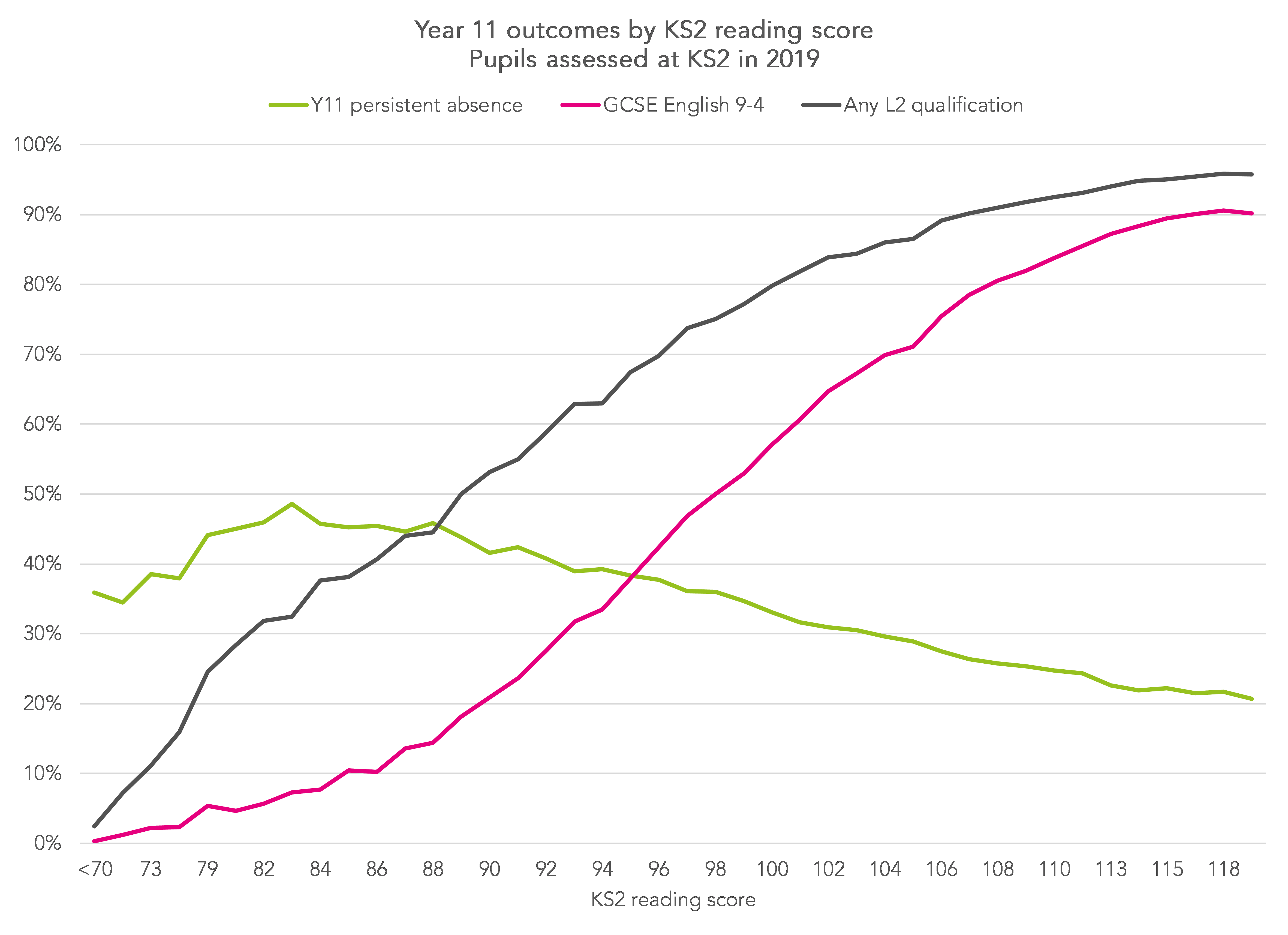
As we can see, outcomes improve as Key Stage 2 reading scores increase.
There is little in the way of difference in outcomes between pupils who score 100 (and who are deemed to have reached the expected standard) and those who score 99 (who have not reached the expected standard). For example, 57% of the former group subsequently achieve grade 4 or above in GCSE English compared to 53% of the latter group.
Pupils who scored 94 or below in KS2 reading were more likely to be persistent absently in Year 11 than achieve grade 9-4 in GCSE English.
But although pupils who score below 98 in KS2 reading tended not to achieve grades 9-4 in English, the majority who scored between 91 and 98 subsequently achieved at least one level 2 qualification.
Outcomes for pupils with low KS2 reading scores
So having shown that the use of 100 to define an expected standard is somewhat arbitrary, at least in terms of subsequent outcomes, we now revert to the conventional three prior attainment groups for the rest of the article.
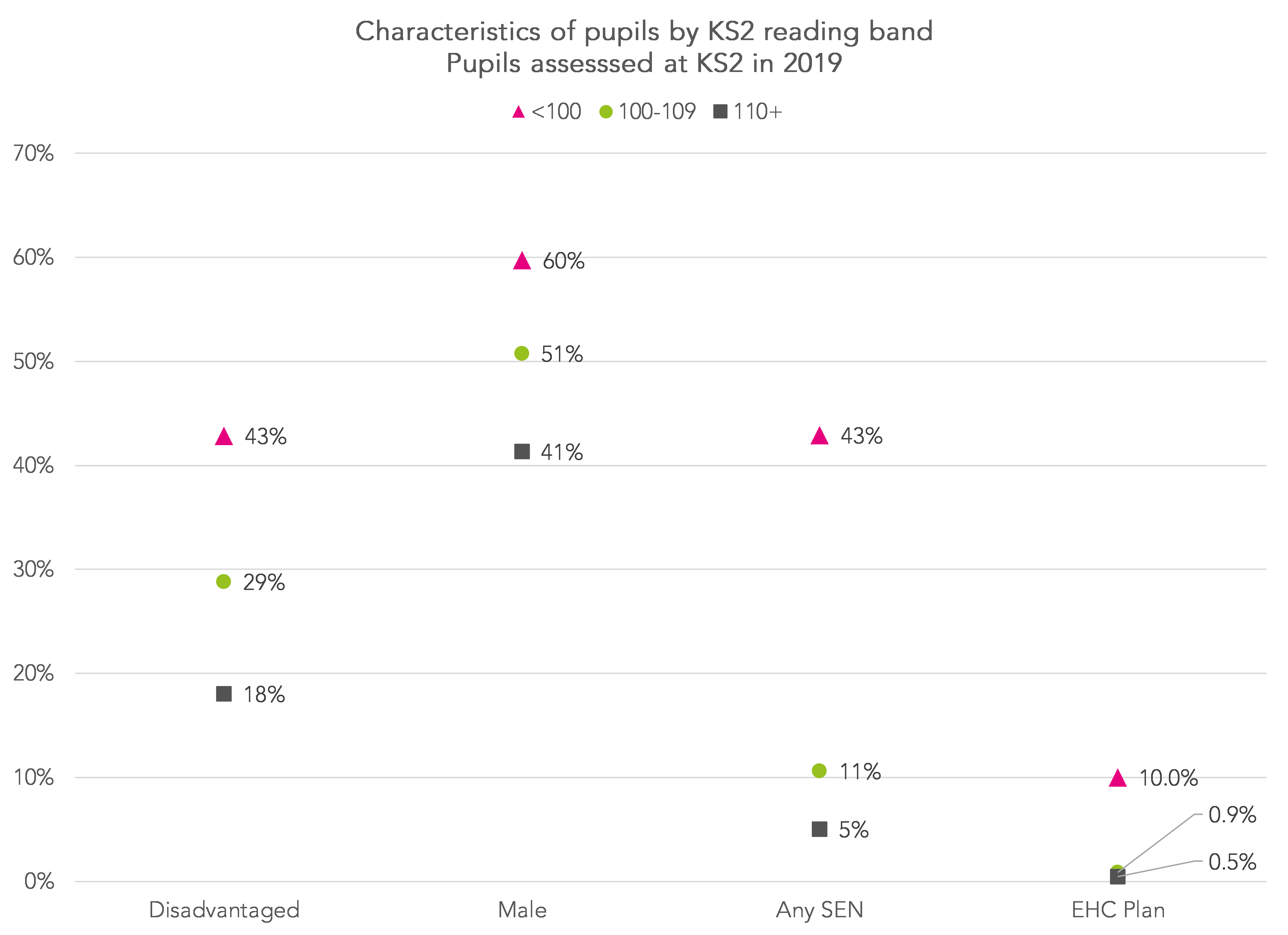
Firstly, it’s worth underlining that low reading attainment at Key Stage 2 is associated with disadvantage and special educational needs (SEN). The causes of poor outcomes at the end of secondary school will be multifactorial.
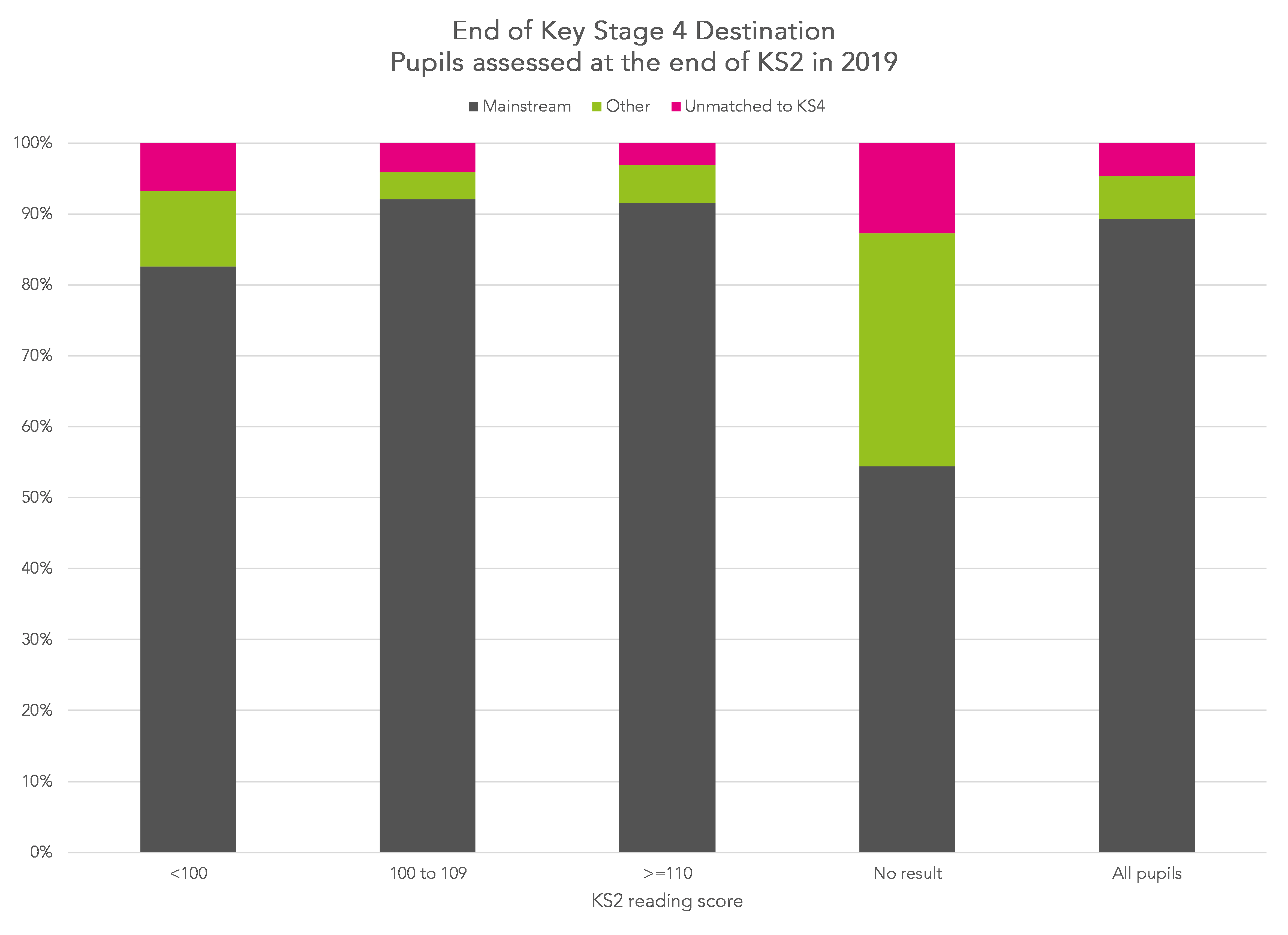
Those with lower prior attainment are more likely to complete Key Stage 4 outside the state-funded mainstream sector. 11% complete Key Stage 4 in “other” types of school, mostly special schools but also Alternative Provision schools compared to 4-5% of those with higher levels of KS2 attainment in reading.
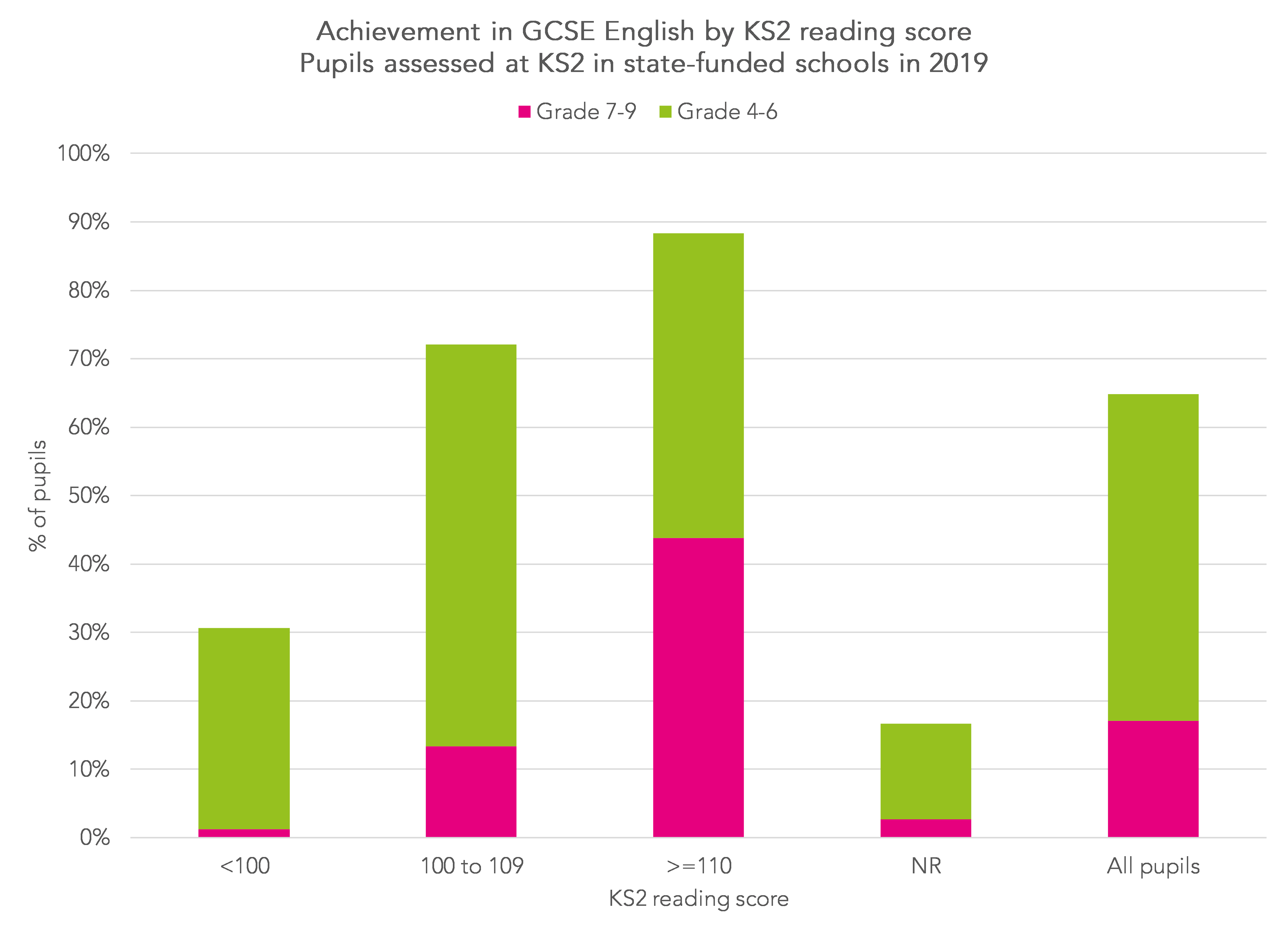
It doesn’t automatically follow that achieving a score below 100 in KS2 reading results in poor outcomes. 1% of pupils who did so in 2019 subsequently went on to achieve grade 9-7 in GCSE English. However, the majority do not go on to achieve grades 9-4.
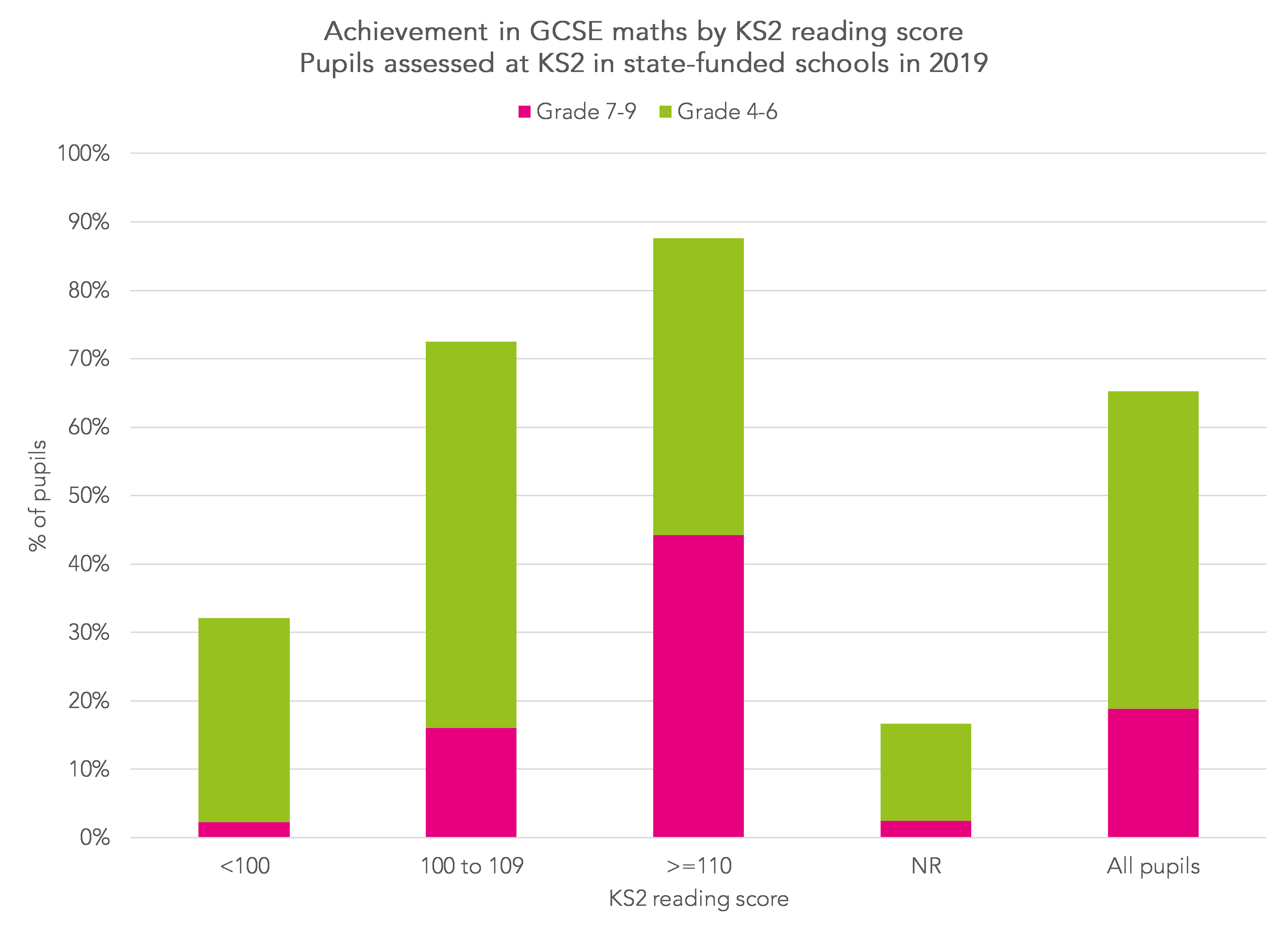
Broadly the same picture occurs in GCSE maths. This is unsurprising as pupils with low KS2 attainment in reading tend to have low KS2 attainment in maths as well.
Finally, we show rates of permanent exclusion and repeat suspensions.
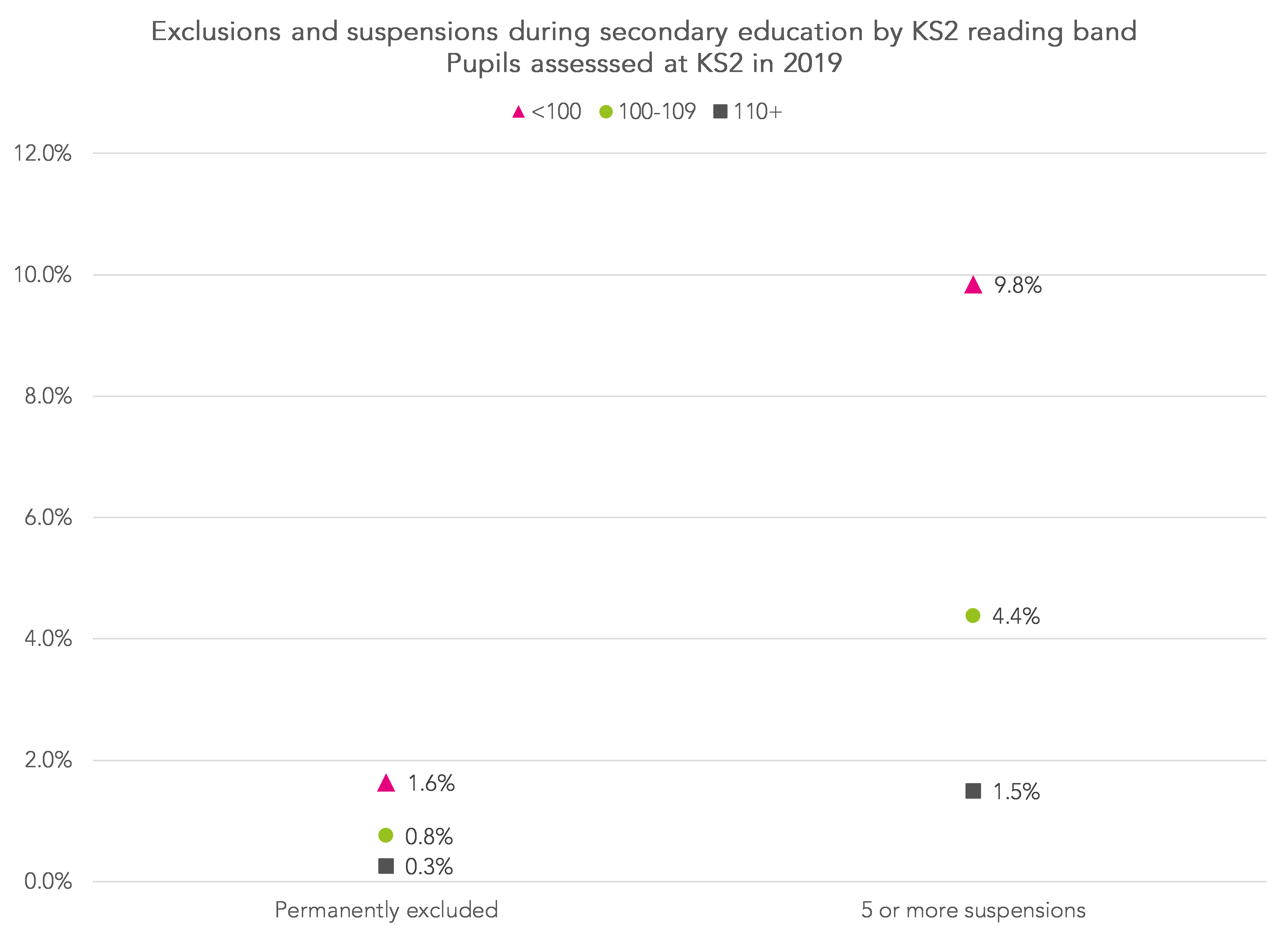
1.6% with a KS2 reading score below 100 were subsequently permanently excluded and almost 10% were suspended at least 5 times between Year 7 and Year 11.
Although pupils who scored below 100 made up 26% of the full national cohort, they accounted for 47% of the suspensions between Year 7 and Year 11 in the cohort.
Summing up
We have left to one side the important question of what the reading test measures: To what extent is it a measure of reading comprehension and to what extent is it a measure of general knowledge? That caveat aside, we have examined how scores in KS2 reading tests are associated with subsequent outcomes.
It does not automatically follow that pupils with low attainment in reading at Key Stage 2 will have poor outcomes by the end of secondary school. However, the higher your Key Stage 2 results the better your chances of good outcomes.
And it’s just not reading, it’s low prior attainment in general. We would see very similar results to those presented here if we looked at outcomes conditional on KS2 maths scores.
In 2019 around 26% of pupils achieved a Key Stage 2 reading score below 100 although the outcomes of those who score exactly 100 tend to be only slightly better than the outcomes of those who score 99.
31% of those who scored below 100 in KS2 reading in 2019 went on to achieve grade 9-4 in GCSE English and 32% in GCSE maths. Those who struggle in reading at Key Stage 2 also tend to struggle in maths. Nonetheless, the majority of pupils who achieved a KS2 reading score between 91 and 99 went on to achieve at least one level 2 qualification, either in a GCSE or in a vocational subject.
Finally, rates of Year 11 persistent absence, permanent exclusions and suspensions are higher among pupils with low KS2 prior attainment than other pupils. In fact, pupils who scored below 100 in the KS2 reading test were more likely to be permanently excluded than achieve grades 9-7 in GCSE English.
Want to stay up-to-date with the latest research from FFT Education Datalab? Sign up to Datalab’s mailing list to get notifications about new blogposts, or to receive the team’s half-termly newsletter.


Leave A Comment