




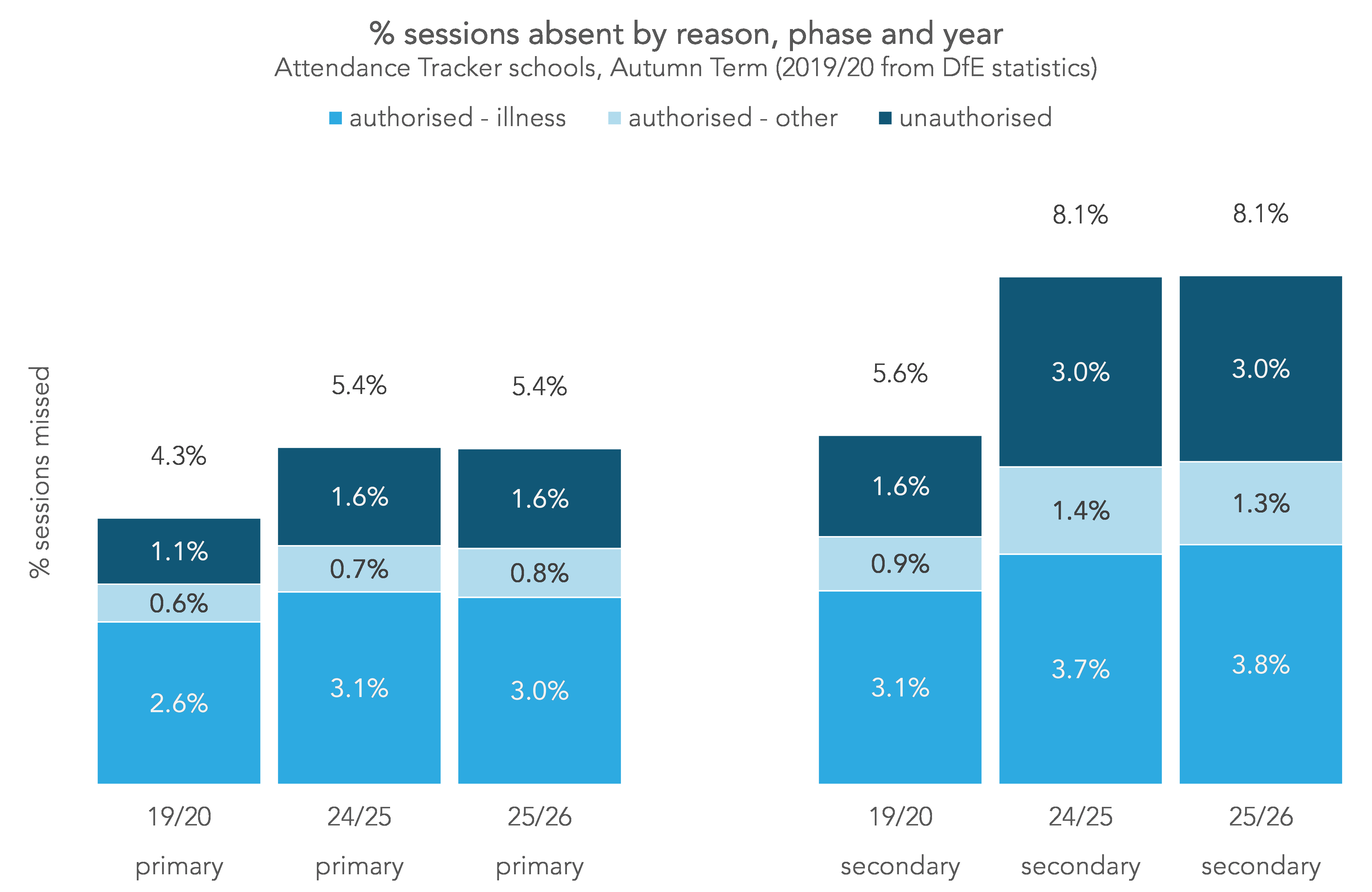
For the last few years, there has been a lot of focus on pupil attendance. In our Autumn Term update, we saw that rates of absence remained above pre-pandemic levels, particularly at secondary, where pupils missed around 45% more school than they did in Autumn Term 2019.
A big factor is the increase in the amount of absence which is “unauthorised”.
Absence is recorded as unauthorised in the following situations:
- parents or carers haven’t contacted their child’s school to provide a reason, or
- they have, but the reason falls outside of the limited circumstances in which a school can authorise an absence[1], or
- the reason is one which could, in principle, be authorised, but there are doubts about its authenticity.
Unauthorised absence accounts for around 30-40% of all missed sessions. At primary, rates are around 50% higher than pre-pandemic. At secondary, they’ve almost doubled.
So today we’re going to take a more detailed look at the patterns behind the headline figures. For example, are a small number of pupils responsible for the bulk of unauthorised absence, or do most pupils contribute a little? Are pupils missing big chunks of school every so often, or regularly missing the odd day?
To answer these questions, we’ll be using data submitted by our 10,000 Attendance Tracker schools over the last academic year, 2024/25.
We’ll look both at the volume of absence recorded, and also the number of “spells”. A spell of absence is made up of a number of consecutive sessions missed. For example, a pupil who was present all week apart from Wednesday records one spell of absence lasting one day. Another pupil who missed four consecutive weeks of school also records one spell, but lasting four weeks[2]. For this post, we’ll just be looking at spells of unauthorised absence.
Spell length
Let’s start by looking at how long spells of unauthorised absence tend to last. We’ll look at this from two angles: firstly, how many spells of each length were there and, secondly, how many days of school were missed due to spells of each length.
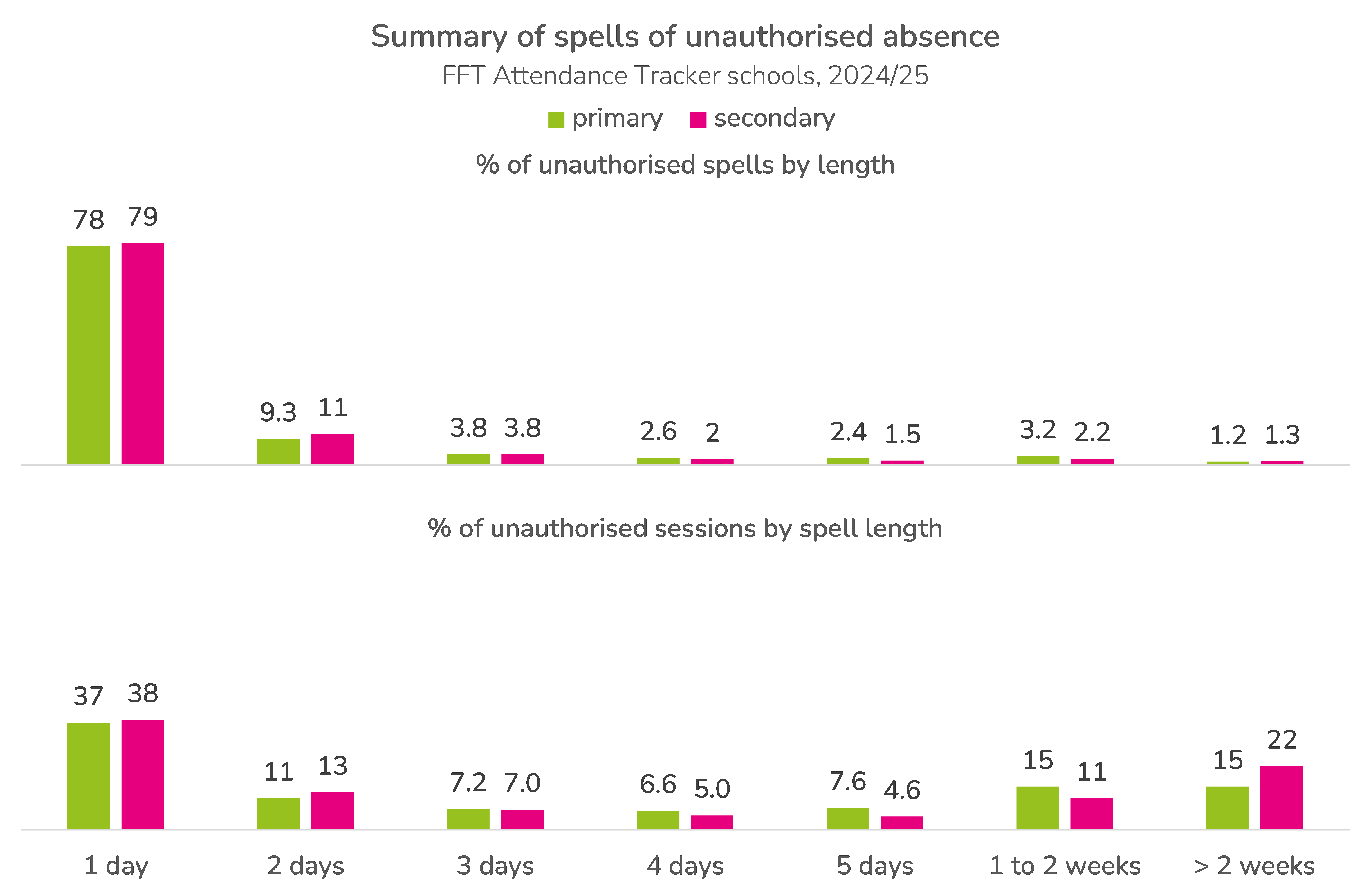
The top panel shows a very similar pattern at both primary and secondary: a large majority of unauthorised absence spells lasted a single day (almost 80% of spells at both primary and secondary). Longer spells were relatively rare, with fewer than 10% lasting longer than three days.
However, despite being most common, single day spells were not responsible for the majority of unauthorised absence. At both primary and secondary, just under 40% of all sessions missed due to unauthorised absence were down to spells lasting a single day, with just over 60% down to spells lasting longer.
Despite making up just over 1% of spells, absences lasting more than two weeks were responsible for 15% of unauthorised absence at primary, and 22% at secondary.
Spell frequency
Let’s turn now to frequency of unauthorised absence. Here, we aggregate spells at the pupil-level, and count the number of spells of unauthorised absence each pupil had across the year. Below, we plot the percentage of pupils by this number.
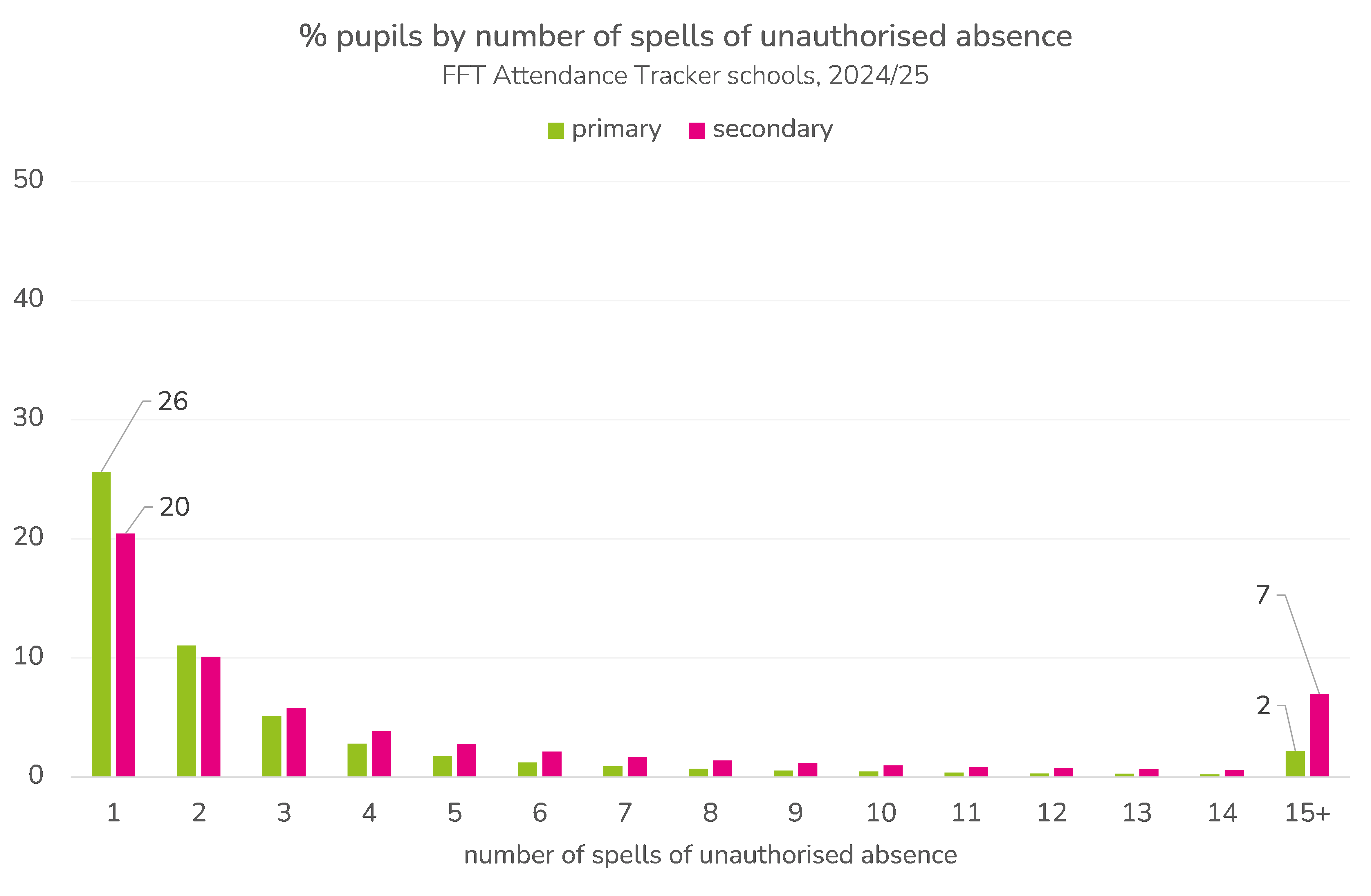
Surprisingly, perhaps, the proportion of pupils with at least one unauthorised absence (the sum of each set of bars) was similar at primary (54%) and secondary (60%). The distributions, however, are slightly different, most notably at the top end. At primary, 2% of pupils had 15 or more spells of unauthorised absence, whereas at secondary, 7% of pupils did.
At both primary and secondary, the most common number of spells of unauthorised absence was one – 26% of primary pupils had a single spell across the whole academic year, and 20% of secondary pupils.
Let’s look now at the proportion of unauthorised absence accounted for by pupils in each frequency grouping. (So, for example, the bar for one spell tells us the proportion of unauthorised absence sessions which belonged to pupils with a single spell of unauthorised absence.)
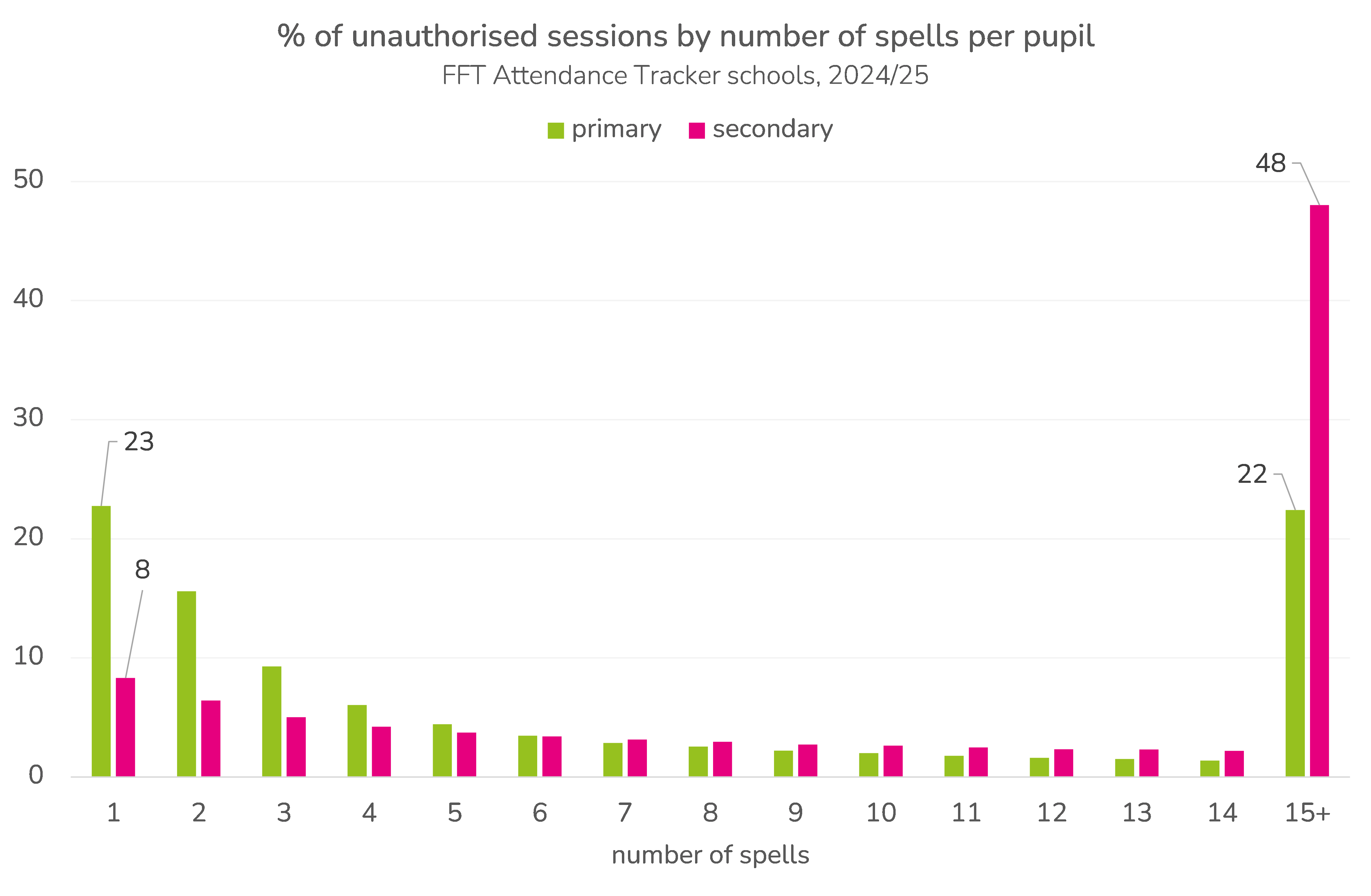
Now the distributions are quite different. We see that, at secondary, almost half (48%) of unauthorised absence was down to those with 15 or more spells, whereas at primary, these pupils contributed less than a quarter (22%).
At the opposite end of the distribution, 23% of unauthorised absence at primary came from pupils with a single spell, compared with just 8% at secondary.
We can also look at this same information from a slightly different angle: the proportion of total sessions missed due to unauthorised absence by pupils in each frequency band.
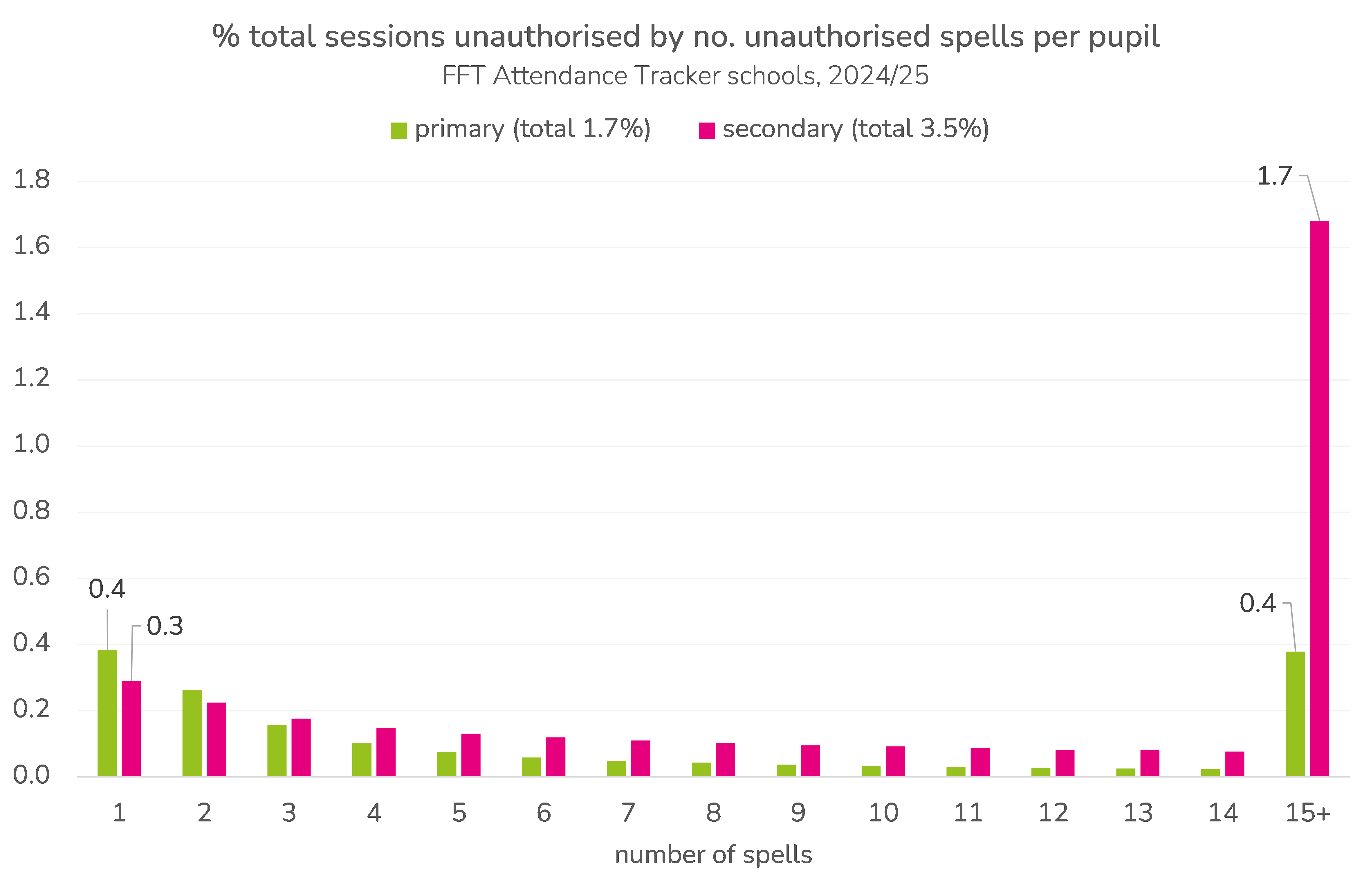
The biggest difference by far between primary and secondary is the contribution from pupils absent very frequently. Pupils with 15 or more spells of unauthorised absence across the year added 1.7 percentage points to the unauthorised absence rate at secondary, compared with 0.4 percentage points at primary.
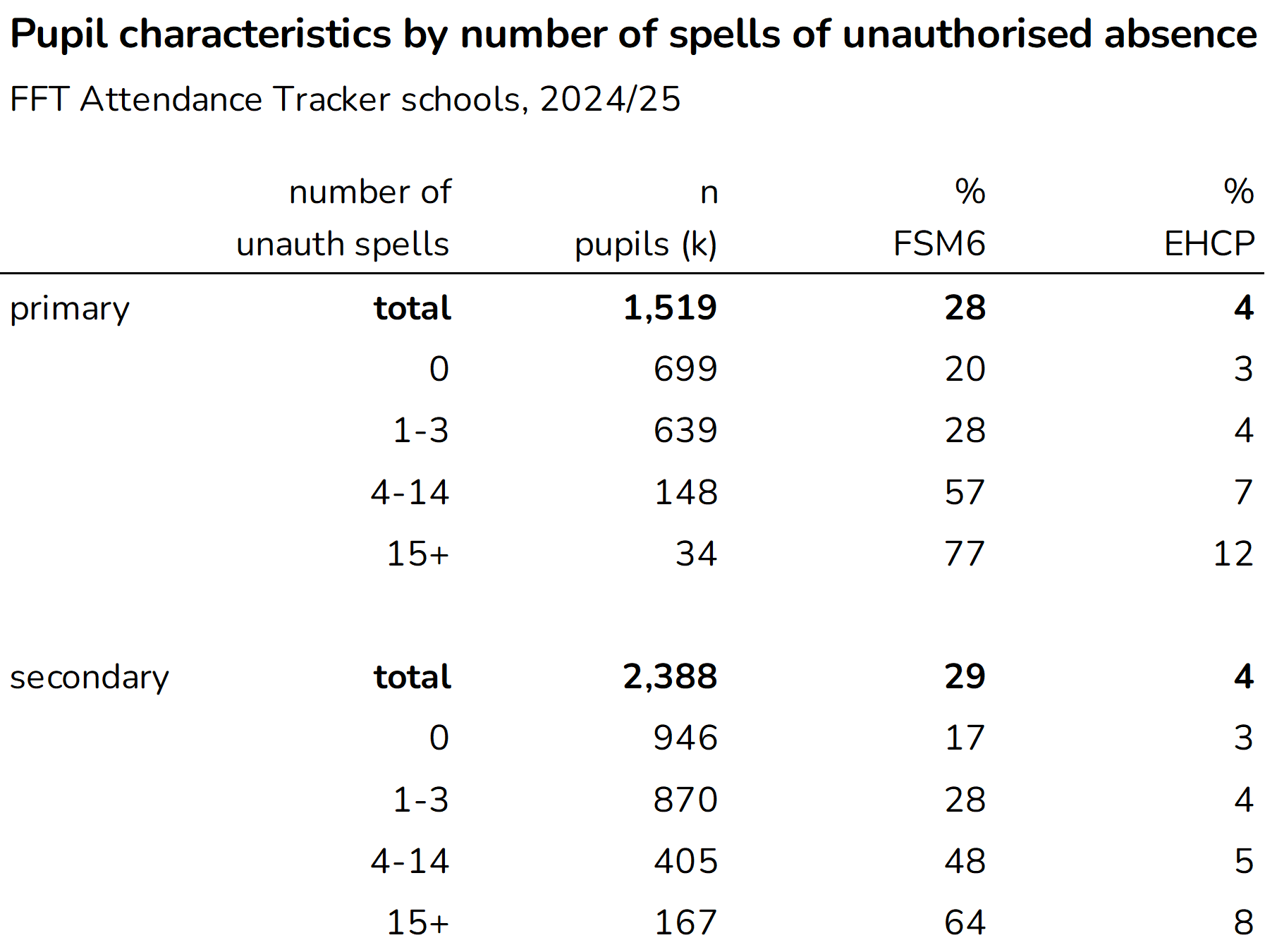
Finally, we consider how pupils’ characteristics varied by the number of spells of unauthorised absence they recorded. We find that pupils with a large number of spells were much more likely to be disadvantaged (as measured by FSM6) and to have an education, health and care plan (EHCP) than both those with no spells and those with only a small number.
Summing up
Most pupils at both primary and secondary had at least one unauthorised absence in the 2024/25 academic year. The majority of these pupils only had a handful of such absences across the year. And the absences tended to be short, with around 80% lasting a single day or less.
However, small numbers of longer spells, and small numbers of pupils with large numbers of unauthorised absences made outsized contributions to the overall unauthorised absence rate. For example, at primary, 22% of unauthorised absences came from 2% of pupils and, at secondary, 48% came from 7% of pupils.
In fact, the disparity between primary and secondary in the number of frequent absentees was the main driver of unauthorised absence rates being higher at secondary than primary. These pupils were disproportionately likely to be disadvantaged, and to have an EHCP.
Want to stay up-to-date with the latest research from FFT Education Datalab? Sign up to Datalab’s mailing list to get notifications about new blogposts, or to receive the team’s half-termly newsletter.
[1] Most authorised absences are illness related, but schools can also authorise absence for a few other reasons, such as medical appointments or interviews. See DfE guidance for further details.
[2] Non-school days (weekends, school holidays) and sessions where pupils are not required to attend (e.g. inset days, snow days) are excluded from the calculation of spells. This means that, for example, a pupil who missed one day either side of a weekend or a school holiday would record a single spell of absence lasting two days rather than two spells of absence each lasting for one day.
Is it possible to tell what % of absence is made up from parents taking children on term time holidays?
As far as we can tell from register codes, at primary, around 8% of all absence (and around 30% of unauthorised) is due to term-time holidays, and at secondary, around 3% of all absence (10% of unauthorised). These numbers rely on schools using the specific code for an unauthorised holiday (“G”) rather than the general code for an unauthorised absence (“O”) so are likely an underestimate.
I disagree with this statement:
• the reason is one which could, in principle, be authorised, but the school deems the parent or carer to have provided insufficient evidence
Note, for example, paragraph 362 in the current ‘Working together to improve school attendance’ statutory guidance:
362. Schools are not expected to routinely request that parents provide medical
evidence to support illness absences. Schools should only request reasonable medical
evidence in cases where they need clarification to accurately record absence in the
attendance register – i.e. making a decision that code I is the absence code that
accurately describes the reason the pupil is not in school for the session in question. In the
majority of cases a parent’s notification that their child is too ill to attend school will be that
evidence and can be accepted without question or concern. Only where the school has
genuine and reasonable doubt about the authenticity of the illness should medical
evidence be requested to support the absence.
There is no mention of ‘insufficient evidence’ in this document. However, schools’ refusal (and often done at the direction of the local authority) to authorise legitimate absences through illness is often a way to avoid other statutory duties or (anecdotally) to influence parents to remove the child from the school roll.
Instead, based on the current statutory guidance, this bullet point should read:
• the reason is one which could, in principle, be authorised, but the school deems the parent or carer to have not been truthful about the absence (ie doubts the veracity / authenticity of the reason provided).
See our take on inaccurately recorded unauthorised absences:
https://notfineinschool.co.uk/home/f/unauthorised-absences
Thanks Claire, that’s useful context. I’ve changed the wording of that bullet point to better reflect the situation you describe.