




Over the past two years, we have been working on a project exploring the outcomes of children from disadvantaged socio-economic backgrounds who show high levels of achievement early in their education. Funded by the Nuffield Foundation, the project draws on a wide range of data sources – including both survey and administrative datasets – to provide what we believe is the most comprehensive analysis to date of how this group fares as they progress through the education system.
Along the way, we have shared several findings on this blog. These have explored issues such as mental health outcomes, patterns of absence and exclusion from school, and progression to university.
Today we are publishing the project’s final report, which you can now read online.
To mark this milestone, this blog post brings together some of the “greatest hits” from across the project, highlighting a selection of the findings that stood out most over the course of the research.
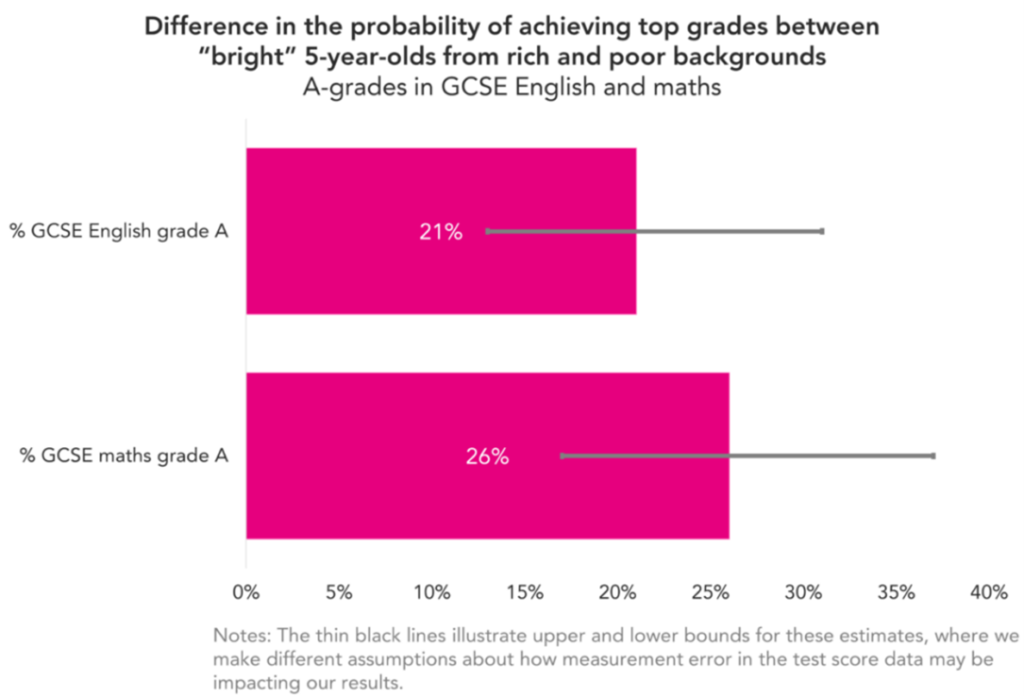
Finding 1. Initially high-achieving children from low-income backgrounds are much less likely to obtain top GCSE grades than initially high-achieving children from rich backgrounds
Five-year-olds from low-income families with strong early cognitive test scores are 21 percentage points less likely to obtain a top GCSE grade in English than their equally able, high-income peers. The difference in mathematics is estimated to be slightly larger, standing at 26 percentage points.
You can read more about this study in this blog post.
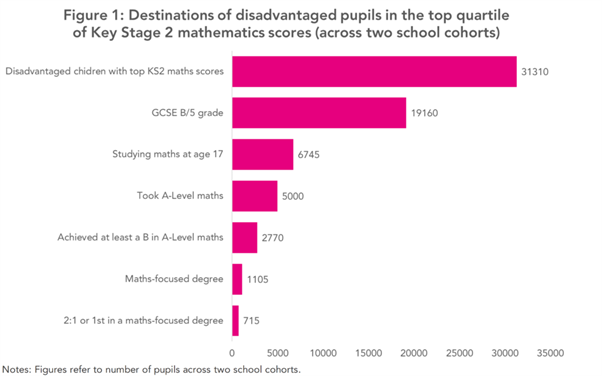
Finding 2. Very few disadvantaged children with top Key Stage 2 mathematics scores obtain a 2:1 in a mathematics focused degree
Across two school cohorts, 31,310 young people from disadvantaged backgrounds achieved Key Stage 2 maths scores in the top 25% nationally.
However, only 19,160 (61%) of these pupils ended up achieving a grade B/5 in GCSE maths, with just 5,000 (16%) taking maths at A-Level.
Eventually, only 715 (less than 3%) of the initially 31,3100 went on to obtain at least a 2:1 in a maths focused degree.
You can read more about this study in this post from September.
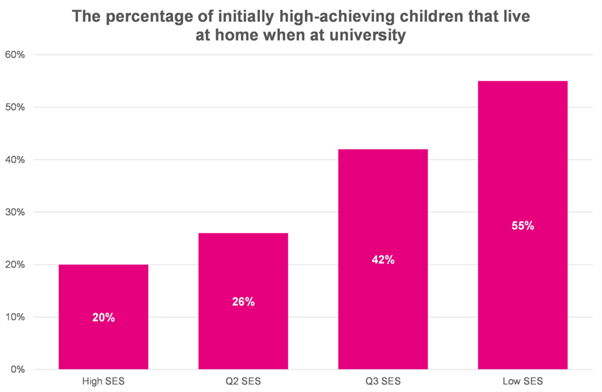
Finding 3. Even when high-achieving disadvantaged children do go to university, they are more likely to stay living at home
More than half (55%) of initially high-achieving disadvantaged children who obtain top Key Stage 2 scores and go on to university choose to live at home as an undergraduate. This compares to just 20% of initially high-achieving children from the most socio-economically advantaged backgrounds. This may mean that disadvantaged young people may miss out on certain aspects of the university experience, including how to live independently and participation in extracurricular activities.
In the research paper we show that high-achieving disadvantaged young people of Asian ethnicity are particularly likely to stay living at home.
You can read more about this study in this post.
Finding 4. The gap in school absences between high-achieving children from advantaged and disadvantaged socio-economic backgrounds grows as young people progress through secondary school
When high-achieving children enter secondary school, there is a difference of just one percentage point in their school absence rates.
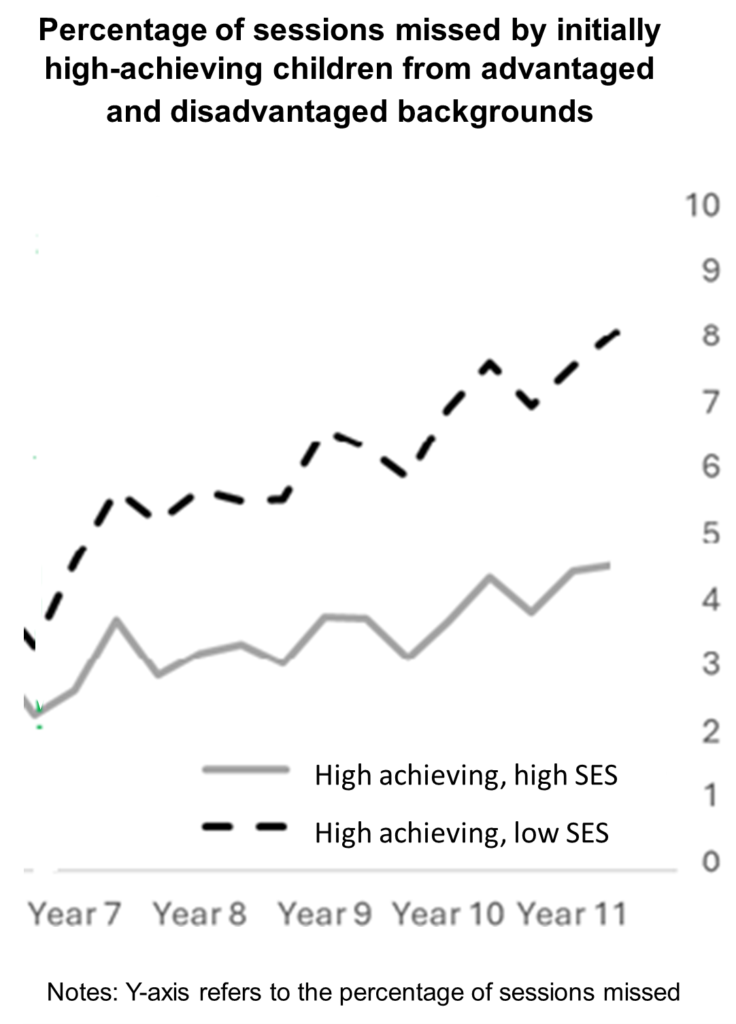
This gap grows, however, throughout young people’s time during secondary school. It reaches about a three percentage point difference during Year 9 and nears a peak of 3.5 percentage points during Year 10.
Finding 5. The increase in school absences during secondary school amongst high-achieving disadvantaged children is particularly acute amongst White and Asian pupils
School absence rates also differ across high-achieving children from disadvantaged backgrounds of different ethnicities.
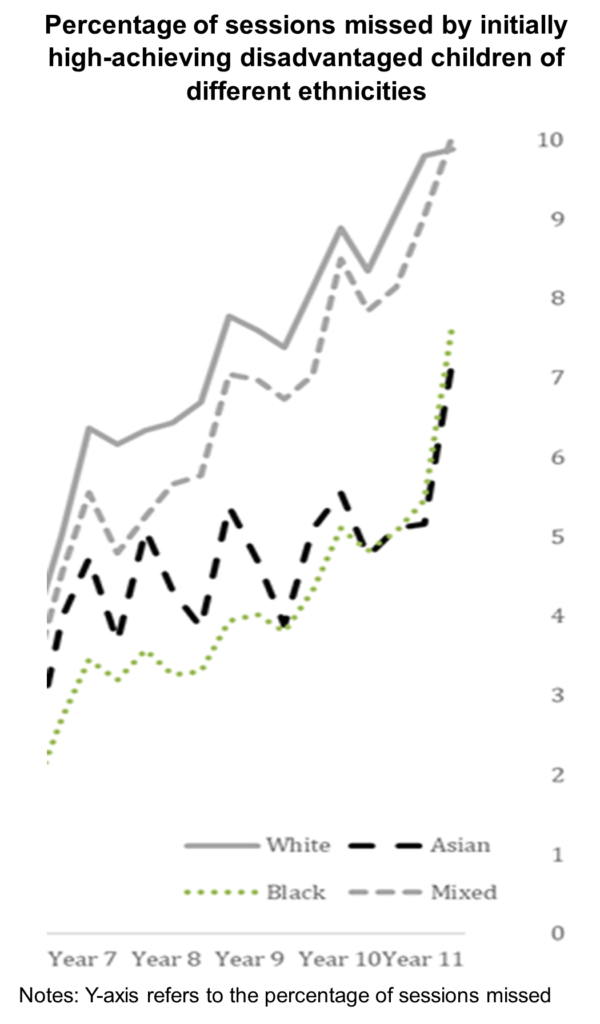
Initially high-achieving, disadvantaged pupils of White and Mixed ethnicity have the highest absence rate, approaching ten percentage points in Year 11 (i.e. they miss one-in-ten sessions at school). This is far higher than their Black and Asian peers, where the figure is closer to six percentage points.
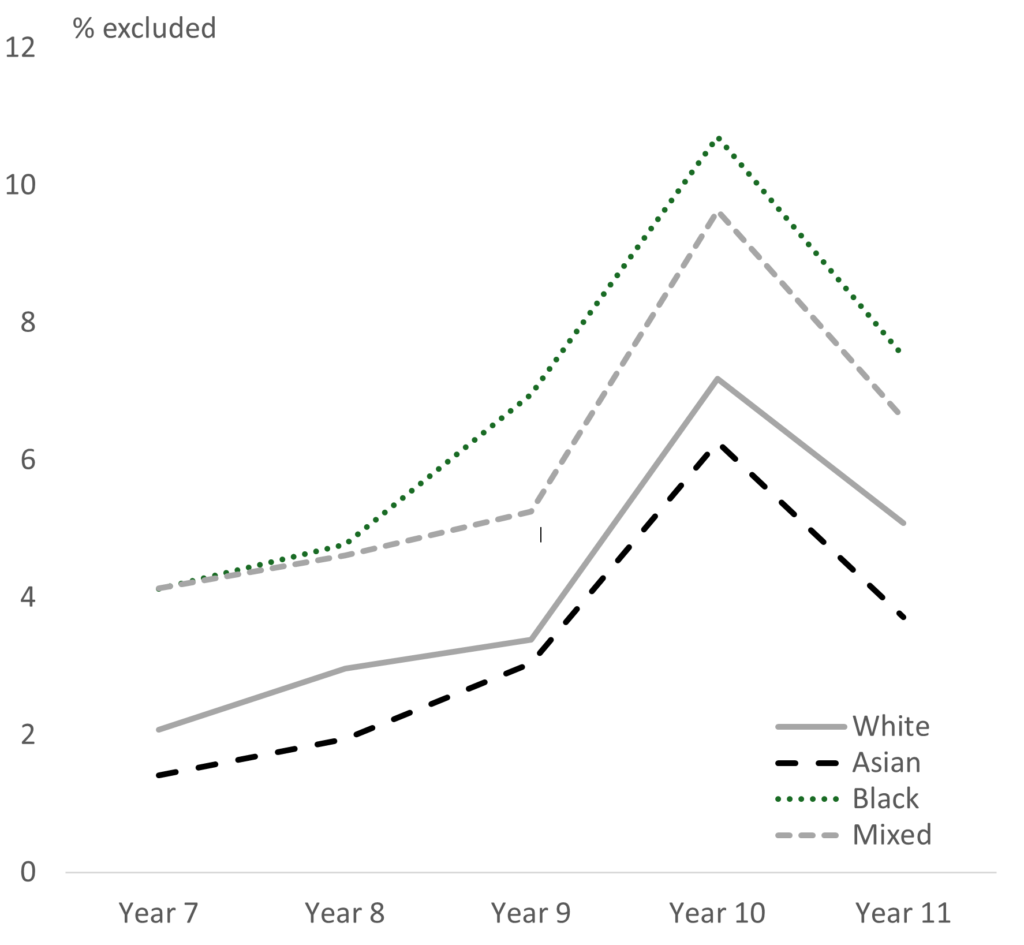
Finding 6. High-achieving disadvantaged Black and Mixed race boys are more likely to be excluded from school than their White and Asian peers
Amongst high-achieving disadvantaged children, there is a sharp rise in exclusions from school in Year 10. At this point, around 10% of high-achieving disadvantaged Black and Mixed race pupils experience at least one school exclusion, compared to 7% of their equally high-achieving, equally disadvantaged peers.
You can read more about this study in this post from last year.
Finding 7. High-achieving disadvantaged children are more likely to be hospitalised due to self-harm as teenagers as low-achieving children from socio-economically advantaged backgrounds
In Year 10, almost 10 in every 1,000 high-achieving disadvantaged children make contact with hospital services related to self-harm. This is roughly double the rate for low-achieving children from socio-economically advantaged backgrounds.
You can read more about this study in this post.

Finding 8. There is no evidence that academically selective school systems lead to serious mental health problems than comprehensive school systems
The table below illustrates “risk ratios” – the chance being admitted to hospital for a mental-health related issue if attending a grammar school relative to the chance of being admitted to hospital amongst those attending non-selective schools. Values close to 1 indicate that there is no difference between pupils attending selective versus non-selective schools.
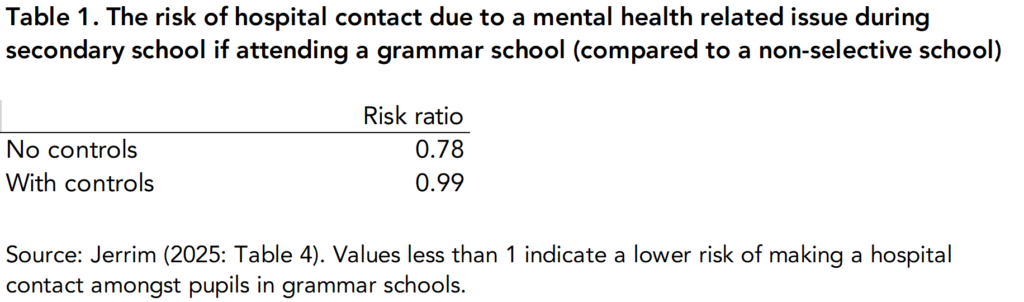
The raw differences (no controls) suggests that grammar school pupils are 22% less likely to contact hospitals due to mental health related issues than their non-selective peers. However, once prior achievement and family background has been controlled, there is no evidence that attending at grammar school is linked to contacts with hospitals related to mental health.
You can read more about this study in this post.
Finding 9. Participants in the Gifted and Talented programme from the last labour government were more likely to go to a (selective) university
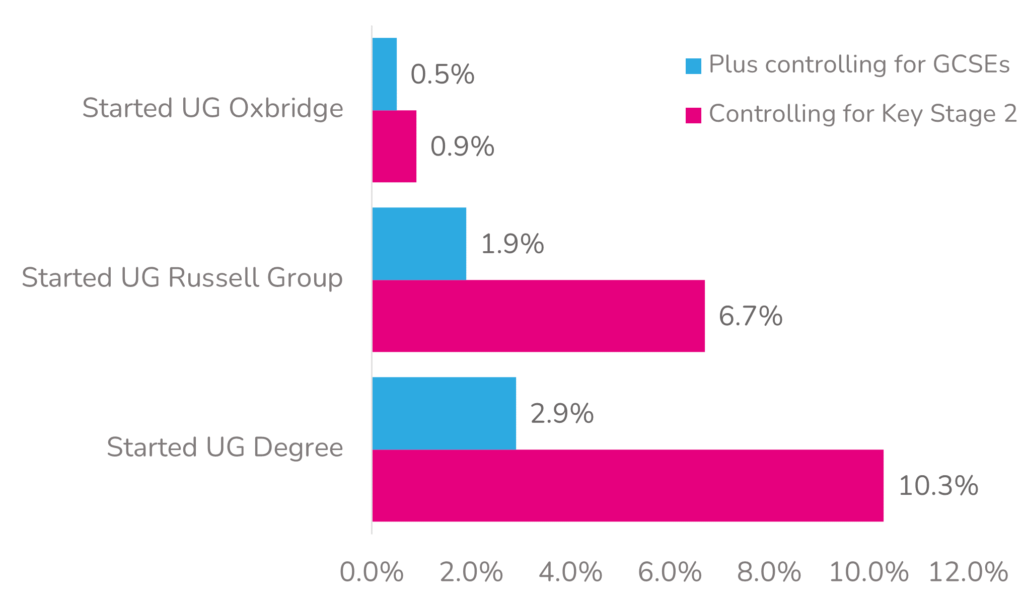
Amongst children with the same Key Stage 2 scores, participants in the Gifted and Talented programme were almost seven percentage points more likely to attend a Russell Group university.
Even after accounting for Gifted and Talented pupils going on to obtain better GCSEs, we still find they were two percentage points more likely to enter a selective higher education institution.
You can read more about this study in this post.
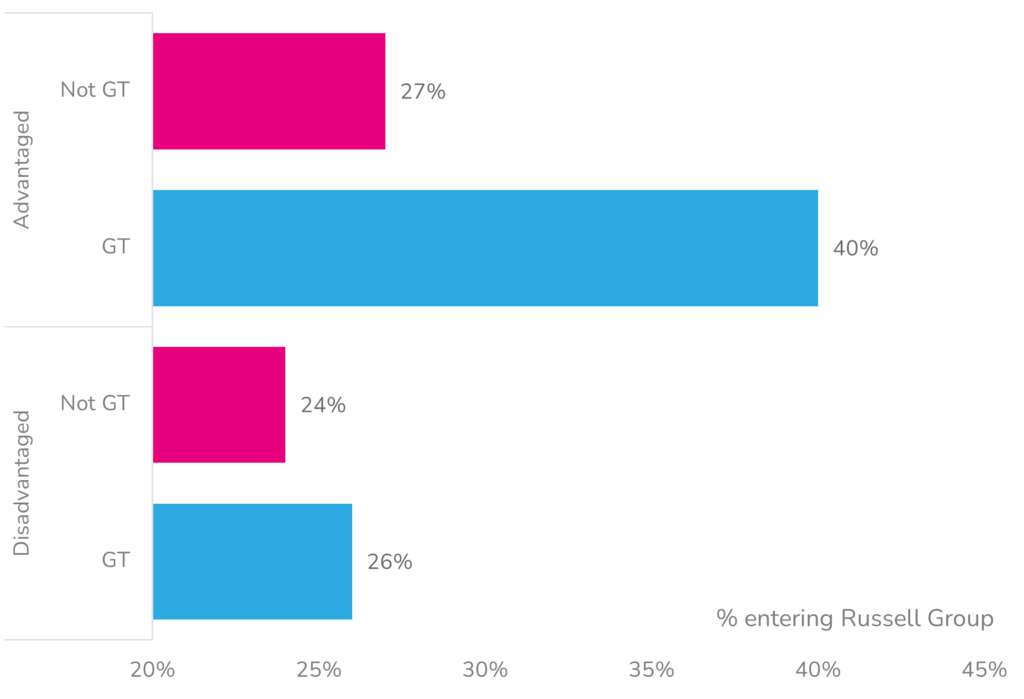
Finding 10. However, participation in Gifted and Talented programme mainly brought benefits for more socio-economically advantaged children
Amongst disadvantaged children with the same Key Stage 2 scores, participants in the Gifted and Talented programme were two percentage points more likely to enter a Russell Group university.
For pupils from the most advantaged socio-economic backgrounds, the equivalent difference was 13 percentage points.
You can read more about this study in this post.

Leave A Comment