




Since 2013/14, it has been a requirement that students who have not achieved grade 4 (or higher) in either GCSE English or GCSE maths must continue to study these subject if enrolled in post-16 study. Only those achieving grade 3 must study at GCSE level. Stepping stone qualifications (Functional Skills in numeracy and literacy) are available for those achieving Grade 2 or below.
The issue of resits has recently been in the news. The new secretary of state was reported in the media of wanting to end the “conveyor belt of resits”.
This time last year we examined resits by age 18 for one cohort of students, those who completed Key Stage 4 in 2022. It did not appear that many students had multiple resits over the two years.
Now, with an additional year of data, we examine resits by age 19 and expand our analysis to examine attainment by 19 more generally.
Data
To begin with, we use Key Stage 4 data for 2022 relating to all pupils in state-funded schools (mainstream, special, alternative provision).
We identify a pupil’s highest grades in English (the best of language or literature) and maths.
We then use Post-16 achievement data for 2023, 2024 and 2025 to identify instances where a pupil has entered GCSE English language, GCSE maths, and stepping stone qualifications in literacy and numeracy.
One thing to bear in mind is that GCSE results in 2022 were higher than in subsequent years as grading returned to pre-pandemic standards following increases in grades during the pandemic when exams were cancelled. Consequently, the 2022 resit cohort is smaller than that of subsequent cohorts.
The resit population
In total, just over 189,000 students did not achieve grade 4 in both GCSE English and GCSE maths.

Compared to the state-funded school population, this group of pupils was more likely to be disadvantaged and identified as having special educational needs (SEN) in Year 11.
In the grid below, we show the GCSE English and GCSE maths grades of the 189,000 students.
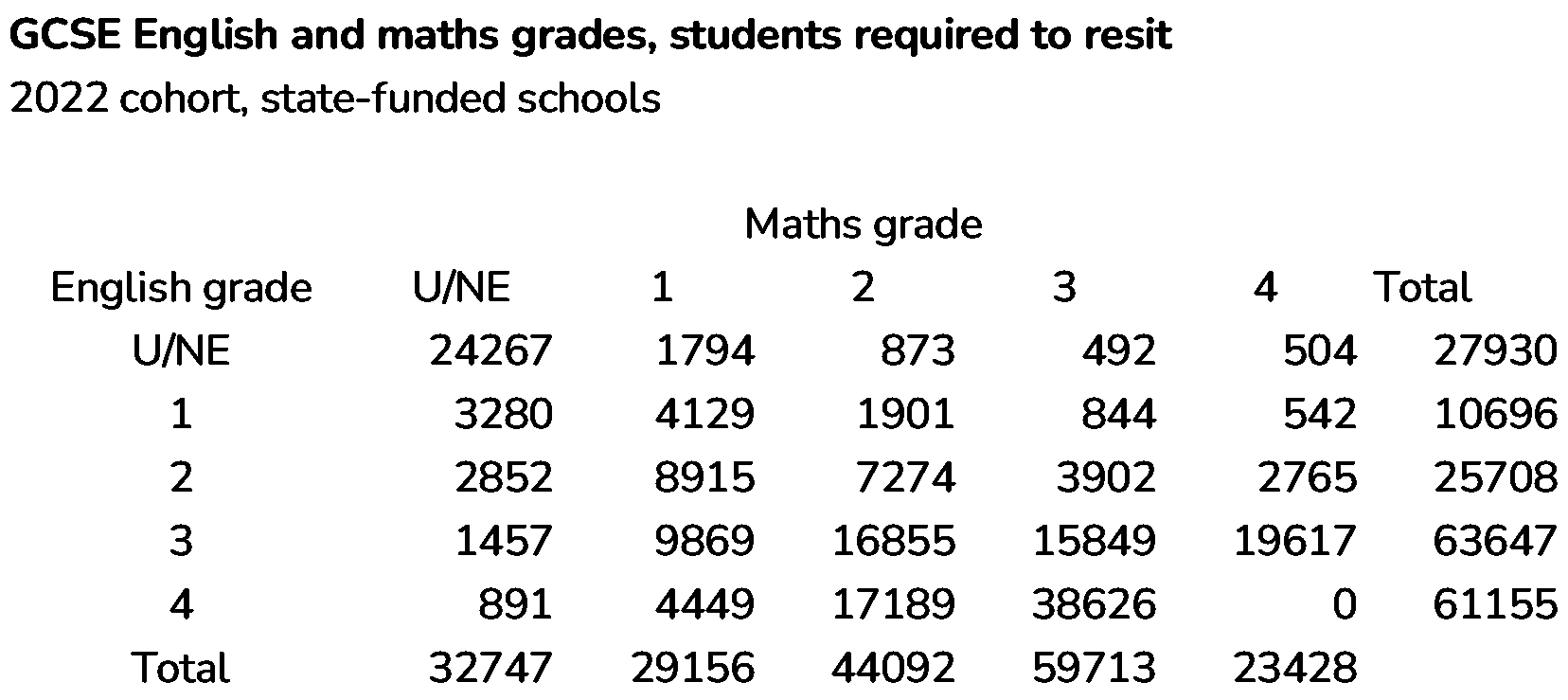
166,000 students were below grade 4 in maths and 128,000 in English. This lower number for the latter is a consequence of using the best of 2 GCSEs (language and literature) rather than reliance on a single grade. 89,000 pupils were below grade 4 in both subjects.
Not everyone will have gone on to study English and maths post-16. Some students may have migrated (including going to Wales or Scotland) or moved to the independent sector. And not all students enrol in post-16 study even though they are legally expected to remain in education until their 18th birthday. Finally, students with SEND working below level 1 were exempt.
How many students resit?
In the table below we show the percentage of pupils who resit English or maths broken down by end of Key Stage 4 grade.
We include GCSEs and functional skills qualifications but also show entries in GCSE separately.
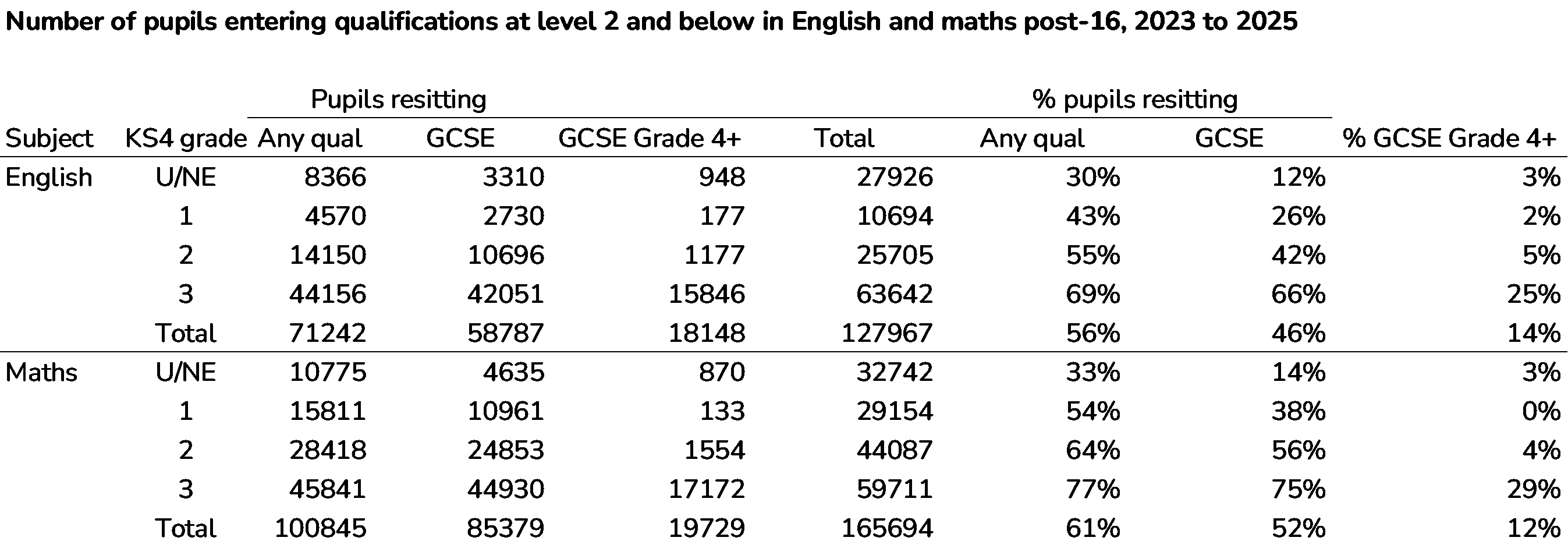
Of the 128,000 GCSE English resit population, 71,000 (56%) subsequently entered a resit qualification post-16 at least once, of which 59,000 (46%) entered a GCSE at least once.
Turning to the GCSE maths resit population, of the 166,000 students in total, 101,000 (61%) entered a resit qualification post-16 at least once, of which 85,000 (52%) entered a GCSE at least once.
The probability of resitting increases with prior attainment. Those with a grade 3 at the end of Key Stage 4 are the most likely to resit, even when stepping stone qualifications are included. That said, a third of students with grade 3 in English (34%) and a quarter of those with grade 3 in maths (25%) do not appear to have retaken a GCSE by age 19.
14% of those who had not achieved grade 4 in GCSE English by the end of Key Stage 4 had done so by age 19.
In maths, the equivalent figure was 12%.
How many times do students resit GCSEs?
Below, we show the number of GCSE entries per student who did not achieve grade 4 in English and/or maths.
As we saw in the previous section, around half of students who did not achieve grade 4 in English (54%) or maths (48%) by the end of Key Stage 4 did not enter a GCSE between the ages of 16 and 19.
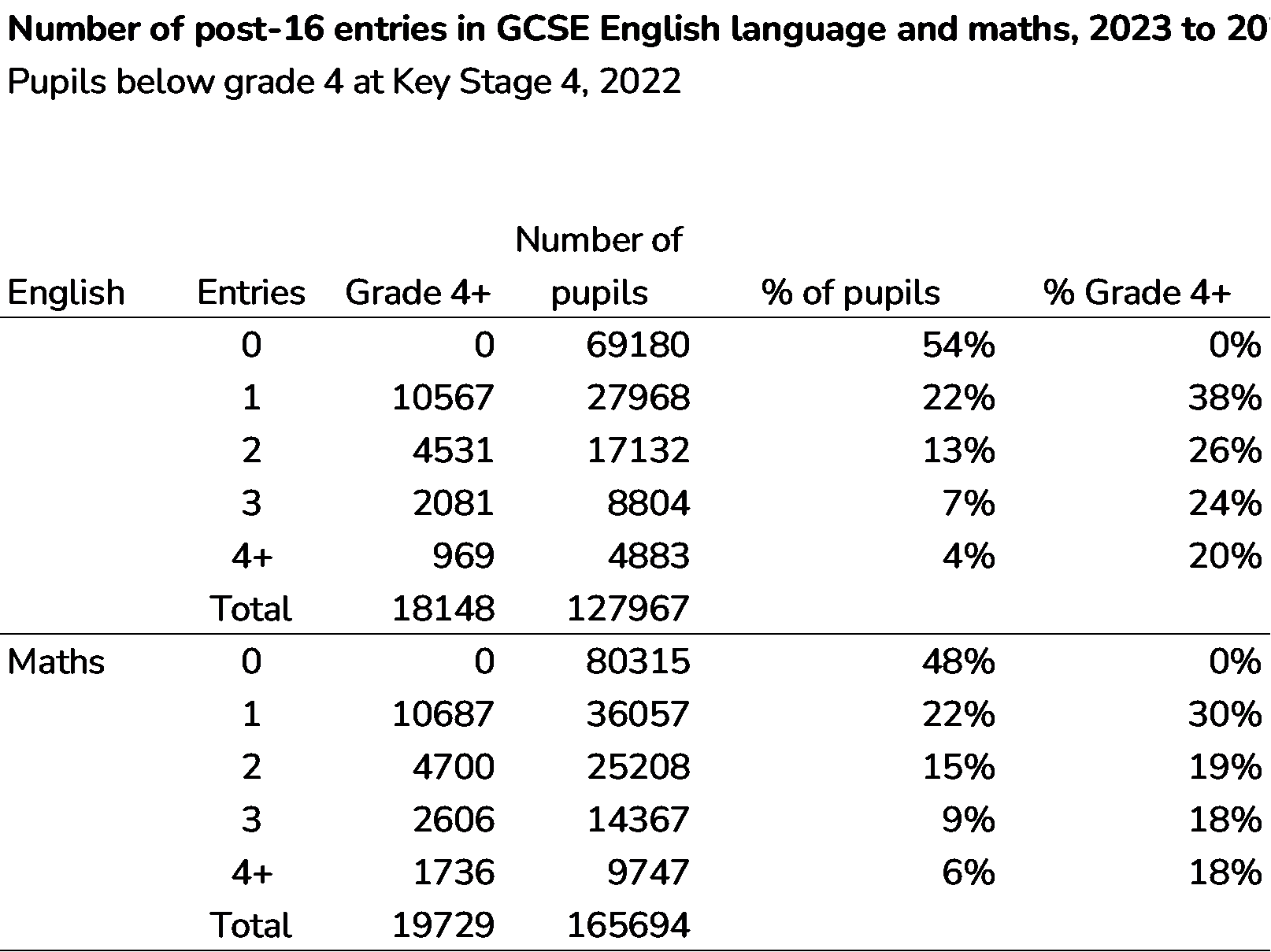
In English, 35% of students entered a GCSE at most twice post-16. 11% entered 3 or more times. Figures for maths were 37% and 15% respectively.
Other qualifications achieved
Finally, we look at a broad level at the qualifications achieved post-16 up to age 19 by the resit population.
We break the group down by their KS4 English and maths grades. In the table below, for example, {3,2} consists of
- Pupils with grade 3 English language and grade 2 maths; and
- Pupils with grade 2 English language and grade 3 maths
For each sub-group, we show the proportion of students who go on to achieve level 3 (equivalent to 2 or more A-levels at grades A-E) or a “large” level 2 qualification (one equivalent to 4 or more GCSEs at grades A*-C). We also show the proportion achieving any qualification, including resit qualifications.
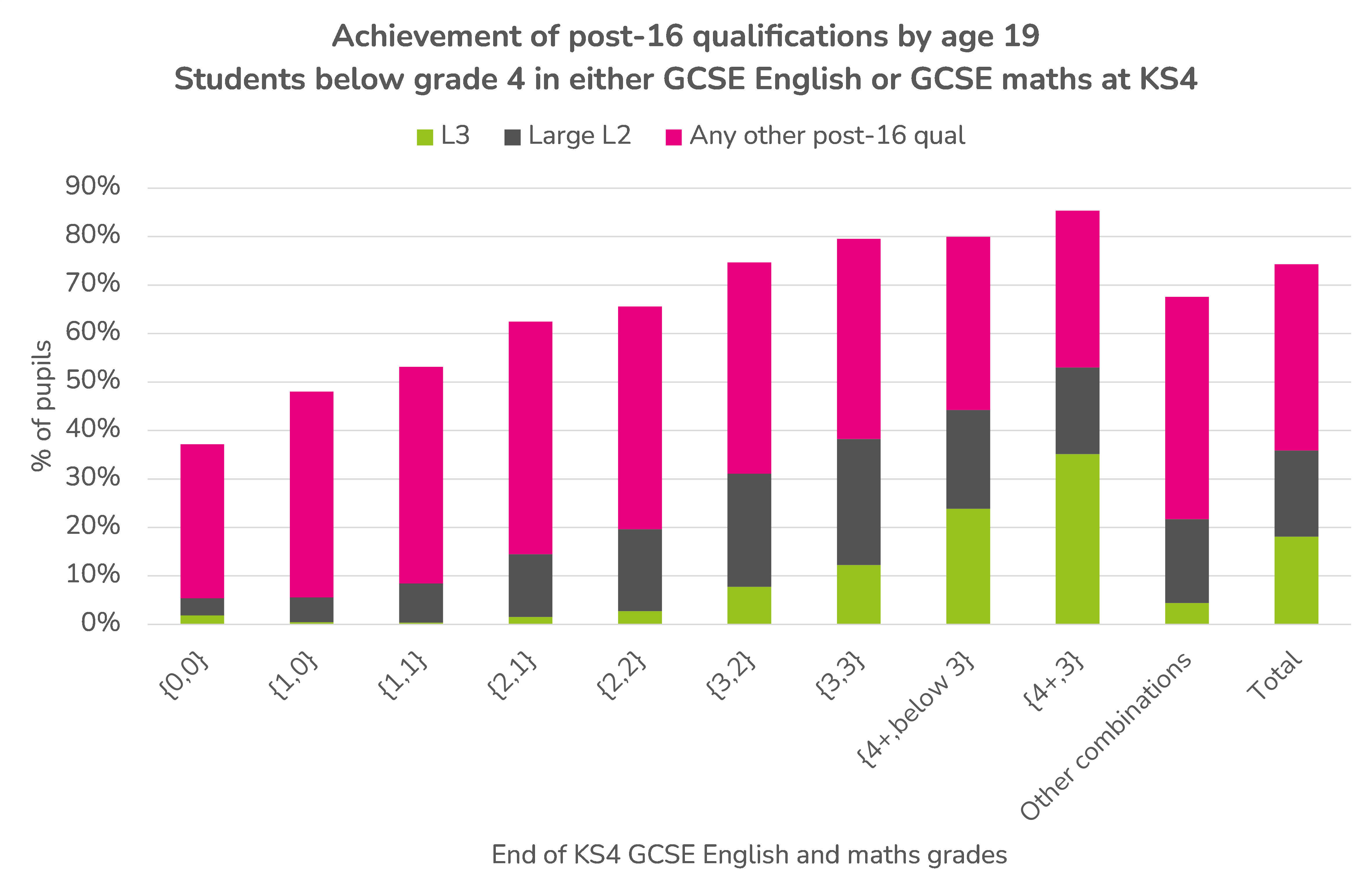
18% of the whole group of students below grade 4 in both English and maths at Key Stage 4 went on to achieve level 3 by age 19. This is unsurprising given that grade 4 in both subjects is often a requirement of many level 3 programmes in many schools and colleges. Those with one grade 4 already (i.e. those resitting just one subject) were more likely to achieve level 3.
In total, a quarter of the resit population (24%) did not achieve any qualifications post-16. Some of this group may have migrated but some will have not been in education, employment or training post-16 (NEET).
Summing up
Students who do not achieve grade 4 in both GCSE language and GCSE maths have been required to continue to study these subjects as a condition of post-16 funding since 2014.
Among the 2022 cohort of students, 56% of those below grade 4 in GCSE English entered either a GCSE or a stepping stone qualification by age 19.
In maths, the equivalent figure was 61%.
It is unusual for students to resit GCSEs multiple times. We find that just 11% of English resit students and 15% of maths resit students enter a GCSE 3 or more times post-16. In fact, it is more likely that students do not resit GCSE at all. However, this does not necessarily mean that they do not study English and maths post-16.
We should also pay attention to the wider post-16 qualifications achieved by those required to study English and maths. Further research into the routes which lead to positive destinations between the ages of 19 and 24 for this group would be instructive.
Want to stay up-to-date with the latest research from FFT Education Datalab? Sign up to Datalab’s mailing list to get notifications about new blogposts, or to receive the team’s half-termly newsletter.


Leave A Comment