




A few weeks ago, we received an email from a reader with the following questions: what percentage of schools have a two-week half-term break, and what is the relationship between half-term length and absence?
With length of half-term breaks having been in the news recently, and last week marking the first week back, we thought we’d have a go at putting an answer together.
The data
As usual, we’ll be using attendance marks from the registers of our 7,000 or so FFT Attendance Tracker schools, and we’ll look at data from the whole of Autumn Term last year – 2025/26.
To identify the length of a school’s half-term holiday we look for weeks with either no or very few sessions recorded between Monday 13th October and Friday 31st October 2025. If we see one such week, we count that school as having had a single week’s half-term break, two consecutive weeks then a two-week break. The small number of schools fitting into neither category we label as “other”.
Numbers of schools
Let’s start by counting the number of schools by the length of their break.
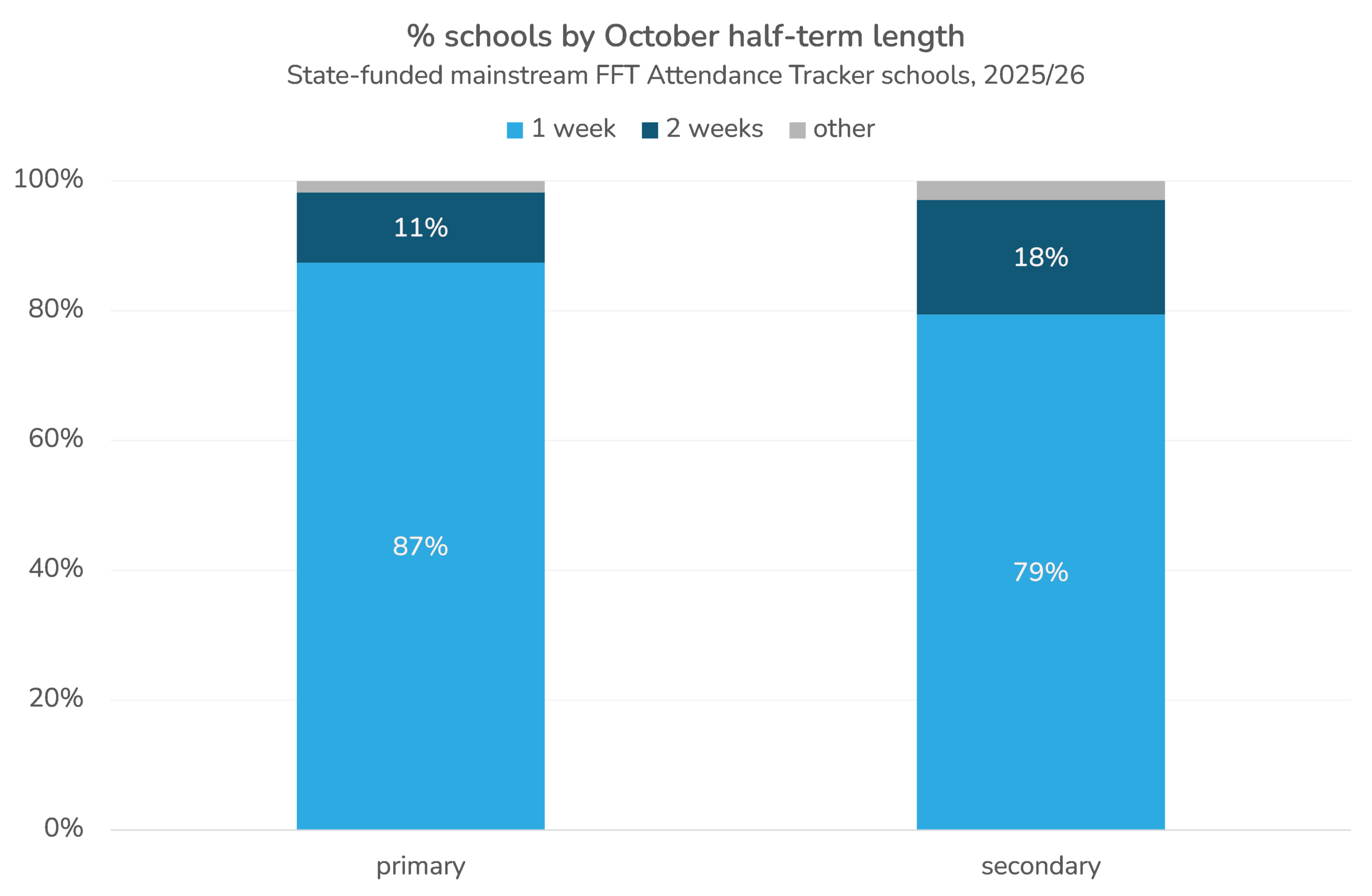
Overall, we think around 11% of primary and 18% of secondary schools had a two-week half-term break last year. These numbers are in the neighbourhood of, though slightly higher than, figures released by Teacher Tapp recently (8% for primary and 15% for secondary).
We can also see how the proportion of schools with a two-week break varied by region.
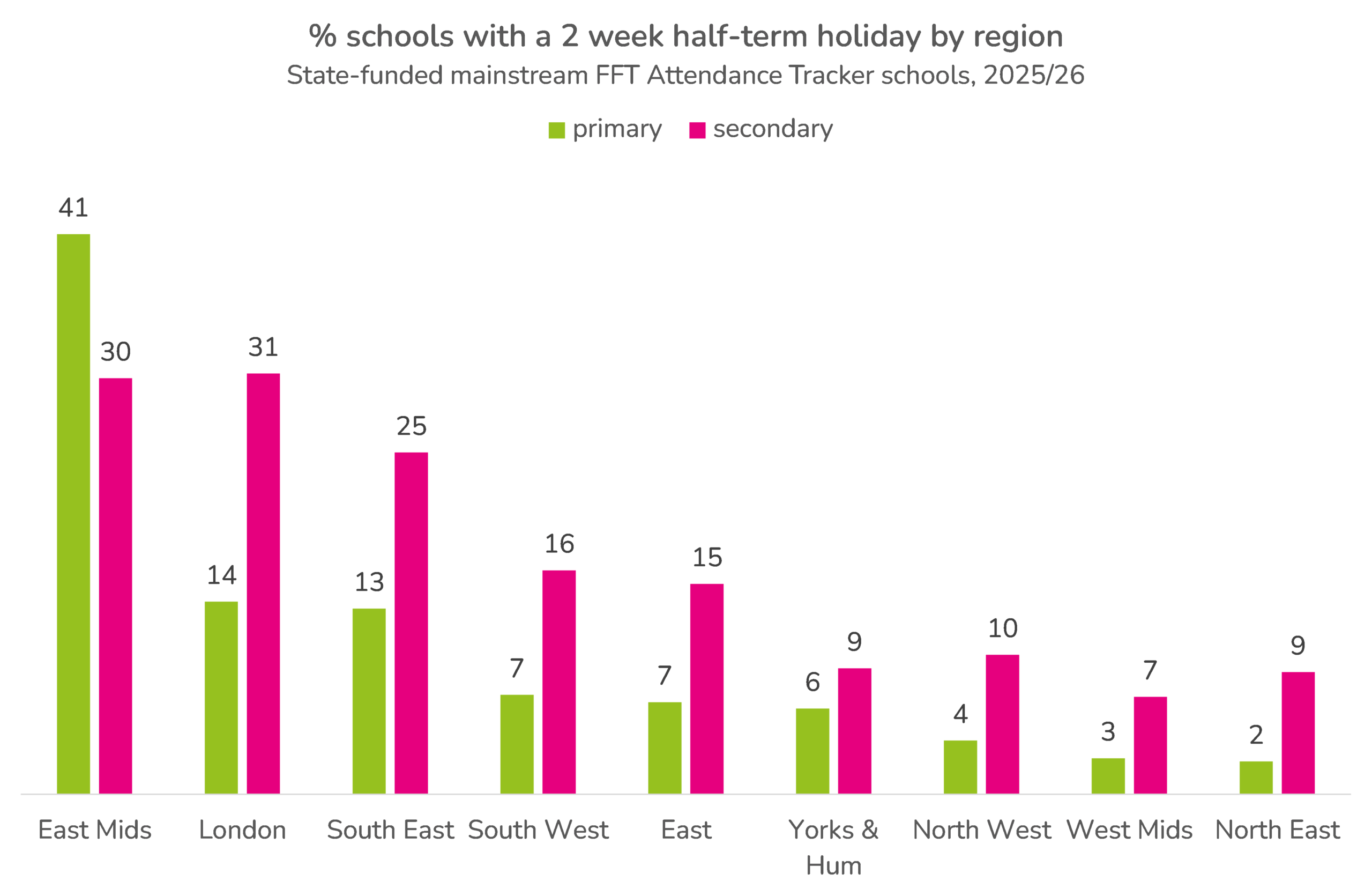
The East Midlands had by far the highest proportion of primary schools with a two-week break – 41%. The region with the second highest proportion was London, at 14%, and the region with the lowest was the North East, at just 2%.
In every region apart from the East Midlands, a higher proportion of secondary schools than primary had a two-week break. London was the region with the highest proportion of secondary schools with a two-week break, at 31%, followed by the East Midlands, 30%, and the South East, 25%. The West Midlands, 7%, North East, 9%, and Yorkshire and the Humber, 9%, were the regions with the lowest.
Relationship with absence across Autumn Term
We now turn to the absence rates of pupils in these schools. We’re going to start by looking at absence across four periods of time: the week immediately before the break, the week immediately after, all of the first half-term apart from the week before the break, and all of the second half-term apart from the week after the break.
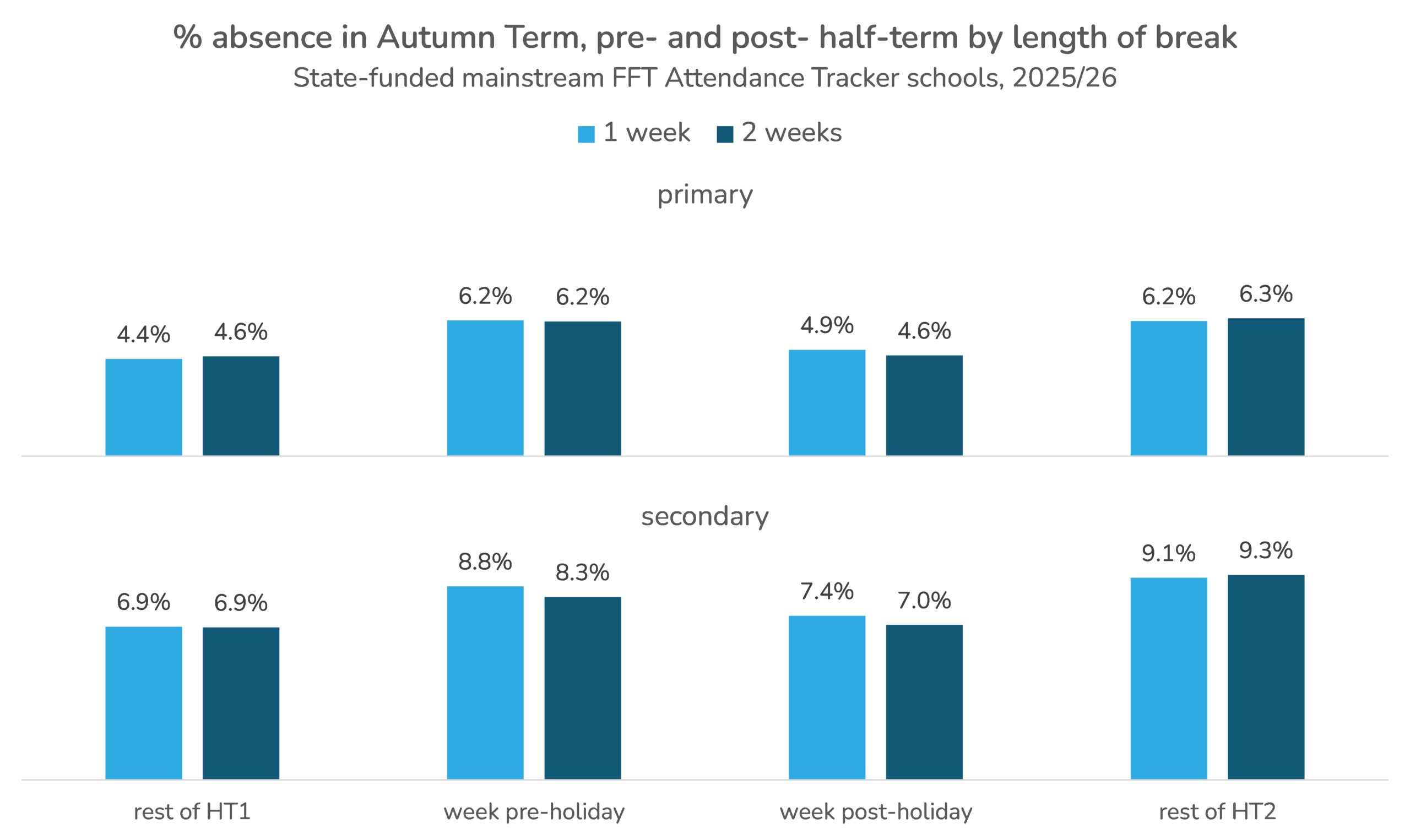
At primary, there was very little difference in absence between schools with a one-week and two-week break either in the week immediately before the holiday, nor across the rest of the first half-term. Absence was very slightly lower in schools with a two-week break than a one-week break in the week immediately following the holiday, however, but this difference was not sustained across the rest of the second half-term.
At secondary, again, absence was similar in the two groups of schools in the first half-term excluding the week before the break. But absence was lower in schools with a two-week break than a one-week in both the weeks immediately before and after the holiday. This difference, as at primary, was not sustained across the rest of the second half-term.
We now make the same comparisons, but only for the subset of pupils who were “disadvantaged”, i.e. eligible for free school meals in the last six years (FSM6).
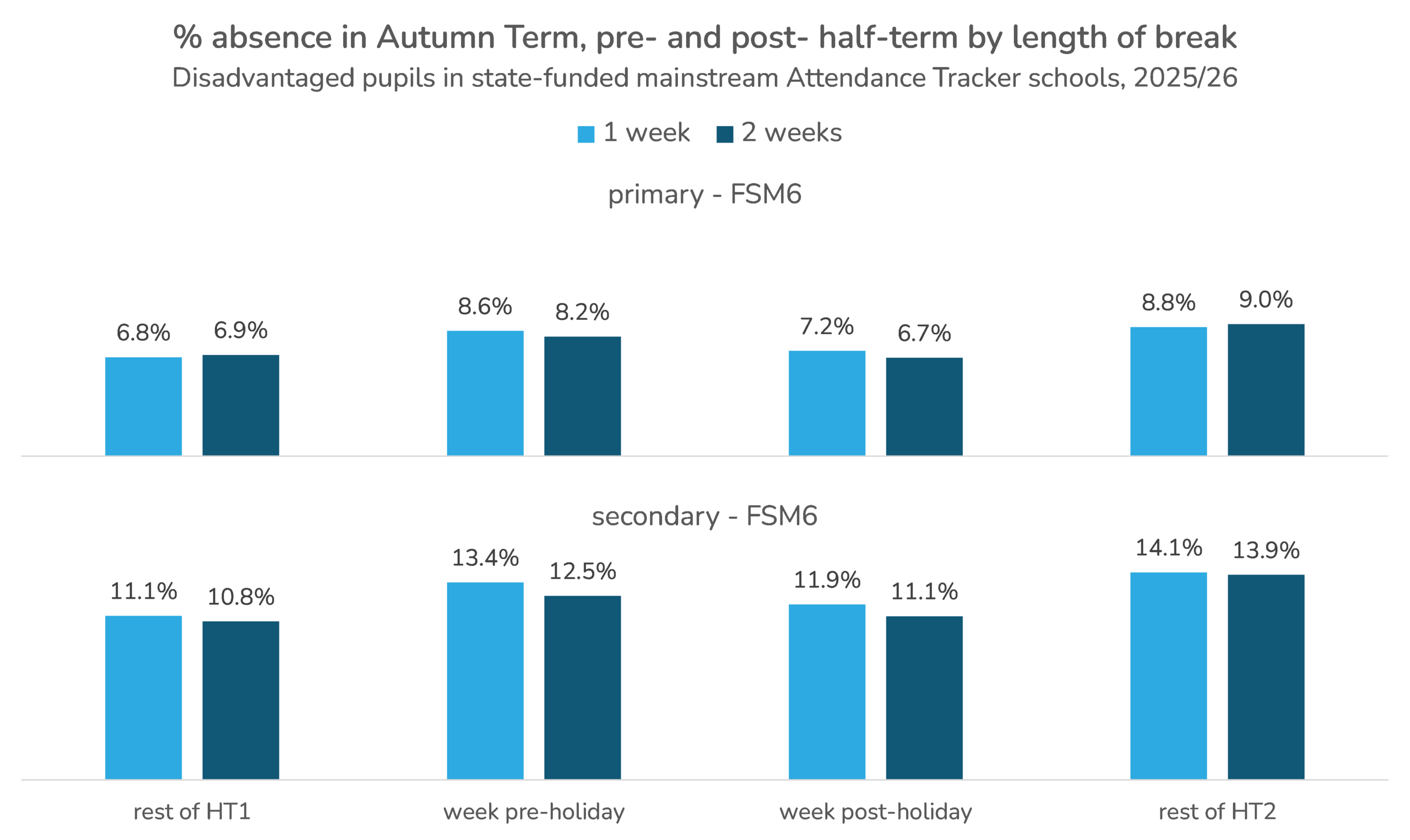
For FSM6 pupils at primary, there appears to be a slightly stronger relationship between length of break and absence in the weeks immediately before and after the holiday than was the case for all pupils. Absence for FSM6 pupils was 0.4 percentage points (pp) lower in schools with a two-week break than a one-week break in the week before the holiday (vs 0pp for all pupils), and 0.5pp lower in the week after (vs 0.3pp for all pupils). Absence across the remainder of Autumn Term was similar in both groups of schools.
At secondary, the picture is a little harder to interpret. Because FSM6 pupils in schools with a two-week break had slightly lower absence across the first half-term than schools with a one-week break, we could reasonably expect them to also have lower absence in the weeks before and after the holiday. Which they do. But, while the difference (0.9pp in the week before the break and 0.8pp after) is higher than the difference for all pupils (0.5pp before and 0.4pp after), it’s not much higher than we’d expect given their lower absence earlier in the term (0.3pp). In other words, we don’t have any evidence to suggest that the relationship between break length and absence before and after the holiday at secondary is impacted by disadvantage.
Relationship with absence by day
We finish by looking at the two weeks surrounding the holiday in a bit more detail, by plotting the absence rates each day. Here we’re back to including all pupils, not just FSM6 pupils.
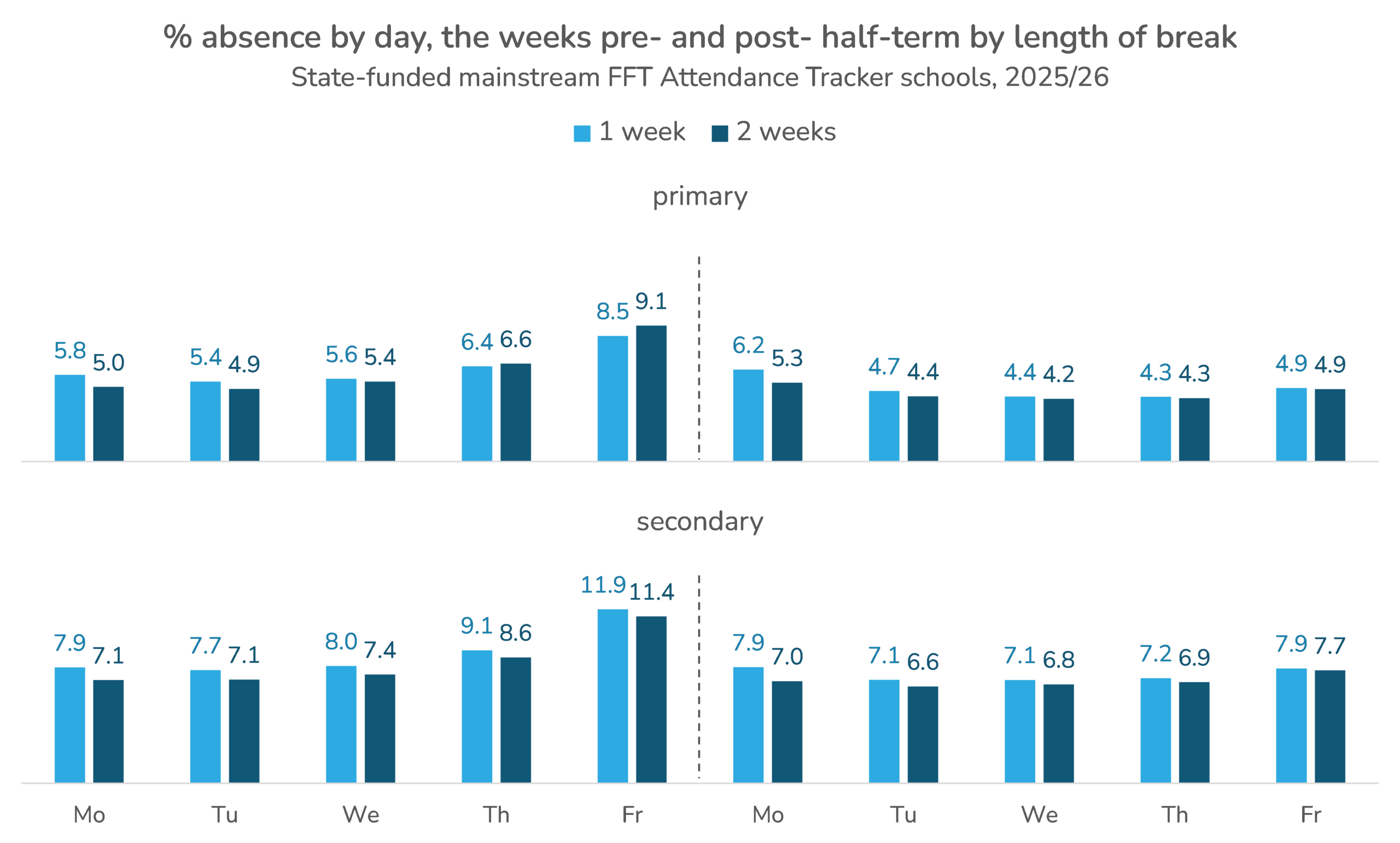
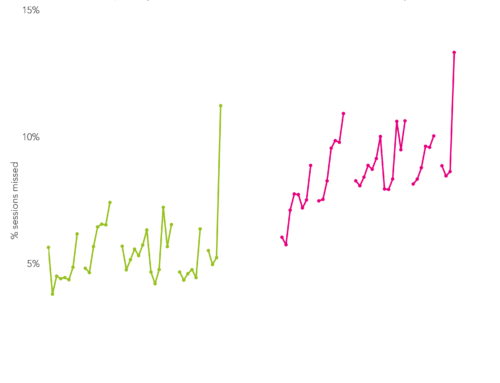
The first thing to notice is that schools with a two-week break didn’t seem to be any less susceptible than those with a one-week break to high rates of absence on the Friday immediately before the holiday. In fact, at primary, schools with a two-week break actually had higher rates of absence on that Friday than schools with a one-week break.
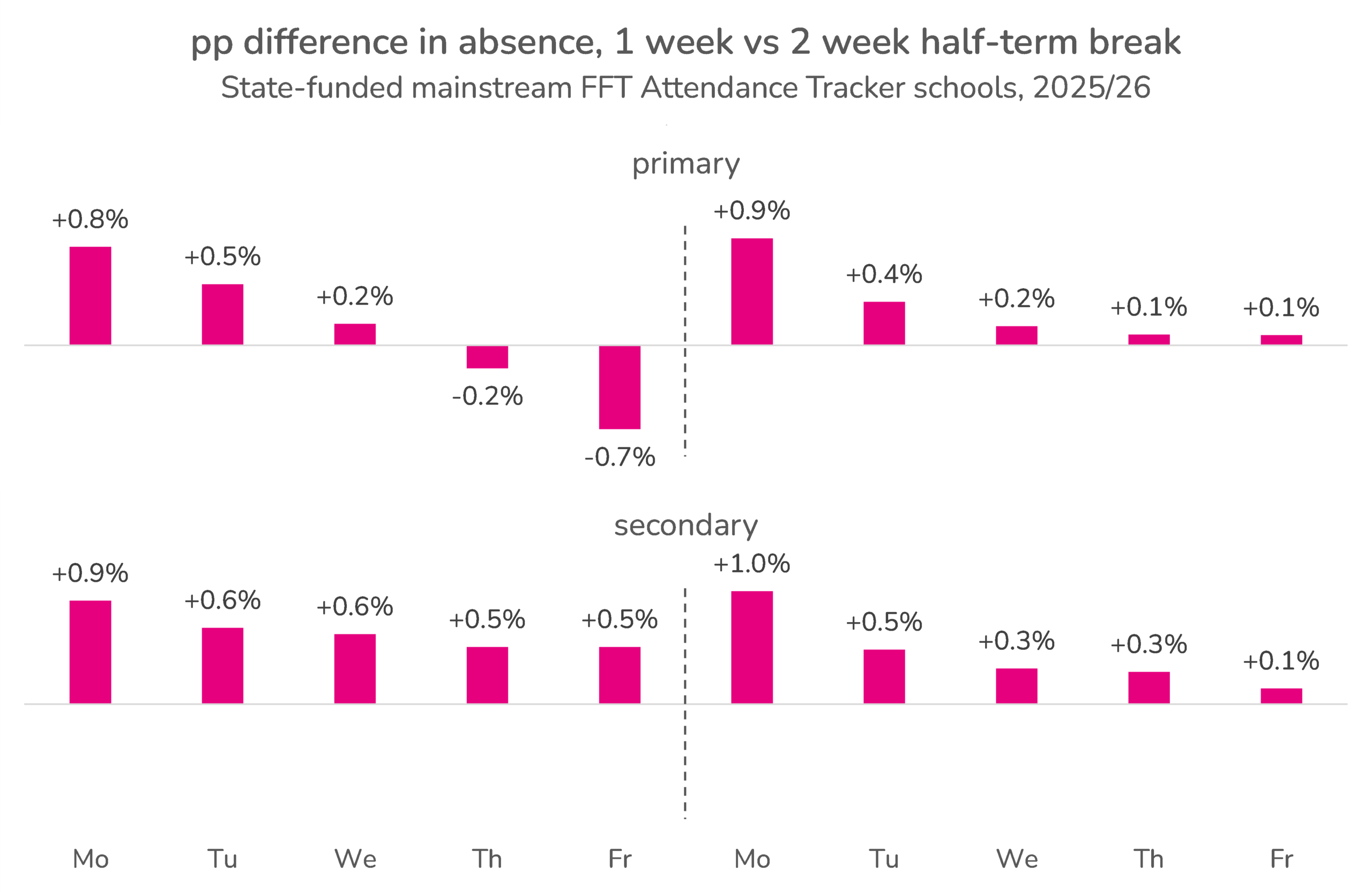
Absence on the Monday immediately after the holiday was around a percentage point lower in schools that had just had a two-week break than a one-week break, a difference which dropped to almost zero by the Friday.
We can see these patterns more clearly by plotting the percentage point difference in absence between schools with a one-week and two-week break, below.
Summing up
Altogether then, it looks like schools with a two-week half-term break did have lower rates of absence than schools with a one-week break, but differences were small, and confined to the weeks immediately before and after the holiday, i.e. not sustained across the remainder of the Autumn term.
There did appear to be a stronger relationship between half-term holiday length and absence at secondary than primary, and among disadvantaged than non-disadvantaged pupils, though we only found evidence for the latter point at primary, not secondary.
Many thanks to Rob Fitzgerald at FMAT for the blog suggestion.
Want to stay up-to-date with the latest research from FFT Education Datalab? Sign up to Datalab’s mailing list to get notifications about new blogposts, or to receive the team’s half-termly newsletter.
This is a good start to analysis. What would be really useful, though, is work to analyse any impact on learning: most state-school teachers will be familiar with the ‘teachers too tired to teach well, pupils too tired to learn well’ syndrome typical of the end of this term, and it would be really constructive if we were able to evidence that a two-week half term were associated with bigger learning gains in the second half of term
I agree with Prof Golding. Also, I wonder if the same effects are seen in the summer term? Here in Tameside, primary schools still have a 2 week break at Whit – a hangover from Wakes Weeks – and very popular with teachers!