




Back in November, the Department for Education (DfE) signalled changes to its headline secondary school performance measures, Attainment 8 and Progress 8. We wrote about their proposals at the time.
Briefly, with the demise of the English Baccalaureate (EBacc), changes were made to which qualifications could count in the 8 slots comprising Attainment 8. These changes were designed to encourage a shift away from a curriculum geared towards the EBacc (GCSEs in science, humanities and languages) to a broader curriculum.
The existing Attainment 8 measure contained 3 slots reserved for the EBacc subjects and 3 “open” slots, which could be taken up by any approved qualification, including up to 3 vocational and technical qualifications (VTQs).
In the new measure, slots for English and maths are retained but there are now 2 slots for science, 2 slots for “breadth” subjects and 2 “choice” slots. Breadth is defined as two of humanities, languages and creative subjects. Choice is defined as any other subject not already counted in any of the other slots.
DfE are now consulting on the new measure. VTQs in creative subjects were not included in their initial proposal but these are now to be included.
However, the changes they propose will change the incentives for schools to offer particular qualifications. In this article we think about how subject entry patterns will change as a result.
Data
We use Key Stage 4 data from the National Pupil Database (NPD) for the 2023/24 academic year, the final year for which Progress 8 was data.
We restrict our analysis to pupils in state-funded mainstream schools and colleges.
As best we can we, we follow the methodology set out in DfE technical documentation. We have produced the proposed new model plus what they call Variation 4. This is where science is considered as a fourth “breadth” slot, with design & technology moving from the “creative” subject group to the science group.
Results
Based on our calculations, had the proposed model been in place in 2023/24 then 68% of pupils would have filled all Attainment 8 slots. This compares to 85% of pupils who entered all slots in the current EBacc-heavy measure.
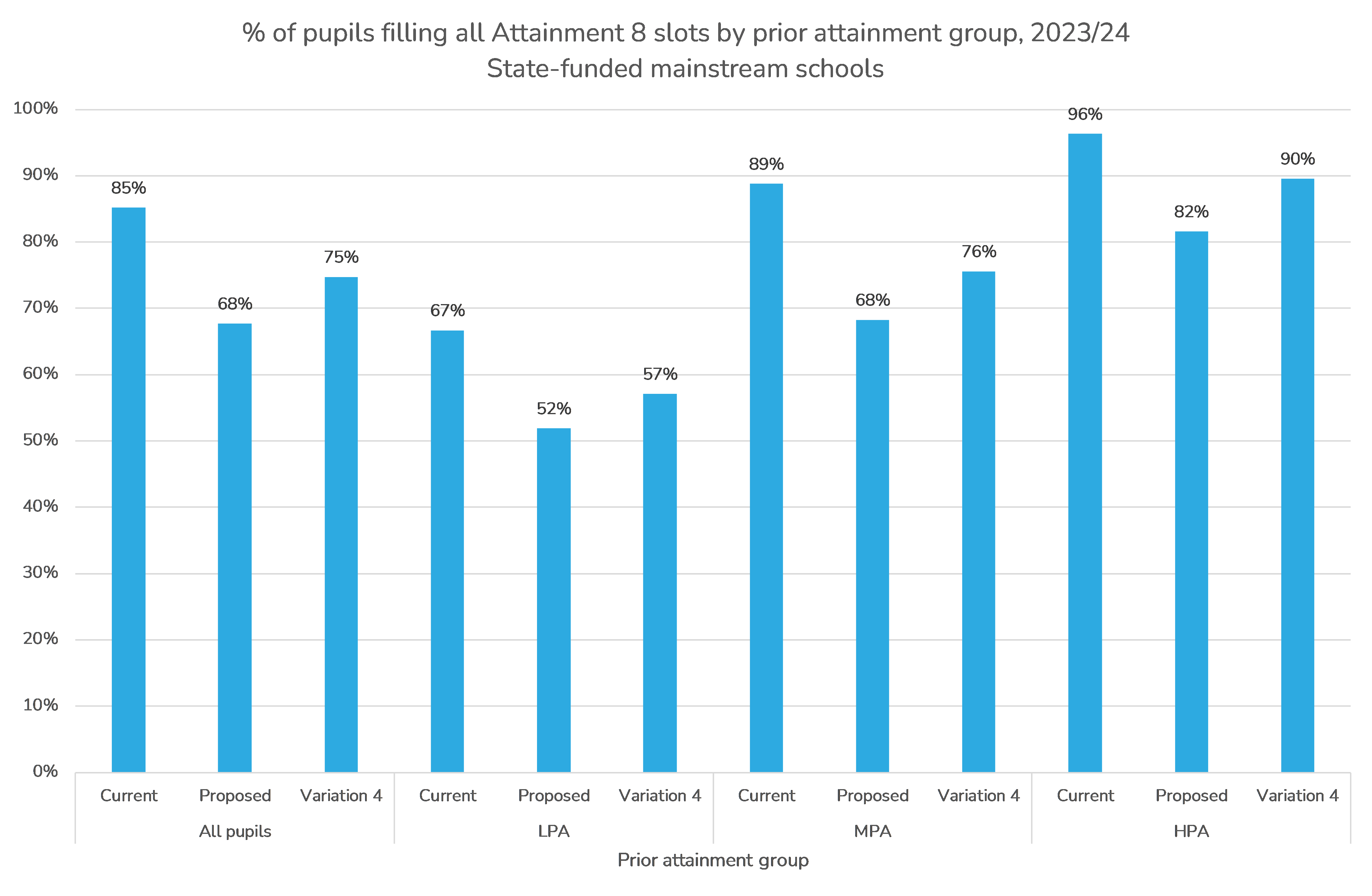
Our figures are slightly higher than those published by DfE (63%). Firstly, we always count entries in qualifications that were failed whereas DfE do not. If we were to exclude the fails, our figure would fall to 66%. The chances are we are counting some qualifications that DfE have chosen not to count but without more information on the specific qualifications in scope of each slot we are not able to investigate further.
The percentage of pupils filling all 10 slots would increase to 75% if science were included within the “breadth” slots. This affects middle (MPA) and high (HPA) prior attaining pupils more than low prior attaining pupils (LPA).
Which subjects will be winners and losers?
It is likely that schools will adjust their qualification offers to be more compliant with the new Attainment 8 measure.
Given that 85% of pupils currently fill their Attainment 8 slots, it would seem likely that we will see a similar figure when the new measure is published for the first time in 2028/29.
So what is likely to change?
Firstly, we will see an increasing percentage of pupils filling their “breadth” slots. In 2023/24, 69% of pupils filled both slots.
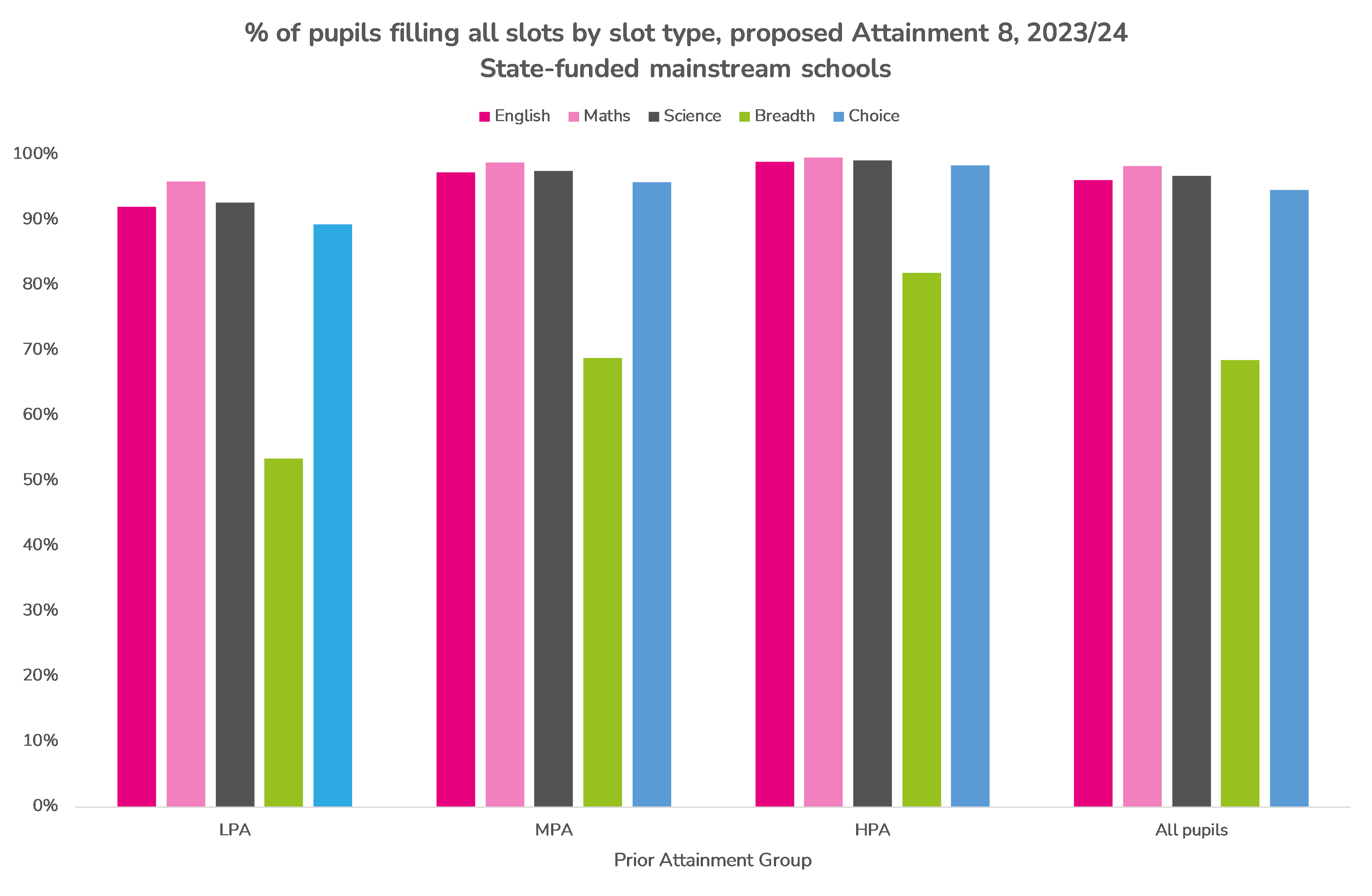
The following chart is restricted to the 31% of pupils who did not fill both of their “breadth” slots.
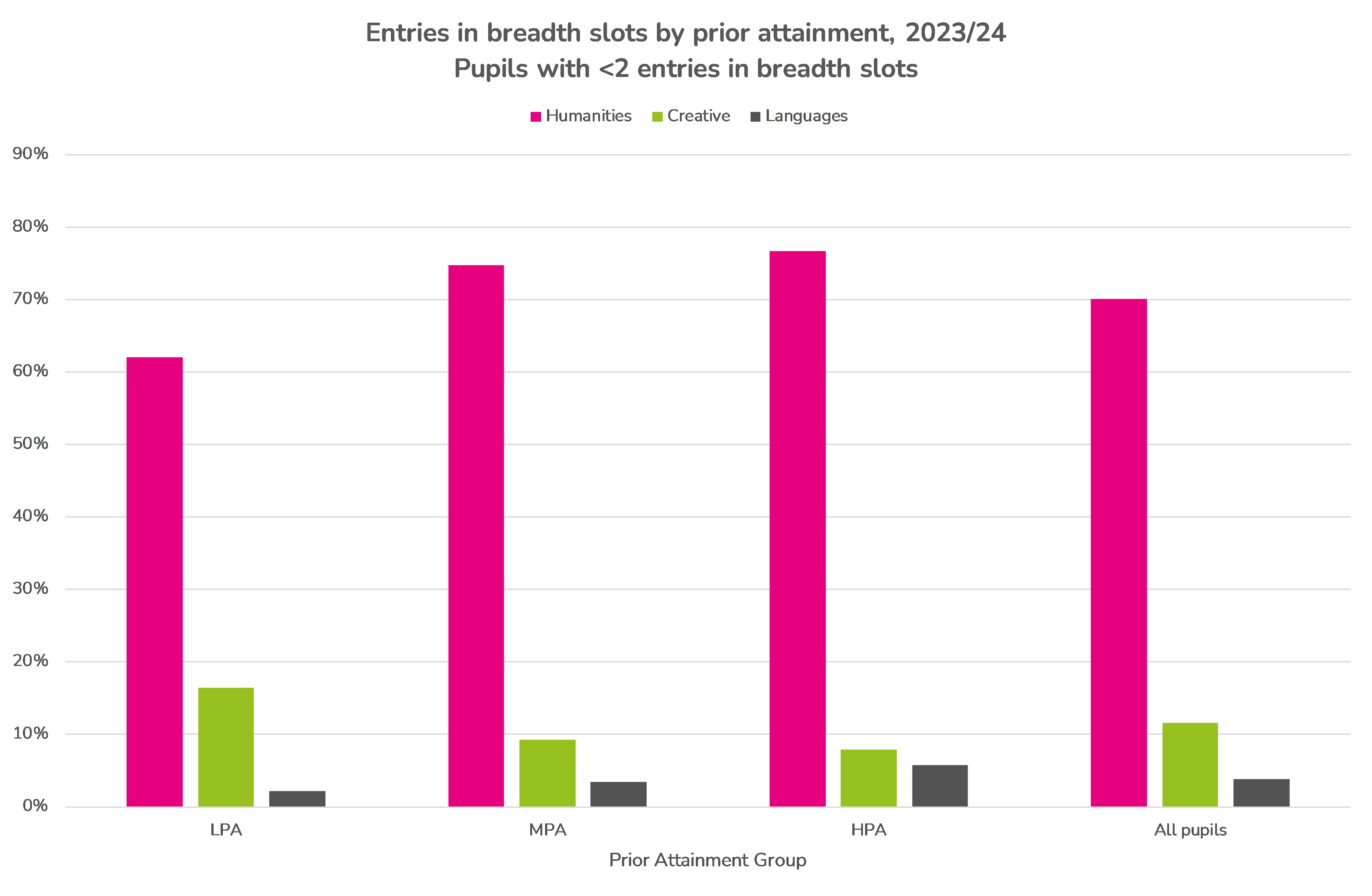
Most pupils entered humanities. We would therefore expect an increase in entries in creative subjects or in languages. Given the harsher grading of languages and a lack of teachers, we would expect a greater increase in creative subjects.
In order to make their qualifications offers more Attainment 8 compliant, schools could either change their current options or introduce additional courses. Recent years have seen a small reduction in the total number of qualifications entered by pupils.
The proposed model may act as a disincentive to enter triple science. There were around 32,000 pupils (around 5% of the cohort) who entered triple science (including computer science) but who, as things stand, only had one entry counted in the “breadth” slots.
Although the proposed model allows vocational and technical qualifications (VTQs) in art & design, music and drama, it does not appear to allow VTQs in design & technology and related subjects, including engineering. There were 14,000 students (2% of the cohort) who entered such a VTQ but who had only one entry counted in the “breadth” slots.
Finally, as we showed in our previous piece, religious studies will henceforth be counted within the humanities. This may result in a slight downturn in entries in geography and history.
Summing up
At present, around 68% of pupils fill all the available slots within the proposed new Attainment 8 measure, but 85% fill all the slots of the EBacc-heavy current version.
Therefore, it is likely that qualification entry patterns will change.
Most of this will be driven by the two new “breadth” slots. The DfE proposal is that these can be filled by subjects from the following groups: humanities, creative subjects and languages, with a maximum of one subject counting per group.
Given that most pupils already enter a humanities subject, we are likely to see increased entries in creative subjects and languages.
This is likely to come at the expense of some of the EBacc subjects, particularly where pupils are taking 3 or more science qualifications or 2 or more humanities qualifications.
Want to stay up-to-date with the latest research from FFT Education Datalab? Sign up to Datalab’s mailing list to get notifications about new blogposts, or to receive the team’s half-termly newsletter.



Leave A Comment