




School belonging is currently high on the education policy agenda in England. This is partly due to a belief that it is positively associated with attendance, attainment and wellbeing. Yet recent evidence suggests that many pupils feel less connected to school than they once did. Consequently, The government now expects every school to monitor pupils’ sense of belonging and engagement by 2029. It plans to support this with a Pupil Engagement Framework, including standard questions on belonging, safety, inclusion, relationships and motivation.
This is a welcome ambition. But it also brings a deceptively difficult measurement problem into view.
What exactly should schools measure?
In my new Nuffield Foundation-funded project I am using data from PISA, TIMSS and PIRLS to investigate how school belonging relates to attendance, exclusions and attainment.
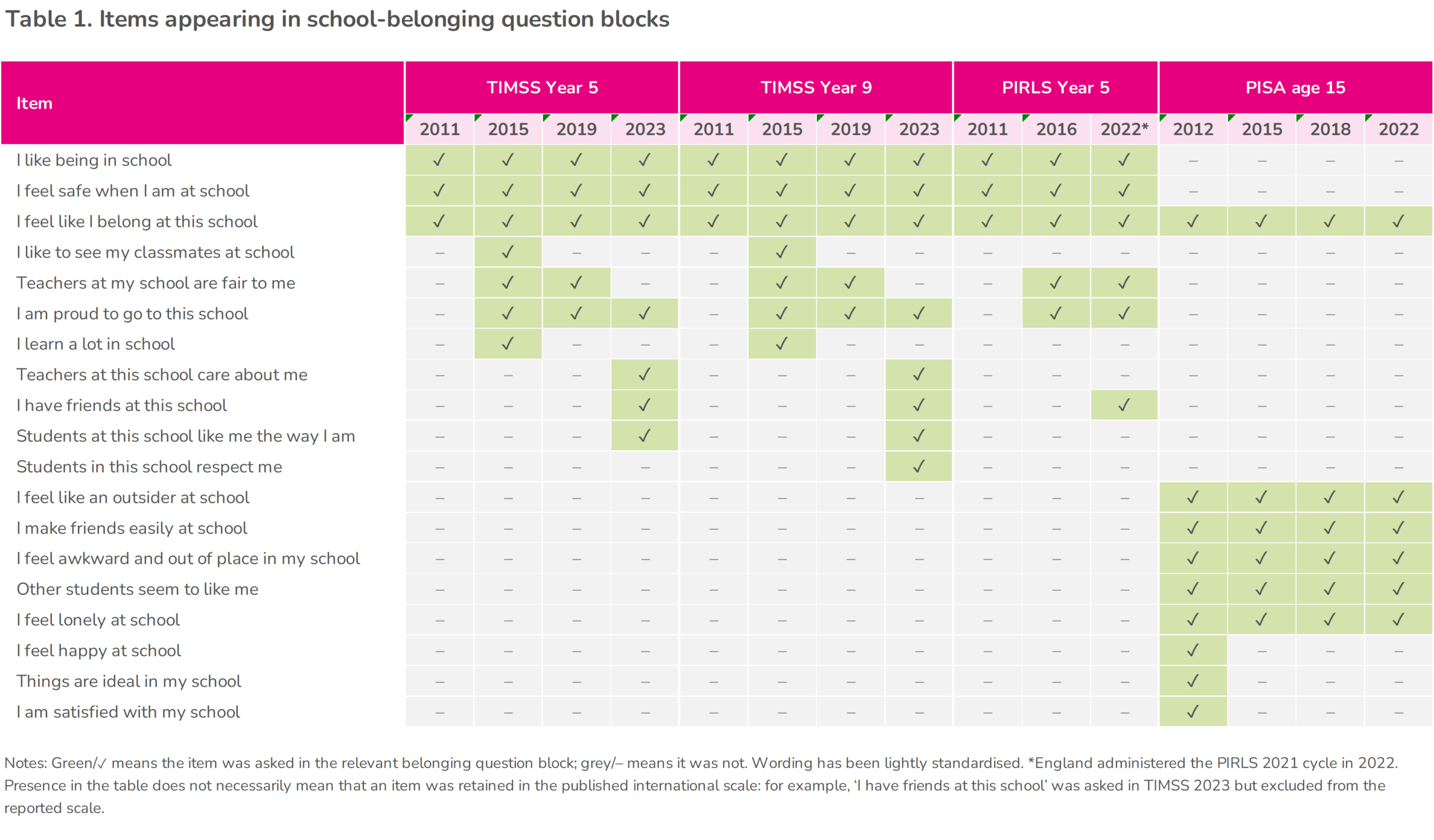
All three studies ask pupils about belonging. Yet, as Table 1 (click here to view) illustrates, the three studies do not capture this construct in the same way.
Three particular aspects of this table stand out.
First, the measures are not stable over time. TIMSS, for example, moved from three items in 2011 to seven in 2015, five in 2019 and a different set in 2023. Questions about enjoying school, feeling safe and belonging appear consistently. Questions about fairness, care, friendship and peer acceptance move in and out. This matters if we want to compare belonging over time. A change in the score may partly reflect a change in what was measured.
Second, the questions cover a wide range of experiences. This includes safety, relationships with teachers, friendship, peer acceptance, pride and simply liking school. One may then question whether these measures of school “belonging” really capture one underlying construct? Or, rather, are several distinct aspects of school life being bundled together? In this respect, perhaps belonging may be better viewed as a meta-construct (i.e. an umbrella term bringing together several interlinked school experiences).
Third, the emphasis differs across studies. Since 2015, PISA has focused heavily on peer relationships and social integration (e.g. feeling lonely, making friends and feeling liked). On the other hand, TIMSS and PIRLS take a much broader approach, also asking about safety, teachers, pride and enjoyment of school[1]. In other words, while the different surveys both report a measure called “school belonging”, they conceptually measure quite distinct things.
What schools should take from this
Suppose a school survey indicates that pupils have a weak sense of belonging. What should leaders do next?
That depends on what lies underneath the headline score. Pupils who feel unsafe need a different response from those who believe teachers do not care about them. Weak friendships require something different again from low pride in the school.
This is where the jingle-jangle problem becomes important. This is where different things are given the same name (jingle) or different names are given to the same thing (jangle). School belonging, in my view, may well suffer from a “jingle” issue, with several quite different measures treated as if they are capturing an identical construct.
Monitoring belonging could nevertheless still be useful for schools. But measurement should lead to action. Schools need to be clear about what the measure they use captures and then link the outcomes to specific, tangible actions. Otherwise, a seemingly precise belonging score may tell us surprisingly little about what pupils need.
This project has been funded by the Nuffield Foundation, but the views expressed are those of the authors and not necessarily the Foundation. Visit nuffieldfoundation.org.
Want to stay up-to-date with the latest research from FFT Education Datalab? Sign up to Datalab’s mailing list to get notifications about new blogposts, or to receive the team’s half-termly newsletter.
[1]: In fact, while PISA also asks some questions about school safety, these do not form part of its belonging measure. Rather, these questions are parcelled up with bullying and form a separate scale.
A great ambition, but as you say, problematic! I recall the Blair/Brown government wishing to measure “happiness”.