




School belonging is currently high on the education policy agenda in England. The government expects every school to monitor pupils’ sense of belonging and engagement by 2029. The thinking is easy to follow; pupils who feel like they belong at school should be more likely to attend, participate and learn.
A substantial research literature also reports a positive link between belonging and achievement. But much of that evidence is cross-sectional. This means that existing evidence on the link between belonging and achievement could reflect other factors, such as differing levels of prior achievement. So, is belonging really associated with better academic progress? Or do pupils who feel they belong at school simply differ in other ways?
What did I do?
In a new paper, produced as part of my Nuffield Foundation-funded project, I investigate this issue using several waves of PISA, TIMSS and PIRLS linked to England’s National Pupil Database. Together, these data cover pupils in Years 5, 9 and 11. They allow me to examine performance in both international assessments and national examinations. Critically, I can account for pupils’ earlier attainment, demographic characteristics and previous records of absence and exclusion. This provides a much stronger comparison than a simple correlation (though, at the same time, it may also not capture cause and effect).
What did I find?
At first glance, there does indeed seem to be a meaningful link between belonging and achievement. Amongst pupils whose belonging was measured in Year 9, a one-standard-deviation difference in belonging (roughly the gap between a pupil with an average sense of belonging versus a pupil in the top 15% of the belonging distribution) was associated with an increase in almost half a GCSE mathematics grade, as shown in the chart below.
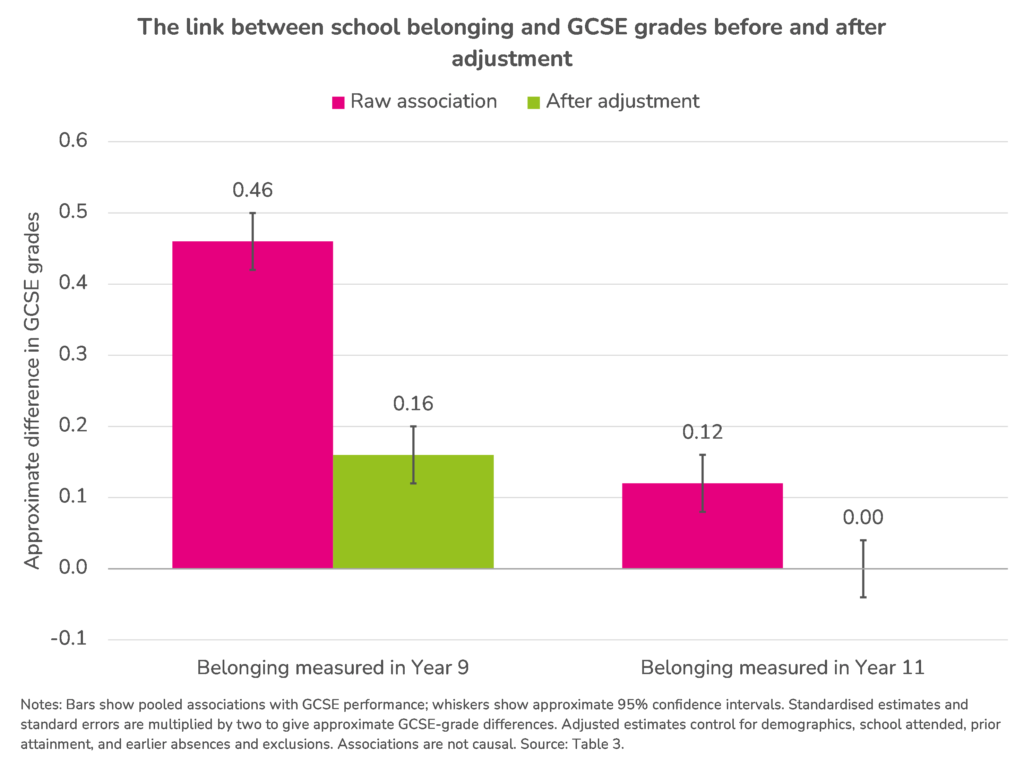
Yet, once I compare pupils with similar backgrounds, prior attainment, earlier attendance and exclusion records, the difference falls to just 0.16 of a mathematics grade. Thus, around two-thirds of the apparent Year 9 relationship between belonging and achievement disappears once I compare otherwise similar pupils.
For pupils measured in Year 11, the raw difference is around 0.12 of a grade and disappears entirely after adjustment. (As I show in an earlier post, PISA, TIMSS and PIRLS also measure belonging in different ways. This means the contrast between Years 9 and 11 may partly reflect measurement, rather than age alone).
Interestingly, I produce similar results regardless of whether achievement is measured using low-stakes international tests or national examinations. Likewise, there is little evidence that the relationship differs by gender, ethnicity, disadvantage, special educational needs or prior attainment.
The only exception is that I do find that very low levels of belonging may be particularly detrimental in Year 9. Though whether this is due to “belonging” per se (versus other aspects of young people’s engagement at school) is open to debate. For instance, once I account for differences in young people’s interest and confidence, as well as the value they place on learning, the link between belonging and achievement falls close to zero.
Implications
What do I take from this? Not that school belonging is unimportant. Feeling accepted and supported may matter for pupils’ wellbeing, attendance and experience of school. These are worthwhile outcomes in their own right.
But initiatives focused solely on raising school belonging are unlikely to translate into large improvements in attainment. For the Year 9 pupils, when we control for demographics, school attended, Key Stage 2 scores and prior absences/exclusions, this amounts to only around one-sixth of a GCSE grade.
This project has been funded by the Nuffield Foundation, but the views expressed are those of the authors and not necessarily the Foundation. Visit nuffieldfoundation.org.
Want to stay up-to-date with the latest research from FFT Education Datalab? Sign up to Datalab’s mailing list to get notifications about new blogposts, or to receive the team’s half-termly newsletter.
Leave A Comment