




In our round-up of this year’s GCSE results, we were somewhat surprised to see attainment improve in the three most common modern foreign languages (MFL) taught in schools: French, German and Spanish.
We have for many years thought that these subjects were too harshly graded.
This year, the first results from the new GCSE MFL specifications were awarded.
So were this year’s results graded less harshly?
Data
The last time we analysed grading severity was in May last year, using data for the 2024 academic year.
In that article, we used Key Stage 4 data from the National Pupil Database (NPD) relating to all state-funded schools (mainstream and special) in England. We reproduce those numbers in this article.
Such a dataset is not yet available for 2026 so, in its absence, we use data supplied by 1,530 schools participating in the FFT Aspire Early Results Service.
As before, we compare pupils’ results in each subject to their results in English language and maths. The difference between the two gives us a rough measure of grading severity (relative to English language and maths).
Grading severity by subject, 2026
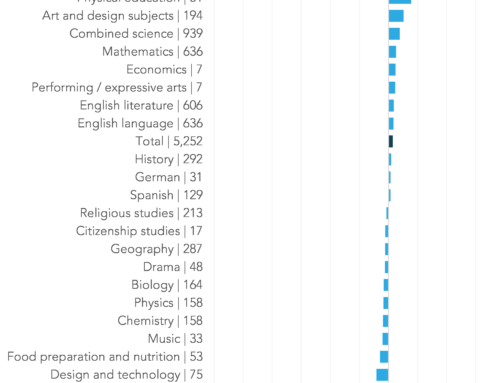
First of all, let us compare our measure of grading severity for 2026 based on a sample of schools (with numbers of entries in brackets), to the full population from 2024.
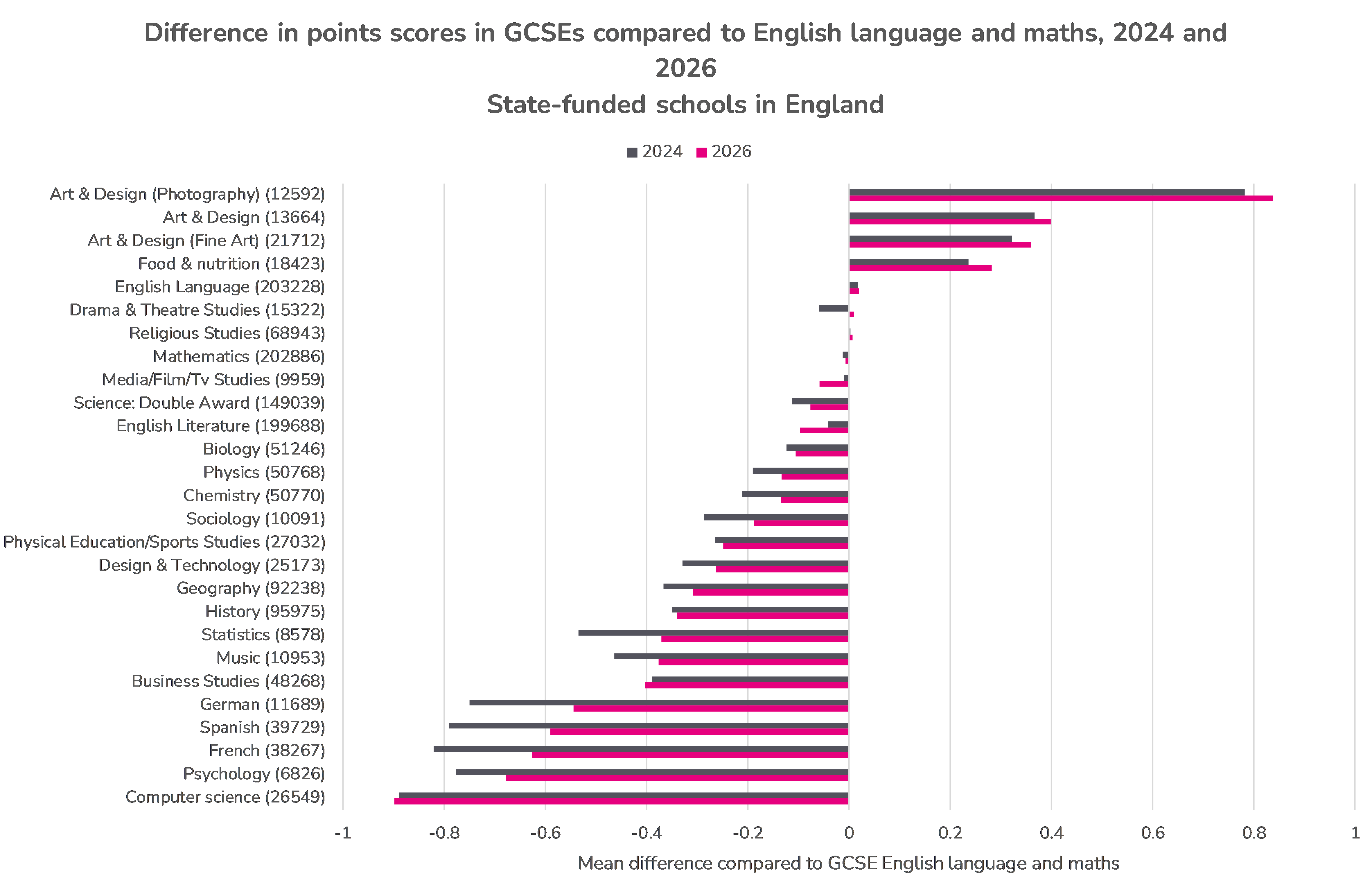
The chart is ranked from least severely graded (Art & design: photography) to the most severely graded (Computer Science).
Broadly speaking, the rank ordering of subjects for both years is fairly similar but it does appear that French, German and Spanish were less harshly graded in 2026 along with music, psychology and statistics.
However, pupils still tended to achieve at least half a grade lower on average in each MFL subject than in English and maths.
It is not so much that differences exist that is an issue. After all, far more curriculum time is dedicated to English and maths than other subjects. It is the fact that these differences vary substantially by subject that we call into question.
Grades in French
The chart below compares pupils’ grades in French with their grades in English language and maths combined.
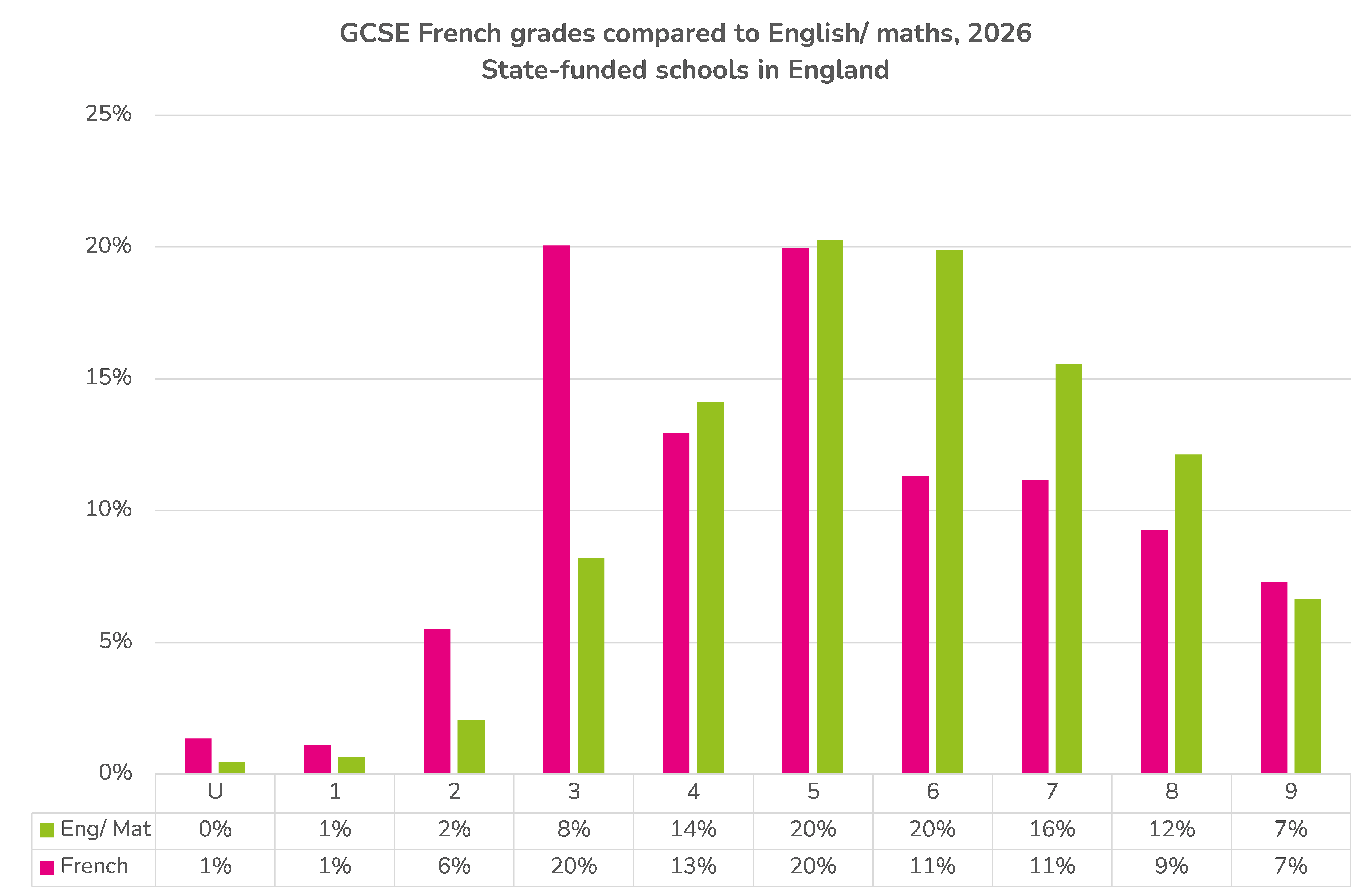
French grades have a bimodal distribution with grades 3 and 5 being the most common. Far more pupils achieve grades 2-3 in French than in English and maths combined. By contrast, pupils are far less likely to be awarded grades 6-8 in French.
Grades in German
The chart below compares pupils’ grades in German with their grades in English language and maths combined.
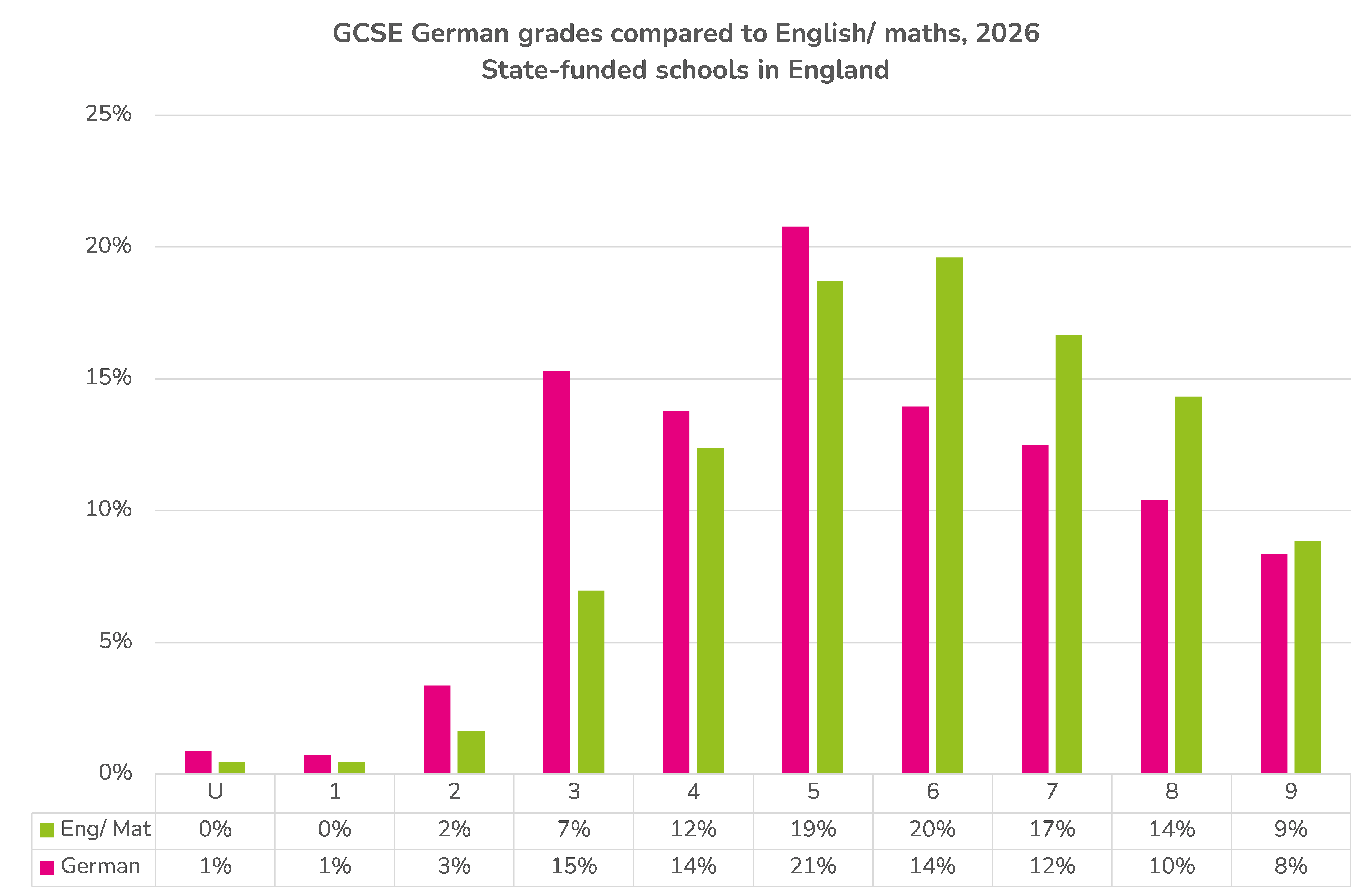
Compared to French, the German cohort is slightly higher attaining. 40% achieved grade 9-7 in English language and maths combined (35% in French, 32% in Spanish).
Proportionately fewer pupils achieved grade 3 in German compared to French. However, compared to English and maths, pupils were more likely to be awarded grades 2-5 in German and less likely to be awarded grades 6-8.
Grades in Spanish
The chart below compares pupils’ grades in Spanish with their grades in English language and maths combined.
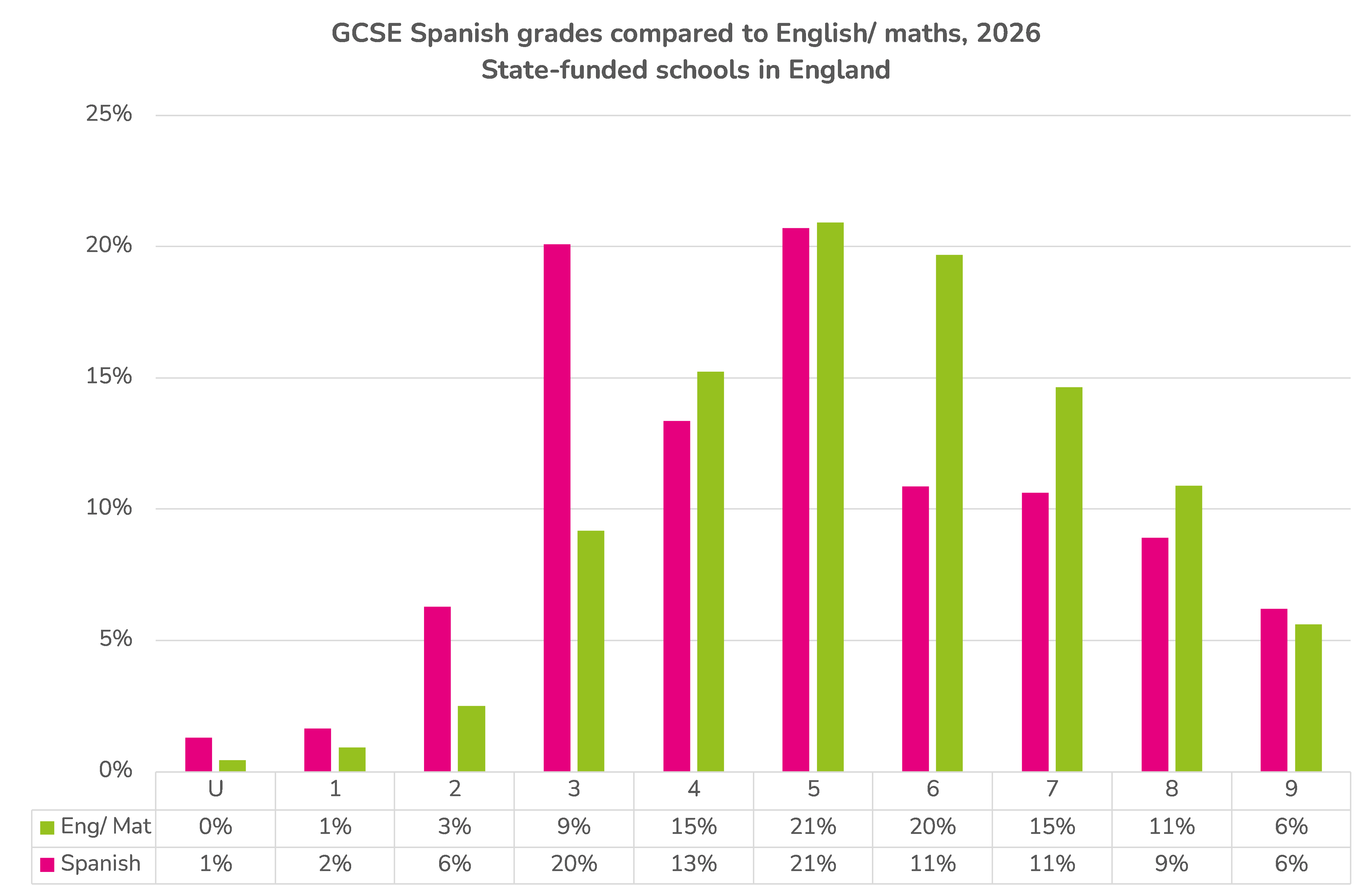
The distribution of grades is similar to that of French: a bimodal distribution with grades 3 and 5 being the most common. Far more pupils achieve grades 2-3 in Spanish than in English and maths combined. By contrast, pupils are far less likely to be awarded grades 6-8 in Spanish.
Why have grades improved in MFL?
It’s a bit of a mystery why grades have improved in MFL.
Firstly, we were not expecting any upwards adjustments to grades this year similar to those made in 2024.
Secondly, results risk falling when new specifications are awarded. To avoid what is known as the “saw-tooth effect”, where the results of the first cohort to take a new specification are lower than the previous cohort who took the old specification, Ofqual applies the comparable outcomes framework to ensure that the former group is not disadvantaged. We see the opposite with this year’s MFL results: Results increased.
Finally, results could increase under the comparable outcomes framework if the cohort of entrants had higher prior attainment than the previous cohort. This is unlikely to occur to any significant degree for large entry subjects like MFL in any event, but the fact that there is no Key Stage 2 prior attainment data for this year’s (or last year’s) GCSE cohort rules out this explanation.
Summing up
It looks as if this year’s GCSE grades in French, German and Spanish have been graded less harshly than in the past.
However, there is still some way to go. Pupils tend to achieve at least half a grade lower per subject in MFL compared to English language and maths. Far fewer grades 6-8 are awarded in MFL than in English and maths.
One caveat is that we have used a convenience sample of data for 2026. We intend to repeat the analysis using the full population of data once 2026 Key Stage 4 data is available from the National Pupil Database. It may be feasible to use this source to examine the effects of tiering on results.
Want to stay up-to-date with the latest research from FFT Education Datalab? Sign up to Datalab’s mailing list to get notifications about new blogposts, or to receive the team’s half-termly newsletter.
Leave A Comment