




For the next six months at least, every education blog must begin with reference to one of the recent white papers. And this one is no exception: among many other things, the schools white paper stated that all schools will eventually be part of a trust.
This isn’t the first time that a government has signalled an intent for all schools to move into trusts. In 2022, the then Conservative government set out an ambition for all schools to join MATs by 2030. The current plan doesn’t include an end date, but the direction of travel is the same. And so this seems like an opportune moment to revisit our occasional series on the state of play for MATs.
What impact did the 2022 announcement have? And what can we expect to see over the next few years if current trends continue? Let’s roll up our sleeves and see what the data can tell us.
Sign up to our newsletter
If you enjoy our content, why not sign up now to get notified when we publish a new post, or to receive our half termly newsletter?
Data
We’ll be using publicly available data from Get Information about Schools from 2015/16-25/26, downloaded in March of each year. We will exclude any schools that were recorded as being closed in November of the relevant academic year, as well as any MATs that did not have any open schools.
Current state of play
We’ll start with a look back over the last ten years. The chart below shows the proportion of schools that were part of a MAT, SAT, another type of trust, or not part of a trust of any kind.
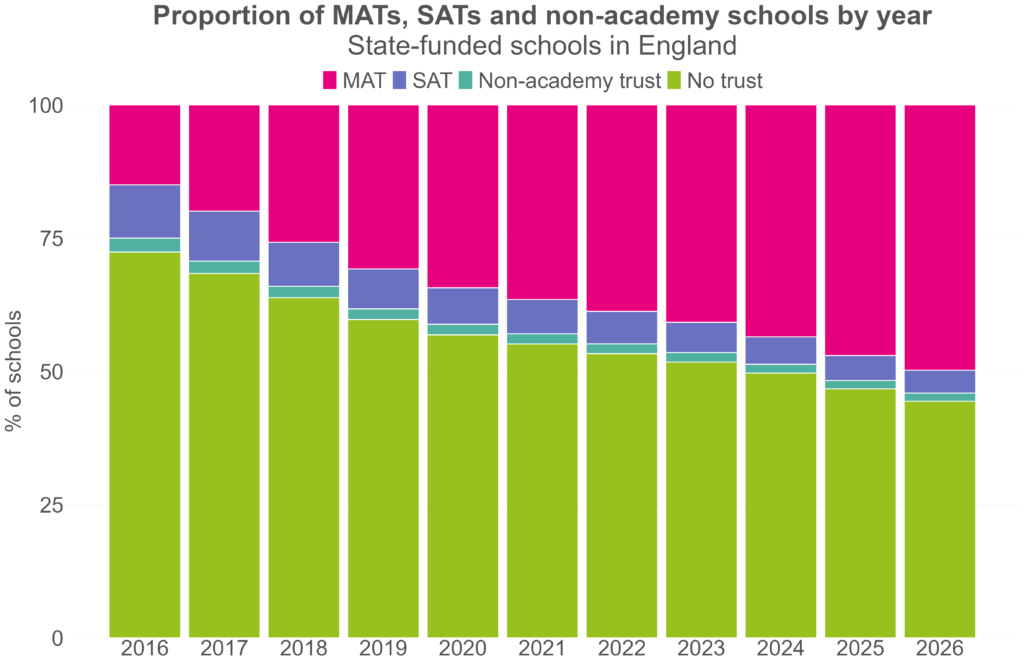
The trends are very clear: schools are now more likely to be part of a MAT, and less likely to fall into any other the other categories. The proportion of schools in a MAT has more than tripled, from 15% in 2016 to 50% in the latest data.
What isn’t particularly clear is the impact of the 2022 government ambition for all schools to join a trust. If anything, the rate of academisation seems to have slowed slightly since then.
But while the number of schools in MATs has been increasing steadily, the number of schools in small MATs of less than 10 schools has been falling in the last few years.
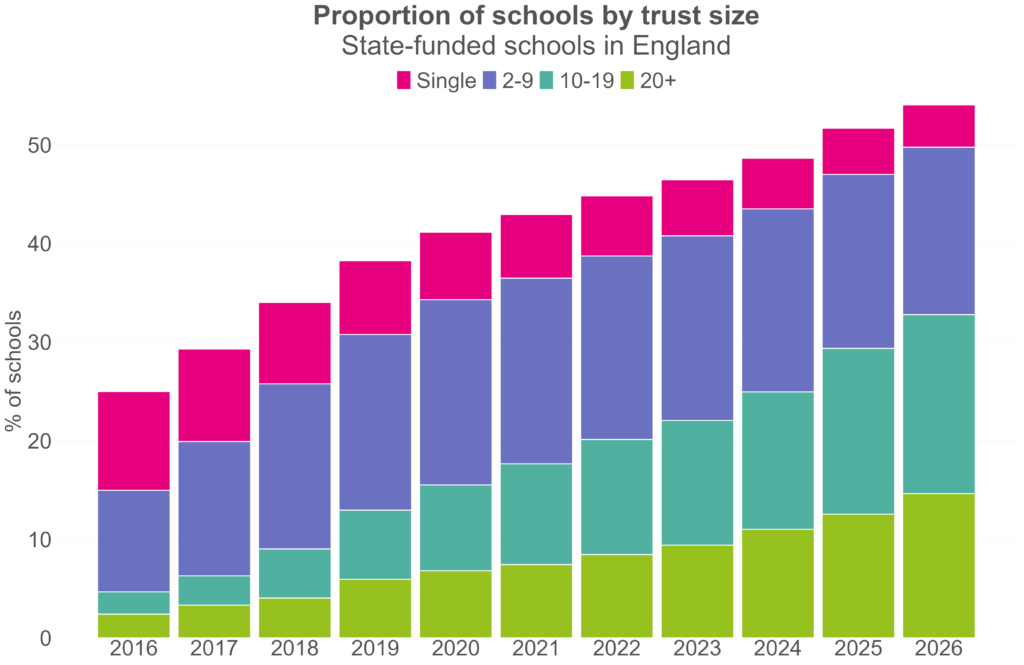
Up until 2021, the proportion of schools in a small MAT was increasing, but since then it has been declining. This does look like a reaction to the then government’s policy, which suggested that all trusts should include at least ten schools.
Looking more closely at the numbers over the last five years, we can see that the average MAT is getting bigger.
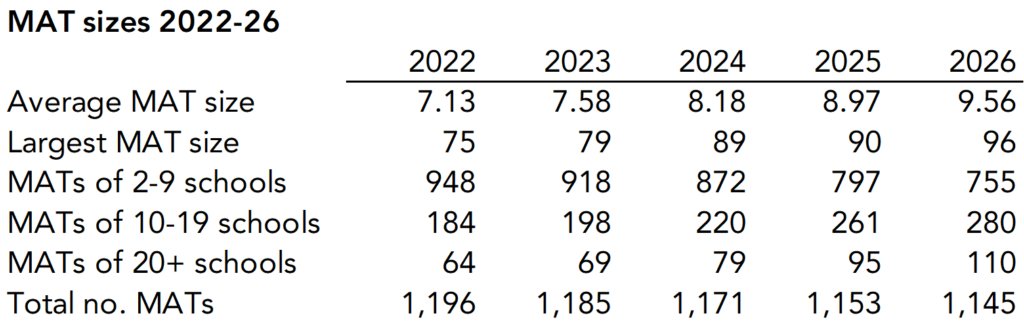
The number of smaller MATs has been falling while the number of larger MATs has been increasing. The largest MAT now has 96 open schools.
Difference by region and phase
Concentrating again on the last five years, the next chart shows the state of play in each region.
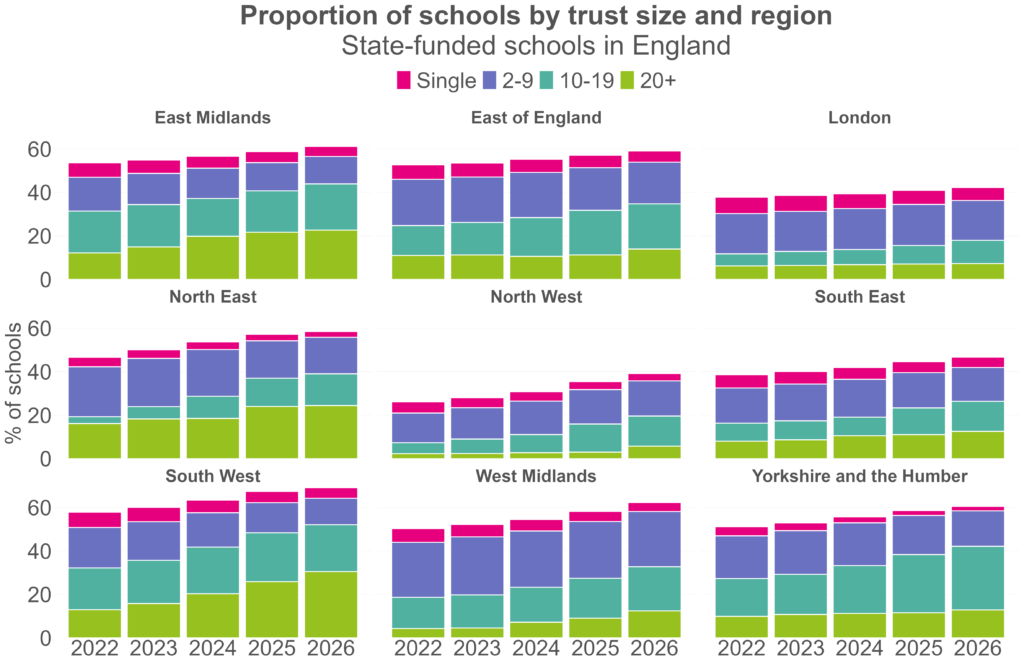
The South West is the most academized region: 69% of schools are academies and 64% are part of a MAT. Least academized is the North West, with just 39% of schools being academies and 36% part of a MAT. The South East and London also have relatively few schools in MATs: 42% and 36% respectively.
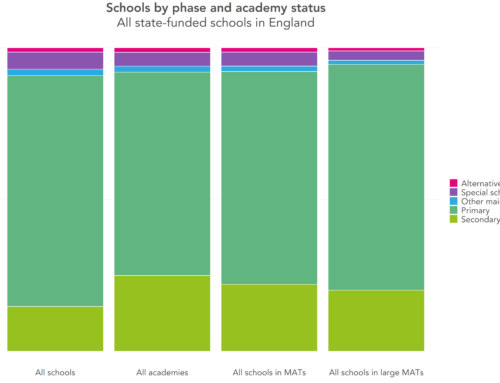
And there are still large differences in academisation by school phase.
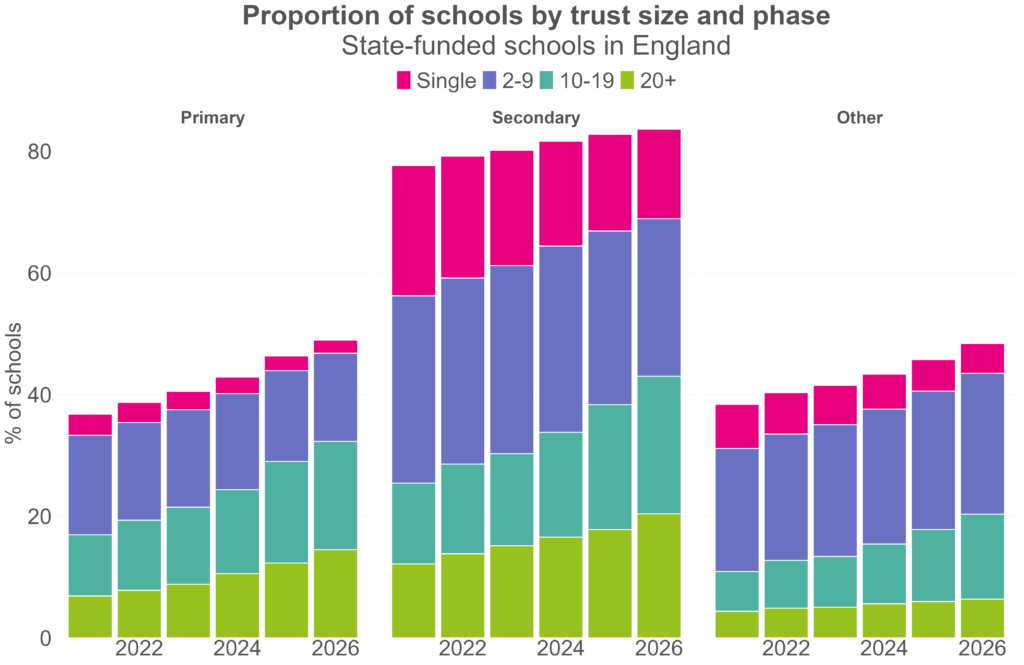
While overall, 50% of schools are part of a MAT, this increases to 69% for secondary schools, with a further 15% in SATs.
What next for MATs?
We’ve seen that larger MATs are growing, while SATs, smaller MATs and non-academies are declining. But what will happen next?
The chart below show the actual and predicted proportions of schools in MATs by size and year, up to 2050.[1]
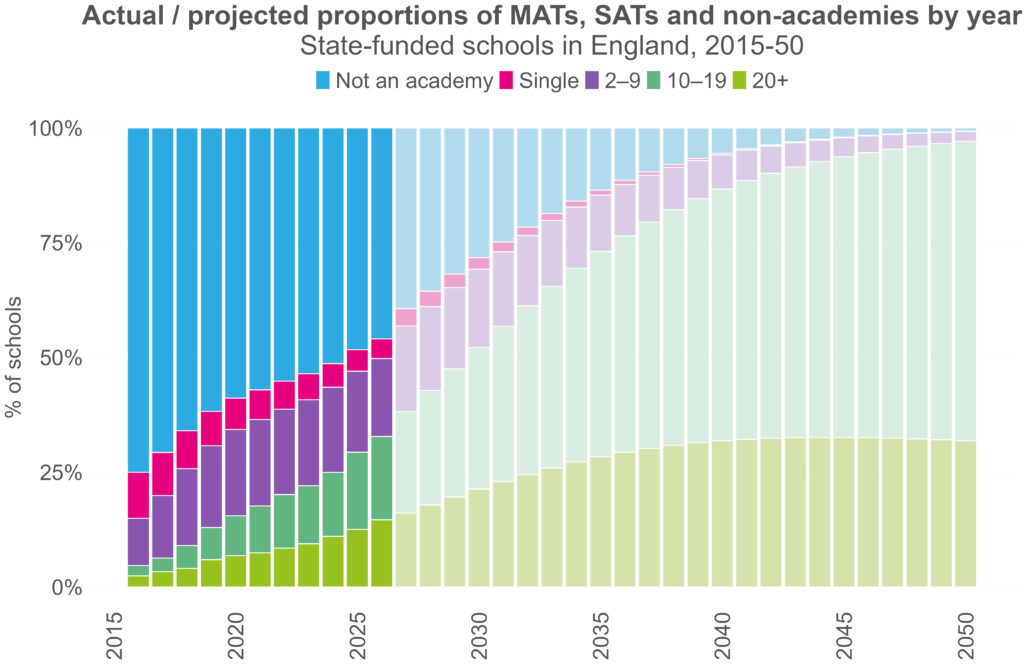
Based on current trends, by 2034 most schools will be part of a large MAT of ten or more schools. However, our model predicts that as many as one in twenty schools will still not be part of a trust as late as 2040.
Of course this modelling doesn’t prove anything, and things probably won’t pan out exactly as predicted here. But, unless something fairly drastic happens to the current trends, we shouldn’t expect to see full academisation anytime soon.
Summing up
The trends over the last few years have been familiar in some ways: more schools have been joining academy trusts, and trusts have been getting bigger. But one difference since 2022 is the number of schools in smaller trusts – those with less than ten schools – has been falling. This is likely a reaction to the then government’s commitment to bring all schools into large trusts.
Whether this will continue now that we have had a fresh set of government ambitions via the latest white paper remains to be seen. But, based on the latest trends, it looks like we could be decades away from all schools being part of a trust.
[1]: Based on predicted probabilities from a multinomial model using data on actual numbers of schools in each category from 2015-26.
Want to stay up-to-date with the latest research from FFT Education Datalab? Sign up to Datalab’s mailing list to get notifications about new blogposts, or to receive the team’s half-termly newsletter.
Leave A Comment