




Discussions of educational inequality usually focus on family income, school quality and neighbourhoods. Much less attention is paid to genetics, often because the topic feels complex and uncomfortable. Yet recent research allows us to ask new questions about how children differ in their educational development and what this does – and does not – mean for schools.
Our study uses data from the UK Millennium Cohort Study to examine how children’s genetic predisposition towards education relates to their educational outcomes, and how this compares with the role of socio-economic disadvantage. This is part of a larger Nuffield Foundation funded study which we have blogged about previously. You can find our most recent paper here.
How is “genetics” being measured?
There are no such things as single “genes for intelligence”. Instead, the study uses what are known as polygenic scores. These combine information from thousands of genetic variants, each with a very small effect, into a single index associated with educational attainment.
Crucially, these scores are probabilistic, not deterministic. They do not determine individual outcomes or fix children’s potential. Rather, they capture one influence among many, potentially interacting with family resources, schooling and wider environments.
Family income differences appear even in genetic predisposition
Before looking at children’s outcomes, the paper first examines how polygenic scores themselves differ by family income. The chart below plots the distribution of education-related polygenic scores for children from low-income and high-income families. The difference is clear – on average, children from higher-income backgrounds have higher polygenic scores for education.
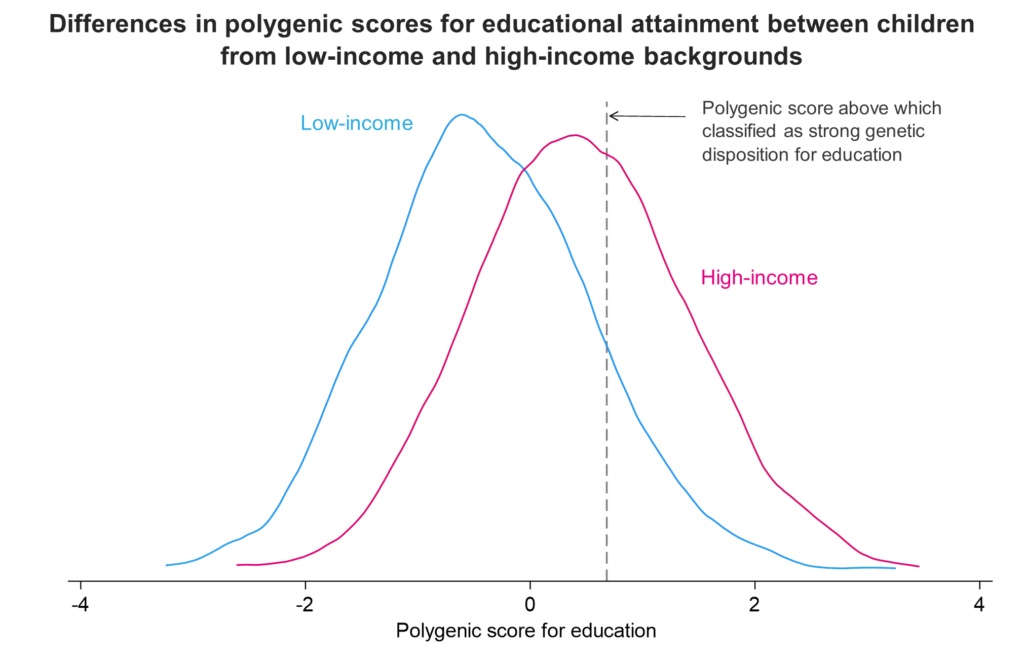
This does not necessarily mean that children from low-income families are innately less able than their more advantaged peers. Instead, it can reflect long-standing social processes, such as assortative mating, social mobility and the way educational advantage is transmitted across generations.
Early gaps emerge long before school starts
Among children with similarly high polygenic scores, socio-economic gaps in development appear very early. By age three, disadvantaged children already score substantially lower on vocabulary tests than their more advantaged peers, amongst those with similarly strong genetic dispositions towards education. By age five, this gap has widened further.
The paper shows that these differences closely mirror gaps in early literacy activities, such as parents reading to children or visiting libraries. Genetic predisposition does not shield children from the effects of early environments.
These early gaps have lasting consequences. By age sixteen, disadvantaged pupils with high polygenic scores are around 20–30 percentage points less likely to achieve top GCSE grades in English and mathematics than their high-income peers with comparable genetic predispositions.
This finding is particularly important for debates about social mobility. Even among those children who, on paper, have the strongest chances of academic success, socio-economic disadvantage remains a powerful constraint on outcomes.
What does this mean for the education community?
The key takeaway is not that genetics should influence expectations of pupils, but that potential and opportunity are not the same thing.
First, the findings reinforce the importance of early intervention. Genetic predisposition does not erase early disadvantage; high-quality early years provision and support for families remain essential. Likewise, disadvantaged young people with high polygenic scores will need access to high quality education to allow their academic potential to manifest.
Second, the study challenges simplistic meritocratic narratives. Educational outcomes reflect both effort and circumstance — including factors well beyond children’s control.
Finally, perhaps the most important conclusion is what this research does not show. Genetics does not set limits on what schools can achieve, nor does it justify inequality. Instead, it helps explain why supporting disadvantaged pupils — including those with high potential — requires sustained, systemic action.
I find that the presentation of fine lines to indicate what will, in reality, be massive variability and combination of a large number of criteria all reduced to data points very misleading. There will be multiple possible outcomes depending on the weighting and combination of the wide range of factors. Neither is there any indication of confidence or variability (kertosis) within the individual data points used to generate the simplistic graph.
I don’t think this makes any sense, is misleading and is implicitly a eugenics argument which education has always demonstrated is utter hokum!
How truly longitudinal are these studies? Ie over decades? Without that kind of range, the value of this study set must be somewhat limited?