




The publication of the Schools White Paper signalled substantial long-term reform of provision for children with special educational needs (SEN).
First and foremost is the requirement for schools to have inclusion bases. Many schools already have specialist resourced provisions (SRPs) and SEN Units although the data on how many do is far from clear (see appendix).
In this article I’m going to look at what happens when pupils identified with SEN move from primary to secondary school by addressing three questions:
- To what extent does SEN status change between Year 6 and Year 7 for pupils with SEN met by SEN Support in primary?
- What types of provision do pupils with EHC plans move into in Year 7?
- Are there secondary schools that are “SEND magnets”?
Data
For the most part we will use data from the January School Census from both 2024 and 2025.
We also add data from the Local Authority Alternative Provision Census from both 2024 and 2025. This covers children who are placed in provision outside the state-funded school sector (e.g. in independent schools) but where the local authority pays fees.
Together, the two data sources provide complete coverage of children in state-funded education in England.
To what extent does SEN status change between Year 6 and Year 7
We have shown previously how SEN is not a fixed characteristic and can change over time.
We show in the chart below the percentage of pupils with SEN by academic age in 2023/24. Rates were highest among pupils aged 10, which corresponds to Year 6.
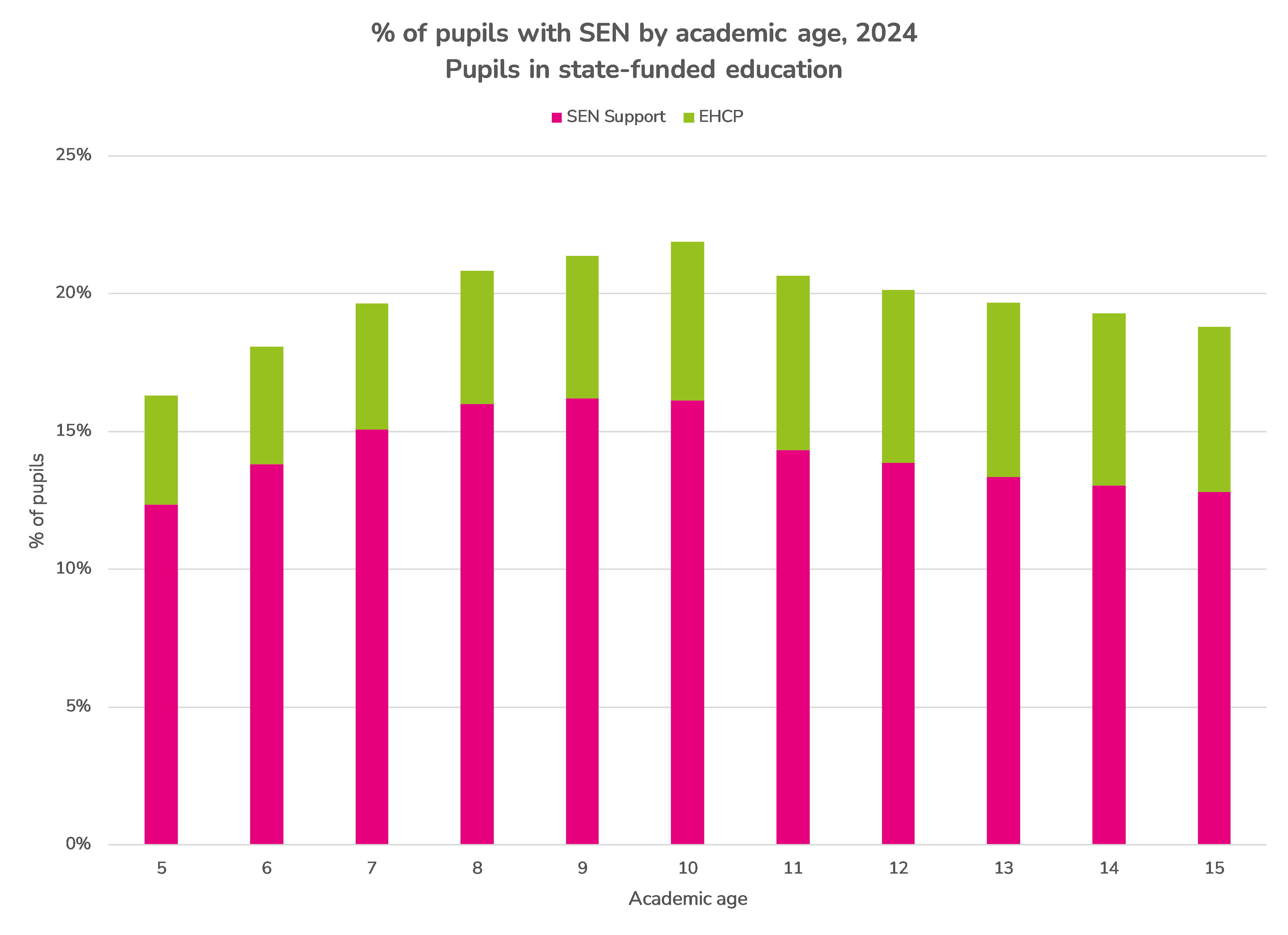
Some 107,000 10-year old pupils (16% of the cohort) were identified with SEN met by SEN Support.
In the following chart we show the SEN status of pupils with SEN met by SEN Support in 2023/24 in the following year (2024/25).
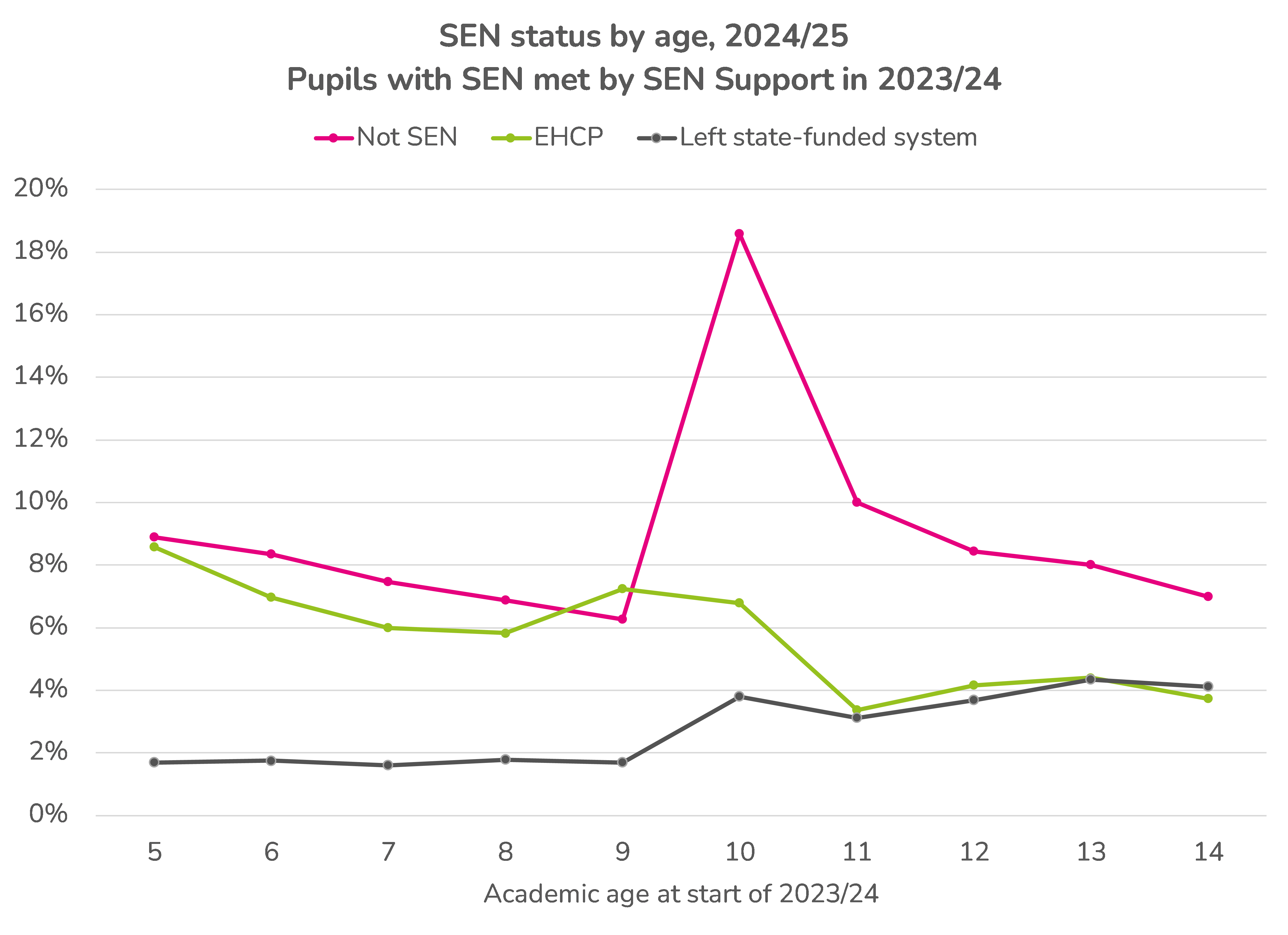
We see that 19% of the 107,000 10 year olds cease to be identified as having SEN the following year, when of Year 7 age. This rate is far higher than for any other year group.
A further 7% obtain an Education, Health and Care Plan (EHCP). 4% are observed to leave the state-funded system, either as a result of migration, death or moving to home education.
In terms of primary SEN types, those classed as “other” or “no specialist assessment” in Year 6 were the most likely to not be identified with SEN in Year 7.
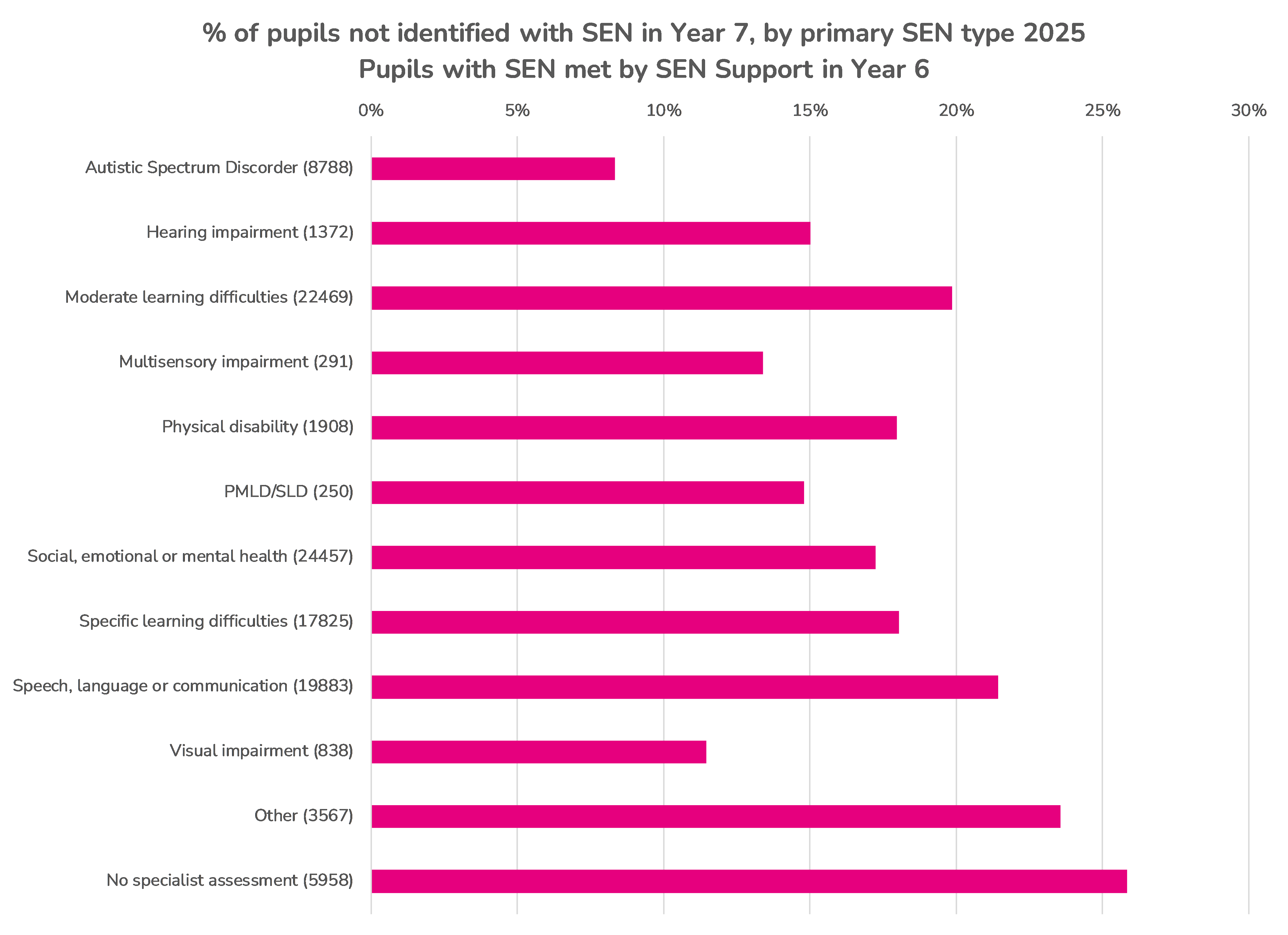
These figures might suggest that secondary schools are better equipped to meet pupils’ needs without making additional provision. Alternatively, it may be that identification of SEN had not yet taken place by January of Year 7.
To investigate this a little more, let’s look at what happened to an older cohort, specifically the cohort which was in Year 6 in 2019/20 and which completed Year 11 in 2024/25.
Of 20,065 pupils with SEN met by SEN support in Year 6 who ceased to be identified with SEN in Year 7:
- 781 (4%) subsequently obtained an EHCP.
- An additional 5771 (29%) were subsequently identified as having SEN met by SEN support between Year 8 and Year 11
In other words, evidence of delayed identification in some, but not all, cases.
What types of provision do pupils with EHC plans move into in Year 7?
We now look at the type of provision pupils with EHC plans move to between Year 6 and Year 7.
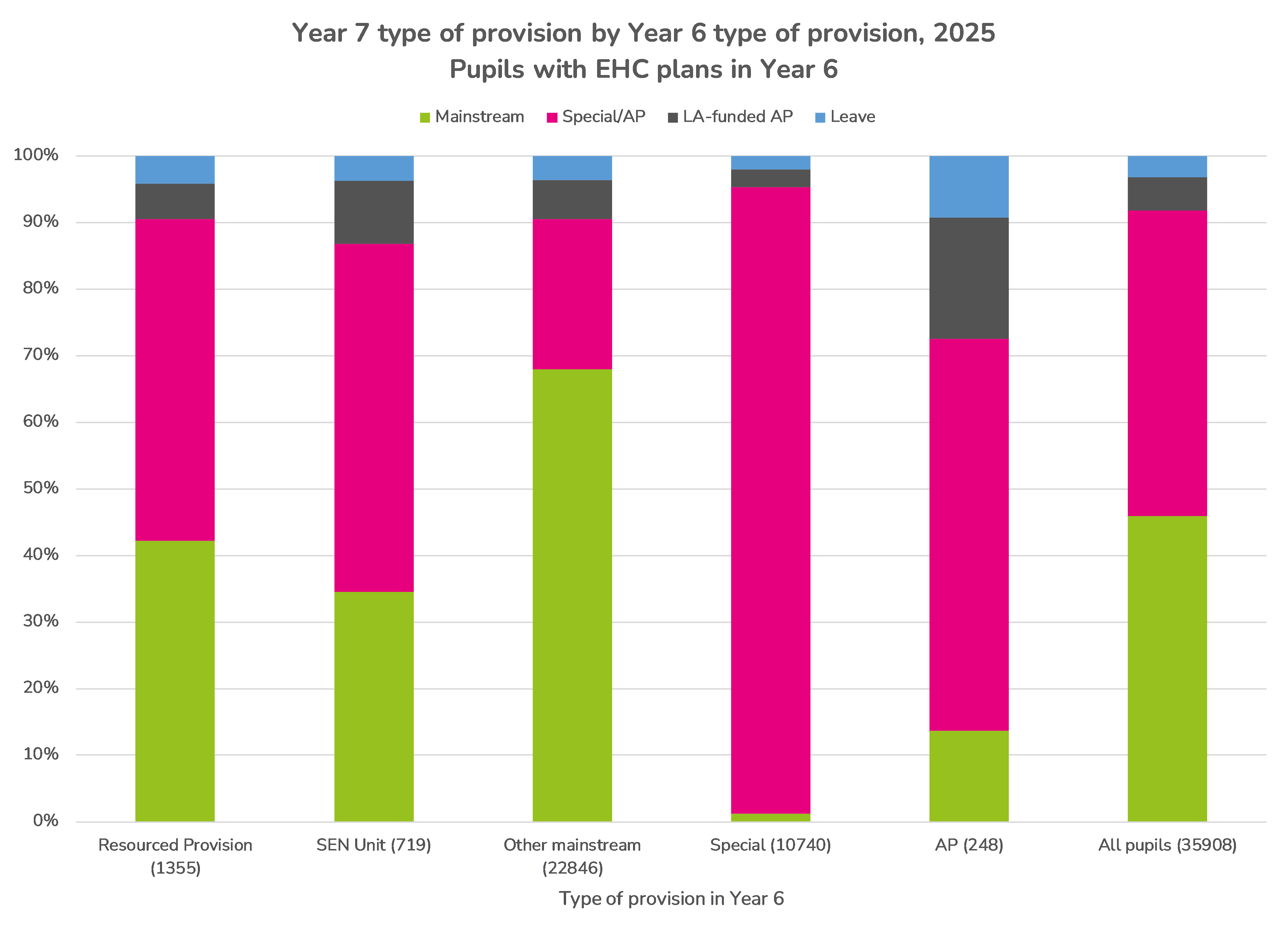
Among all pupils with EHC plans, there is an even split (46% each) of pupils moving into mainstream or special/AP schools. The remaining 8% either have no state-funded school place (e.g. are in home education) or are in local authority funded alternative provision (e.g. in special schools).
Almost all (84%) pupils in special schools in Year 6 transfer to a special school.
But for those in mainstream in primary, 23% move to special/AP and 10% leave the state-funded school system. This includes 6% who move into local-authority funded alternative provision.
It is this group in particular who would be targeted by the White Paper proposal to develop more inclusion bases in secondary schools.
Are there SEND magnet schools?
Finally, we examine whether there are secondary schools that act as “magnets” for pupils with EHC plans in Year 7.
This is defined as schools with a higher rate of pupils with EHC plans than might be expected given the prevailing rates of EHC plans in local areas, taking into account substantial variation in rates between areas.
To tackle this, we calculate the percentage of pupils in Year 7 with EHC plans across three years (2023 to 2025). We restrict our analysis to schools that admit at age 11. Almost all pupils with EHC plans would have had a plan in primary school or would have been going through statutory assessment at secondary transfer.
We then compare these rates with the rates we would expect given the areas that each school draws pupils from. This involves calculating the percentage of pupils with EHC plans resident within a hypothetical catchment area for each school. This is defined as the set of pupils of the appropriate age living closest to the school. If a school had 180 pupils in Year 7 in 2022/23, we would base its hypothetical catchment on the 180 11-year old pupils in 2022/23 living closest to it, regardless of whether they were in a mainstream school, special school, AP school or were funded by the local authority to attend provision outside the state-funded sector.
We define a “SEND magnet” school as one with at least 50% more Year 7 pupils with EHC plans on roll than we would expect given the prevailing rate in the local area. This is based on a three-year average, combining Year 7 cohorts from 2022/23 to 2024/25.
Based on this definition, we identify 73 SEND magnet schools out of over 3,000 state-funded mainstream secondary schools.
Around half of SEND magnet schools have a Year 7 EHCP rate of 9% or above. Not all schools with such a high rate meet our definition of SEND magnet: there are some schools with such rates but where the rate in the local area is also high.
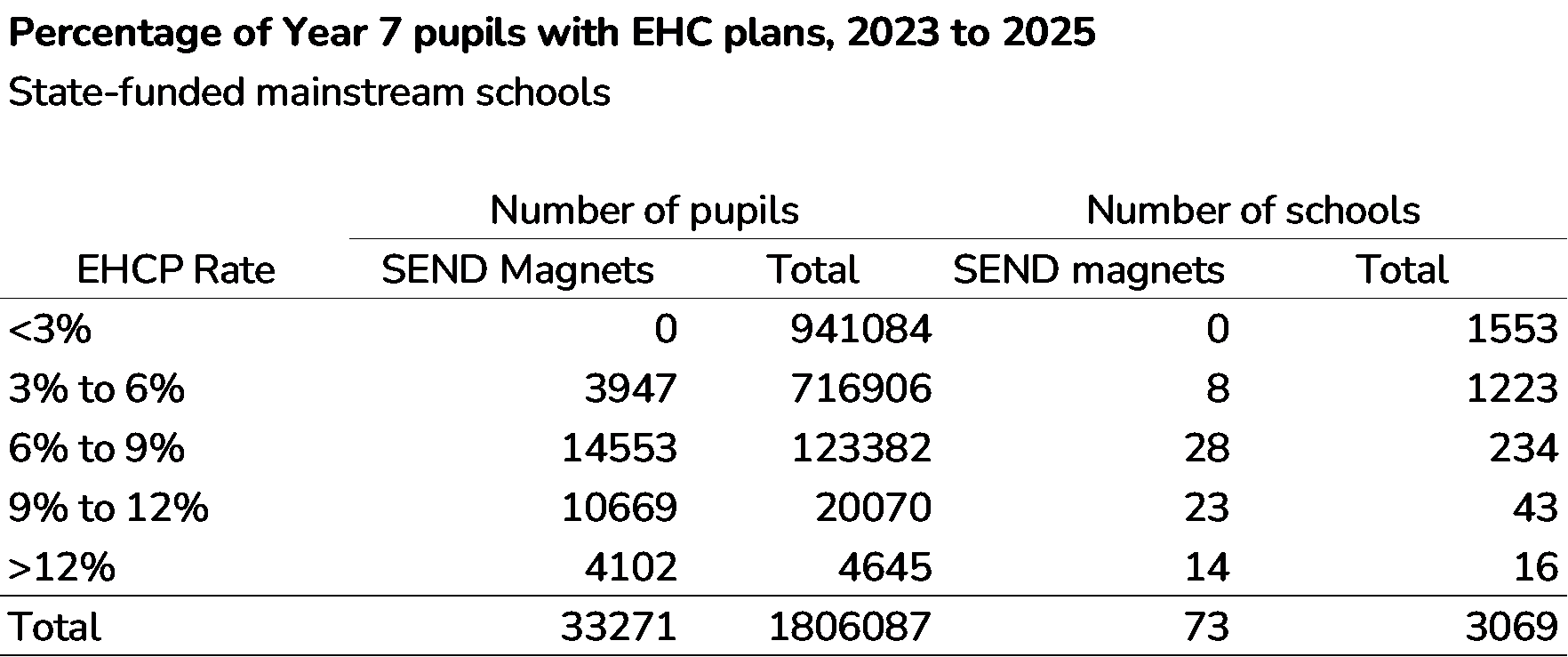
Some of the schools identified as SEND magnets have Year 7 EHCP rates below 9%. These are schools in areas with much lower rates of pupils with EHC plans living close to the school.
Of the 73 SEND magnet schools, 35 had Year 7 pupils recorded as attending a resourced provision or SEN unit. If specialist provision is available for pupils with SEN, it is perhaps unsurprising that these schools attract pupils with EHC plans.
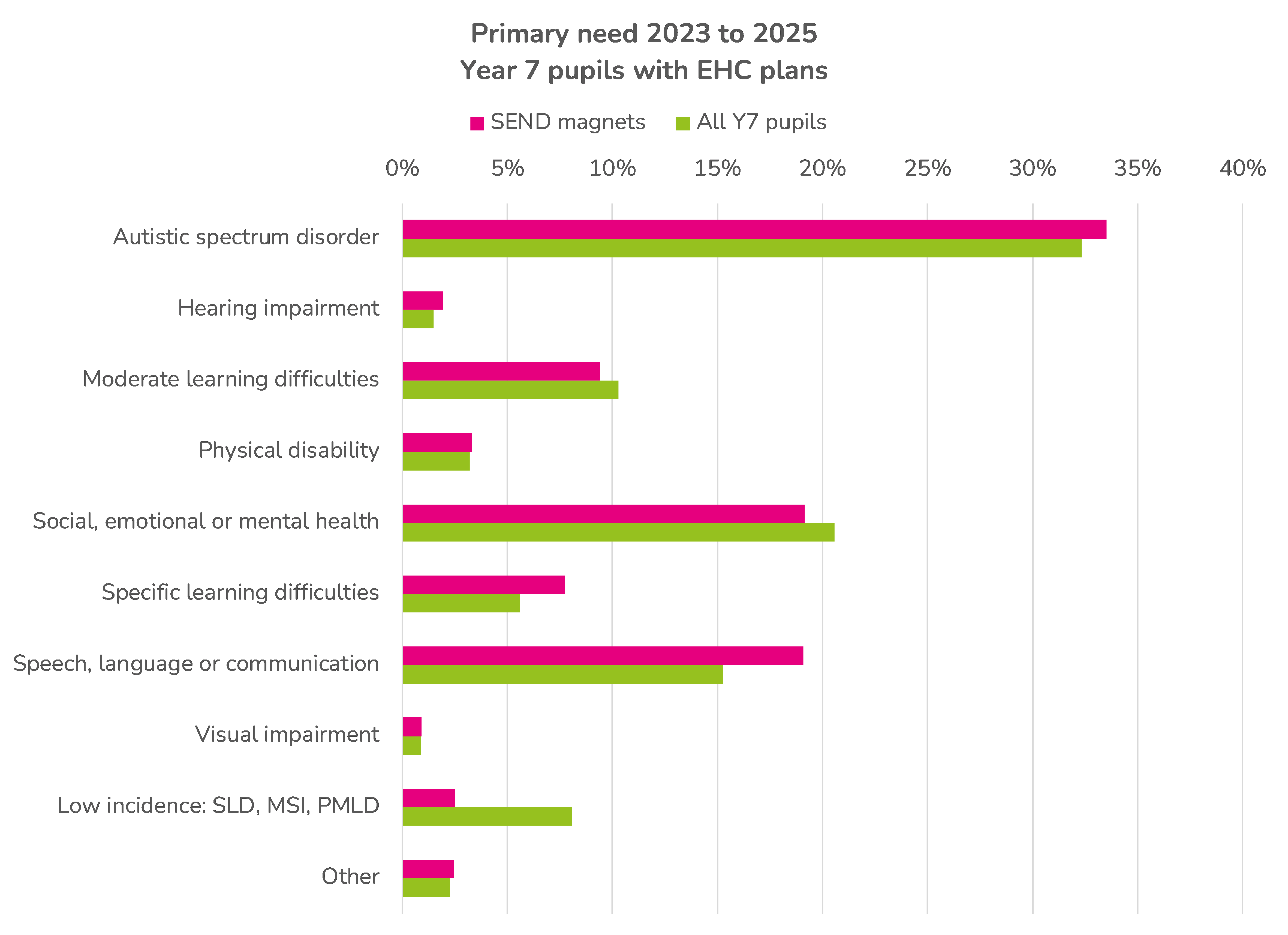
The primary SEN needs of pupils attending SEND magnet schools largely mirrors the primary needs of the cohort as a whole although, as would be expected, there are fewer cases of pupils with low incidence needs: multisensory impairment (MSI), profound and multiple learning difficulties (PMLD) and severe learning difficulties (SLD).
Finally, we look at the Progress 8 scores achieved by the SEND magnet schools in 2023/24.
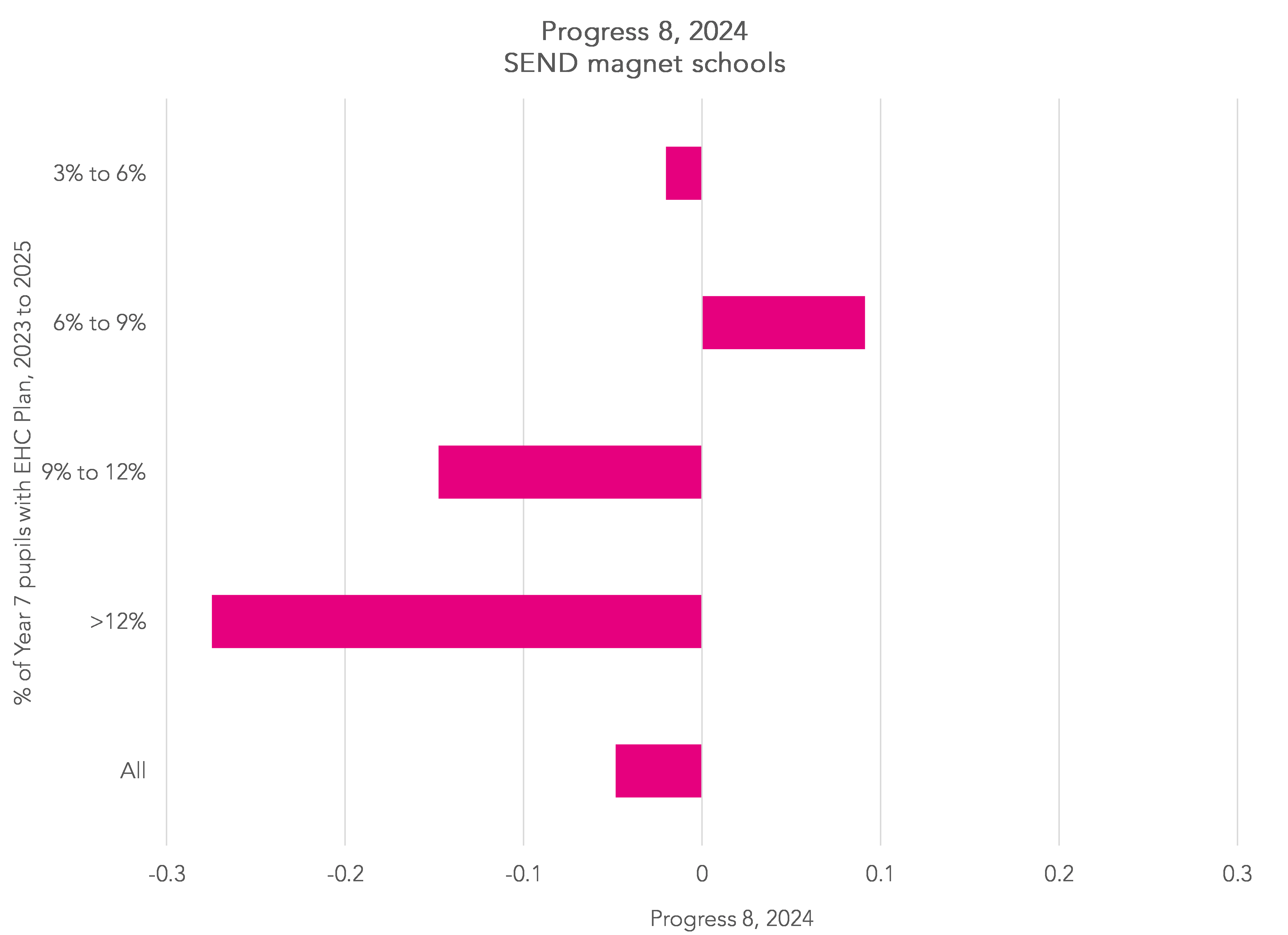
The SEND magnet schools with Year 7 EHCP rates above 9% tend to achieve negative Progress 8 scores. This perhaps highlights the current risk for secondary schools in becoming more inclusive.
Summing up
The transition from primary school to secondary schools results in more than a change of school for a substantial number of pupils with SEN.
Firstly, around 19% of pupils identified with SEN met by SEN support in 2023/24 ceased to be identified as having SEN when moving to secondary school.
The majority of pupils with EHC plans recorded as attending a resourced provision or SEN unit in Year 6 left the mainstream sector in Year 7. However, the data on which pupils attend such provision, and indeed which schools offer such provision, is rather patchy at present.
10% of pupils with EHC plans left the state-funded school system. This included 6% who move into local-authority funded alternative provision and 4% whose next placement was not observed in the data available. This could indicate a lack of school place anywhere. This suggests a lack of suitable placement within the state-funded school system.
Finally, we identified a small number (73) of SEND magnet schools that admitted a far higher number of Year 7 pupils with EHC plans than we would expect given the prevailing rates in the areas where the schools were located.
The Schools White Paper aims to increase inclusion within the mainstream sector. Two measures of success will be a reduction in pupils leaving the state-funded school system after Year 6 and a reduction in the number of schools identified as SEND magnets.
Want to stay up-to-date with the latest research from FFT Education Datalab? Sign up to Datalab’s mailing list to get notifications about new blogposts, or to receive the team’s half-termly newsletter.

Is it possible to provide information re which schools have been identified as SEND magnets in a specific local authority?
Some interesting insights, but the bit that caught my eye was the section on what has happened historically to Yr6 SEN students. From the article –
“Of 20,065 pupils with SEN met by SEN support in Year 6 who ceased to be identified with SEN in Year 7:
781 (4%) subsequently obtained an EHCP.
An additional 5771 (29%) were subsequently identified as having SEN met by SEN support between Year 8 and Year 11”
The first thing that came to my mind when I read this was, ‘How many ended up being excluded from school altogether through a lack of support?’
SEND magnet school implies pupils are coming out of there own communities to travel to another school. In the schools I’ve worked in that’s not the case. The fact is in higher deprived areas eg schools with high Pipil premium have a higher SEN needs cohort. Our needs audit from primary school files always shows miss identification or no SEND identification.