




This project has been funded by the Nuffield Foundation, but the views expressed are those of the authors and not necessarily the Foundation. Visit nuffieldfoundation.org
Managing behaviour in schools is difficult. On the one hand, removing a disruptive pupil can improve the learning environment for everyone else. On the other, exclusion comes with well-documented long-term costs for the pupil who is excluded.
So what should schools do?
A lot of the debate focuses on whether to exclude. But in new research, we ask a slightly different question:
Does when a pupil is excluded matter for their classmates?
In this article we run through the key findings. The full working paper can be found here.
Why timing might matter
Think about a disruptive pupil who is eventually excluded in Year 9. By that point, their classmates may already have spent two or three years learning alongside them. If disruption affects learning cumulatively, then removing that pupil in Year 9 may come too late to undo any harm.
That’s the core idea we test.
What we did
We used data on over 2 million pupils in England, linked from school records through to early adulthood outcomes. We use data on cohorts which reached the end of Key Stage 4 between 2014 and 2017, i.e. prior to the post-pandemic rise in exclusions.
The challenge is that exclusions aren’t random. Schools exclude pupils for a reason, and those reasons are often linked to outcomes.
To get around this, we used a source of variation that is outside the control of individual schools: changes in the number of filled Alternative Provision (AP) places nearby.
The idea is that when AP places are full, there is more of an incentive not to exclude pupils. This allows us to compare otherwise similar cohorts where disruptive pupils are removed earlier or later for reasons unrelated to the school itself.
The key finding: Year 9 matters
In the chart below we show the effect of exclusions in Years 8–10 on peers’ end of Key Stage 4 outcomes in English and maths.
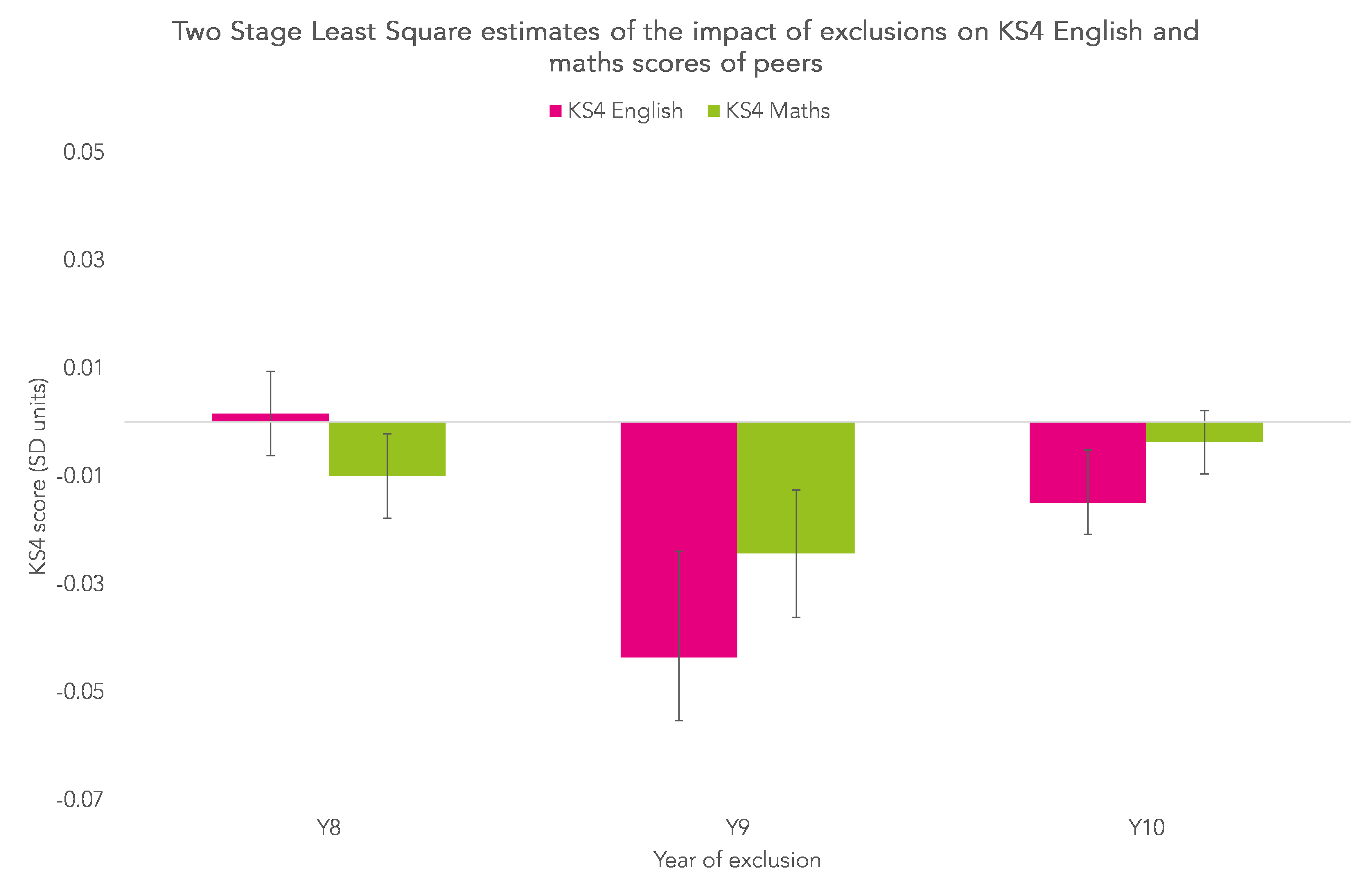
The most striking results come from Year 9 exclusions.
When exclusion happens at this point, we find negative effects on schoolmates:
- GCSE Maths: −0.024 standard deviations
- GCSE English: −0.044 standard deviations
- Higher probability of being NEET at age 21: +0.62 percentage points
In more intuitive terms, this is roughly about one month less progress in both Maths and English.
These are not huge effects for any one pupil, but across an entire cohort, they are meaningful.
The estimates are also a lower-bound estimate of the peer effect as, in the absence of data on how students are allocated to classes, we have defined peers as those in the same school and cohort rather than in the same class. However, individuals are likely to be more affected by peers they interact with most frequently, such as classmates, and less by more distant peers.
So… are exclusions harmful? Not quite
It would be easy to read this as saying that exclusions are bad for classmates. But that’s not what’s going on. The key point is this:
The negative effects reflect disruption before exclusion, not the act of exclusion itself.
By Year 9, excluded pupils have typically already accumulated a history of behavioural incidents. Our analysis shows that much of the damage to peers comes from this prolonged exposure to disruption, proxied by the number of days pupils have been suspended before exclusion.
In other words:
- Early removal → less accumulated disruption
- Late removal → more accumulated disruption (and worse outcomes)
What about earlier or later exclusions?
The timing pattern is quite clear:
- Year 8 exclusions (earlier):
Some evidence of improved longer-term outcomes for certain pupils - Year 9 exclusions (mid-secondary):
The largest negative effects on classmates - Year 10 exclusions (later):
Smaller effects, likely because much of the damage has already been done
This fits a simple story: disruption builds up over time, and by mid-secondary school, it has already taken a toll.
Who is most affected?
The impacts aren’t evenly distributed.
- Low-attaining pupils are particularly affected by Year 9 disruption
- Disadvantaged pupils show mixed patterns: sometimes short-term gains in attainment, but weaker labour market outcomes later on
So this isn’t just about averages—it’s also about inequality.
What about reintegration?
A common concern is that bringing previously excluded pupils back into mainstream schools might harm other pupils.
We find no evidence that reintegration negatively affects classmates
Across attainment, employment, and NEET outcomes, the effects are essentially zero.
That’s an important result for policy: inclusive pathways back into mainstream education appear feasible.
What does this mean for policy?
There’s a clear takeaway, but it’s not “exclude earlier”. Instead, the evidence points to something more fundamental:
The real issue is unresolved disruption, not exclusion itself:
- Persistent disruption harms classmates
- Delaying effective responses makes this worse
- But exclusion carries serious costs for the excluded pupil
So the policy challenge is not choosing between inclusion and exclusion.
It’s: how to intervene earlier and more effectively
This could include:
- Behavioural support
- Mental health provision
- Targeted pastoral interventions
- Alternative pathways within mainstream settings
Final thought
Exclusions are rare—but disruption isn’t. And while the long-run costs of exclusion for individuals are well known, our results show that there are also costs to doing nothing.
The key question for schools and policymakers is therefore not:
Should we exclude?
But rather:
How can we prevent disruption from reaching the point where exclusion becomes necessary?
Want to stay up-to-date with the latest research from FFT Education Datalab? Sign up to Datalab’s mailing list to get notifications about new blogposts, or to receive the team’s half-termly newsletter.

Can you explain again why the year 10 effect is less? I don’t quite understand “…likely because much of the damage has already been done.” – surely if the damage was already done we would expect to see that reflected in the maths and English results? In other words, if we are looking at the impact on maths and English, and going with the argument that these students are disrupting others, then I would expect to see the effect increase year on year. I think I must be understanding the measure incorrectly?
The smaller estimated effects in Year 10 do not necessarily imply that disruptive peer environments become less important at later stages. Rather, GCSE attainment reflects cumulative learning over secondary school, meaning that part of the attainment loss associated with disruptive peers may already have been realised through earlier exposure in Years 7–9. The Year 10 estimates therefore capture the additional marginal effect of contemporaneous exposure conditional on prior accumulated impacts, i.e. the additional impact of disruption in Year 10 over and above previous impacts.
An intuitive analogy is smoking and lung damage. By the 11th year of smoking, lung capacity already reflects substantial accumulated damage from earlier years. Additional smoking may still worsen health, but its marginal effect can appear smaller because much of the deterioration is already embodied in the outcome measure. Likewise, GCSE attainment already incorporates learning losses accumulated through earlier exposure to disruptive peer environments.
Ah, thank you Dave; I think I had missed that the Year 10 effect is measured conditional on students’ attainment at the end of Year 9, so it captures the additional impact in Year 10 beyond what has already accumulated. (I hope that’s correct?)
I applaud your attempts to explore this theme which is very relevant. However, I have practical questions about what appears to be some of the assumptions.
a. Mainstream schools do not need to exclude for a student to be placed with an AP or PRU; in fact the majority of pupils in AP have not been subject to exclusion. A significant number of students subject to exclusion are successfully placed with another mainstream school. Also, my experience is that full-time AP places fill as you progress through the academic year, so I do not know how useful it is as a variable (and I would be of the view that AP capacity would have little bearing on an individual school’s decision to exclude).
b. There are a range of reasons for exclusion, not all about persistent behaviours; again, a significant proportion of exclusions involve one-offs or short-term breaches of rules (e.g drug & alcohol / prohibited item / theft).
Hi Chris. Thanks for taking the time to read the report and leave a comment. On the first part, yes, not all pupils in AP have been permanently excluded (in fact, I once wrote an article with that very title https://ffteducationdatalab.org.uk/2019/05/timpson-review-reflections-part-one-not-all-pupils-who-end-up-in-alternative-provision-have-been-permanently-excluded/) but our assumption is that the number of filled places at an AP school (for whatever reason) could affect the probability of an excluded pupil being placed there. If AP schools faced capacity constraints then (again we assume) this might have led to schools and LAs looking at alternatives to exclusions in some cicumstances (bear in mind we are looking at exclusions 10-15 years ago in a different policy era to today). On point b) we use past suspension record as a proxy for disruptiveness.