




A long-running question in education research is just how much difference individual teachers make to pupil outcomes. Evidence from the United States has been influential in shaping this debate, showing that primary teachers have measurable effects not only on pupils’ maths and English test scores, but also on wider outcomes.
In a recently published paper from the TIDE project – funded by the Nuffield Foundation – I, along with a team of researchers from University College London, the National Institute of Teaching, Evidence Based Education, Teacher Tapp and the University of Brighton, have explored whether similar results hold in England.
Data and approach
Our analysis was based on data from the Teacher Education Dataset (TED). TED brings together anonymised information from schools’ Management Information Systems for research. Our analysis focused on two participating multi-academy trusts, comprising almost 300 teachers and around 8,000 pupils from 29 schools. Pupils in both trusts take standardised reading and mathematics assessments during primary education. To estimate teacher value-added, we use regression models that relate pupils’ end-of-year outcomes (i.e. test scores or attendance rates) to their prior attainment, previous absences, demographic characteristics, class features and school attended. The models produce pupil-level residuals – the difference between each pupil’s predicted and actual outcome. These residuals are averaged for each teacher to generate teacher “value-added” scores.
Primary school teacher effects on achievement
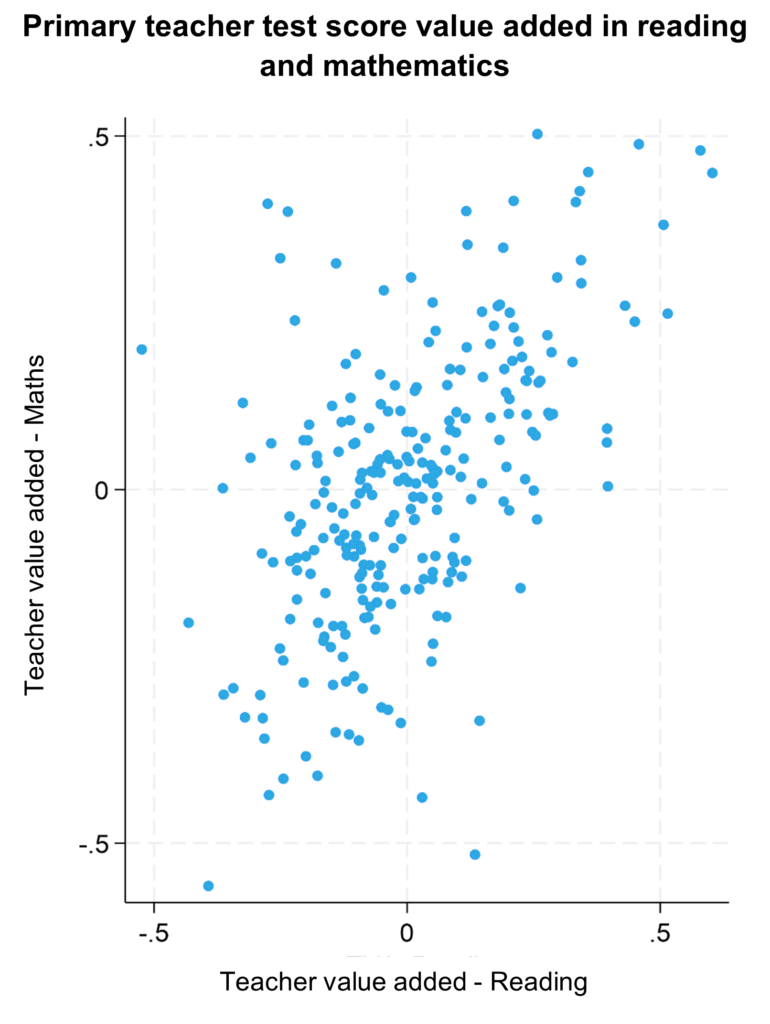
The presence of teacher effects on attainment is well established in the US. In our data from England, we also find that pupils taught by higher-value-added teachers make more progress in maths and reading over the school year, even after accounting for prior attainment and background characteristics.
Teachers who are effective in one subject also tend, on average, to be effective in others. This pattern mirrors the US evidence and reinforces the idea that teacher quality is a key driver of academic progress in primary school.
The chart below illustrates these relationships. It shows a clear positive association between teacher effects in maths and reading. Teachers who raise maths scores tend also to raise reading scores. One potential explanation for this cross-subject correlation is that core teaching skills, such as classroom organisation or clarity of explanation, help boost pupils learning across multiple areas.
Primary school teacher effects on attendance
The story changes when we consider attendance.
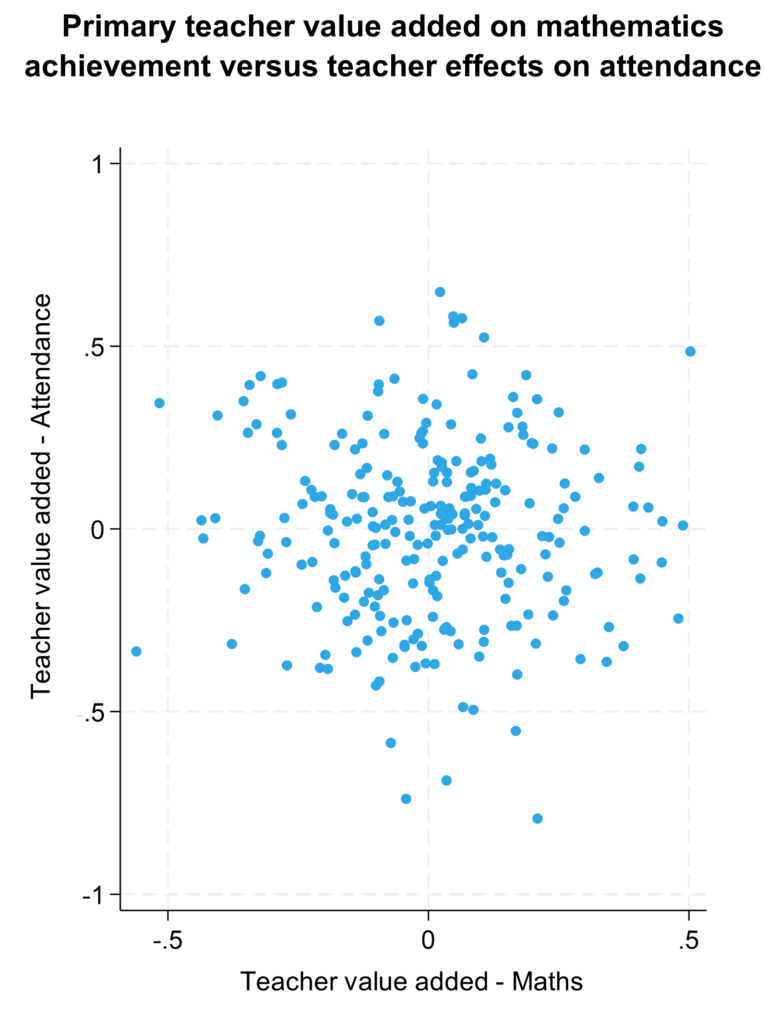
The chart below plots teacher effects on mathematics against teacher effects on attendance. Here, the cloud of points is diffuse, with there being no clear relationship between the two. Teachers who are highly effective at improving test scores are not necessarily the ones that improve attendance.
In fact, the estimated teacher effects on attendance are tightly clustered around zero, indicating very limited scope for individual teachers to influence this particular outcome.
What these results imply for schools
The strong teacher effects on maths and reading reinforce the central role teachers play in shaping pupils’ learning. Efforts to recruit, develop and retain high-quality teachers remain crucial for raising attainment. However, the results for attendance suggest that this may not be true for every outcome.


Confused by the line ‘…find that pupils taught by higher-value-added teachers make more progress in maths and reading over the school year,’
This feels a circular argument as I’d define ‘higher value added teacher’ one whose pupils make more progress (than the average) over the school year…?
John, can you clarify what is meant by a teacher value added score of 0.5 means, and 0.5? I think it is noticeable that for many teachers with a positive value added score for Maths, this coincides with a negative value added score for reading. A smaller amount have the opposite pattern. I’m interested in why ‘reading’ was selected? Were there weaker correlations for other aspects of English or just English? I’m not convinced the argument can be generalised to “Teachers who are effective in one subject also tend, on average, to be effective in others”.