




After last week’s A-level results day, this Thursday it’s the turn of GCSEs and other Level 2 qualifications. As usual, we’ll be posting our analysis throughout the day.
The FFT Early Results Service will open to subscribing schools on Wednesday morning. And the team will be running a free webinar on Friday at 11am, focussing on where your school sits in the national picture.
Datalab will also be running a free webinar on Thursday 10th September at 4pm, looking at the national headlines in more depth, and what they might mean for the year ahead. Sign up now to book your place.
In this post, we’ll take you through some of the things we’ll be looking out for.
1. We don’t really know what will happen to grades overall, but we expect stability
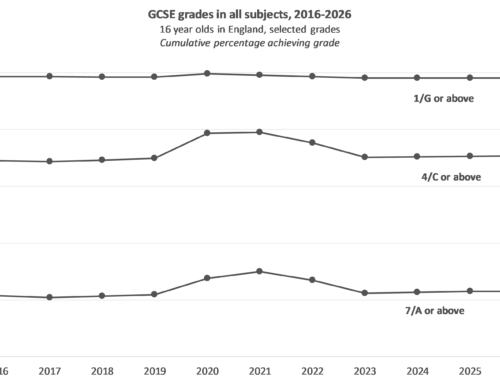
While we do expect grades overall to be broadly the same as last year, there’s a bit more uncertainty than usual. That’s because we don’t know the prior attainment profile of either last year’s or this year’s subject cohorts, both having had their Key Stage 2 tests cancelled during the pandemic.
Usually, Ofqual’s comparable outcomes framework uses prior attainment to provide stability in grading. If a cohort’s prior attainment is similar to the previous year’s, then grade boundaries will initially be set so that the distribution of pupils by key grades is also similar. (Exam boards are free to change these, with evidence, if they think that the standard of work is better or worse than suggested around a particular boundary.) The aim of this process is to ensure that a particular grade in a particular subject “means” the same thing from one year to the next.
We thought last year that Ofqual, being unable to check for changes in prior attainment, might have just used the previous cohort’s grading distribution as the starting point for setting grade boundaries, and that we might therefore have seen more stability than usual. This was true to an extent, though we did see the overall percentage of grades awarded top grades, 9-7, nudge up a bit, which we didn’t expect.
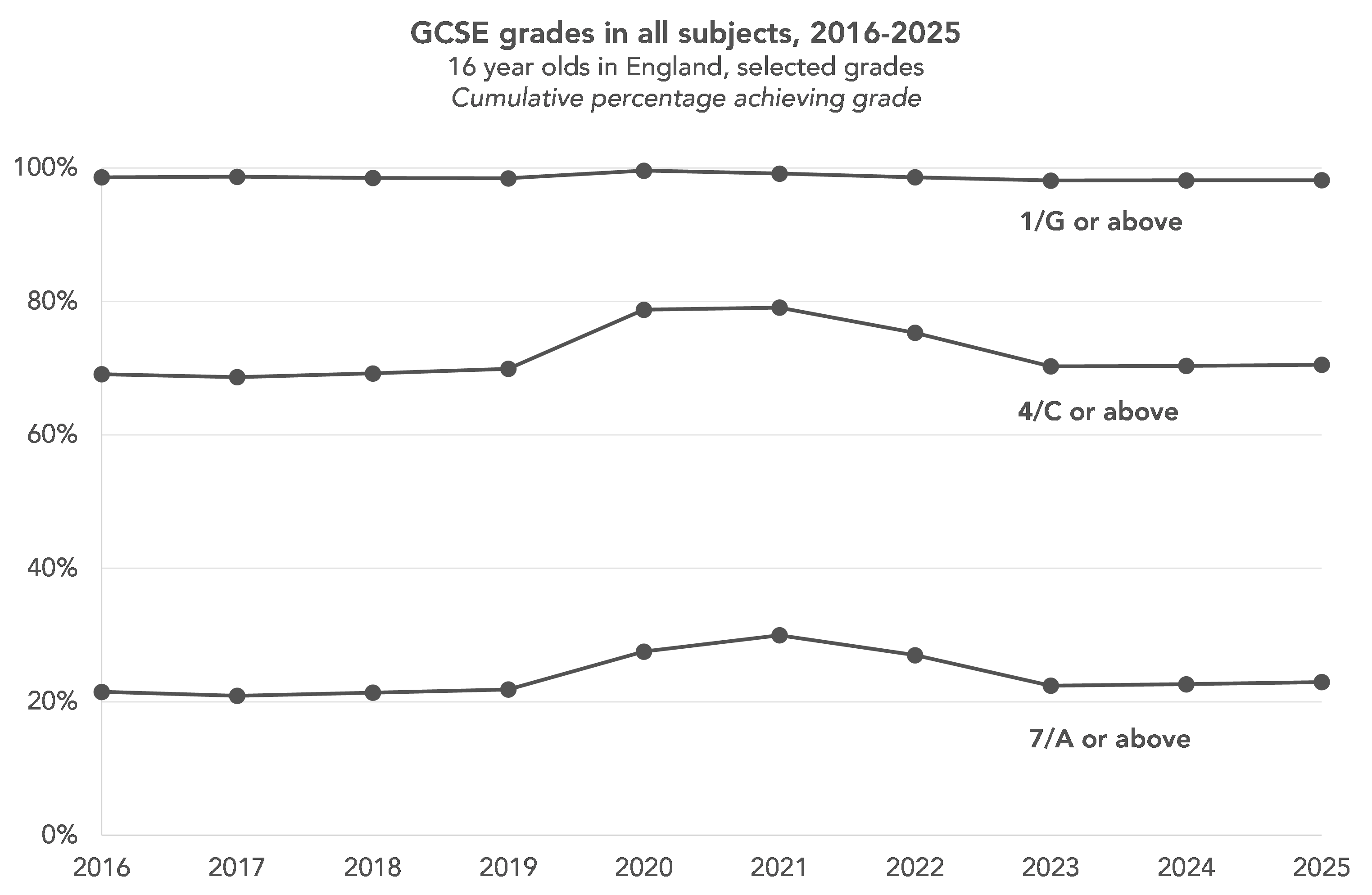
Exactly what Ofqual actually did last year remains a mystery. It only appears very briefly in their 2025 delivery report, and any difficulties posed by missing prior attainment weren’t mentioned at all.
2. The National Reference Test will probably be ignored again
Something that was mentioned in Ofqual’s delivery report, however, is the National Reference Test (NRT). Taken by a representative sample of Year 11 pupils each year, the NRT is designed to detect statistically significant changes in attainment around key grade boundaries in English language and maths.
For the past couple of years, the test has detected that attainment around the 4/5 borderline in English language is weaker than when the test was first administered in 2017. If the process worked as intended, this would have led Ofqual to require grade boundaries to be changed so that fewer pupils achieved a grade 9-4 in English language.
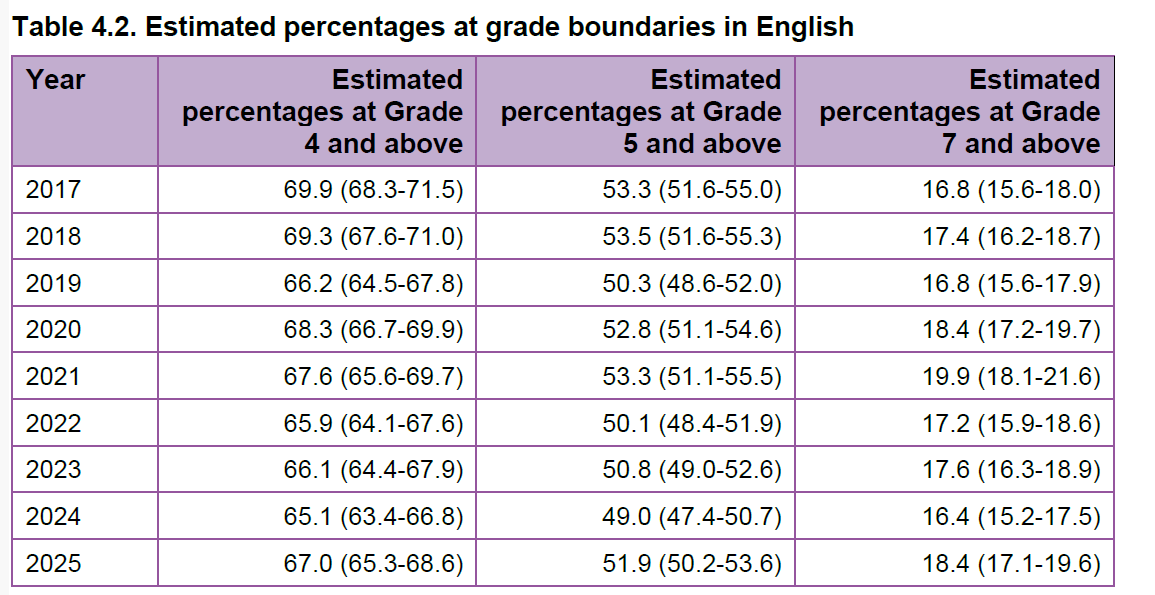
They have, however, declined to do this. No doubt the alternative awarding mechanisms used during the pandemic, and associated increases in grades, has a part to play. It would have been difficult to justify lowering grades further in 2023, the first post-pandemic year where pre-pandemic standards were applied. And, having not applied the suggested reduction that year, it could be seen as inconsistent to apply it in 2024 or 2025. Should we therefore expect the results of the NRT to be ignored indefinitely? In which case, is it still worth doing?
As an aside, despite Ofqual not using the NRT to require an adjustment to the 4/5 grade boundary, we did actually see a slight dip in the proportion of grades awarded 9-4 in English language last year (71.2% to 70.6% among 16 year-olds in England). Did examiners, independently of the NRT, also detect weaker performance at the 4/5 boundary last year?
3. English and maths results might produce conflicting headlines
A lot of attention on GCSE results day tends to be on English and maths, and we expect this year to be no different. But there are a couple of things to be wary of when looking at press headlines about the “pass rates” in these subjects.
Firstly, it’s common practice for newspapers to use the term “pass” to mean a grade 9-4[1], even though in actuality anyone who has obtained a grade other than “U” has passed the qualification. It’s understandable to think this way given that pupils who don’t meet the threshold have to continue with English and maths at post-16 until they do, usually by re-taking GCSE exams.
Secondly, because of this, the English and maths GCSE cohorts contain large numbers of students who are over the age of 16, and who skew results downwards. The numbers of such students tend to vary from year to year, making trends based on the attainment of the whole cohort difficult to interpret, and not always especially meaningful. For example, if the number of re-take students increases from one year to the next, the overall percentage of 9-4 grades will decrease, even if it has remained identical for each age group individually.
If you find yourself looking at a headline quoting “pass rates” for English and maths in the high 50%s or low 60%s, you’re looking at whole cohort figures. And whether it’s gone up or down, it might not be telling you what you think it is.
4. Re-sits might improve before further shake-ups
It’s likely that English and maths re-sit data will be under more scrutiny than usual this year. We saw last year that the proportion of grades at 9-4 among older students remained some way below pre-pandemic levels, particularly in English.
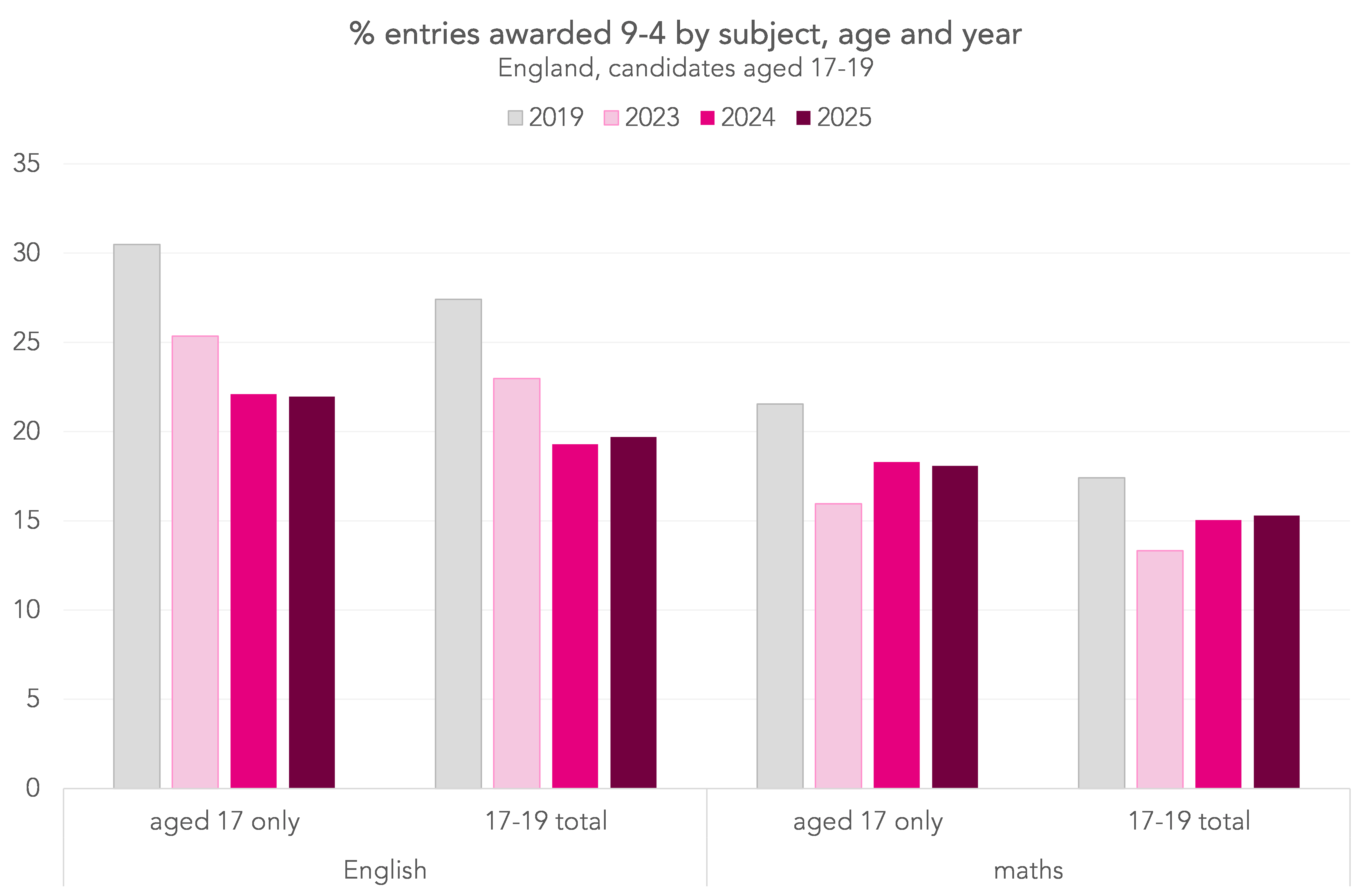
Continued low rates of achievement were mentioned in the Curriculum Review released earlier this year, leading to a recommendation for alternative pathways for some students. Some fairly major changes to accountability arrangements have also been proposed as part of a wider consultation on 16-19 performance measures.
There’s reason to think we might see a slight improvement this year following a hardening of the rules around the number of hours of teaching provided to re-take students. In theory, more teaching hours should mean better results. Whether this will be the case in practice remains to be seen.
5. Entries have gone up slightly overall, but not in all subjects
The one thing we do have a strong idea about before results day itself is the number of entries to different subjects. That’s because Ofqual release provisional information in June. Below, we show the expected change in entries by subject for Year 11 pupils in England[2].
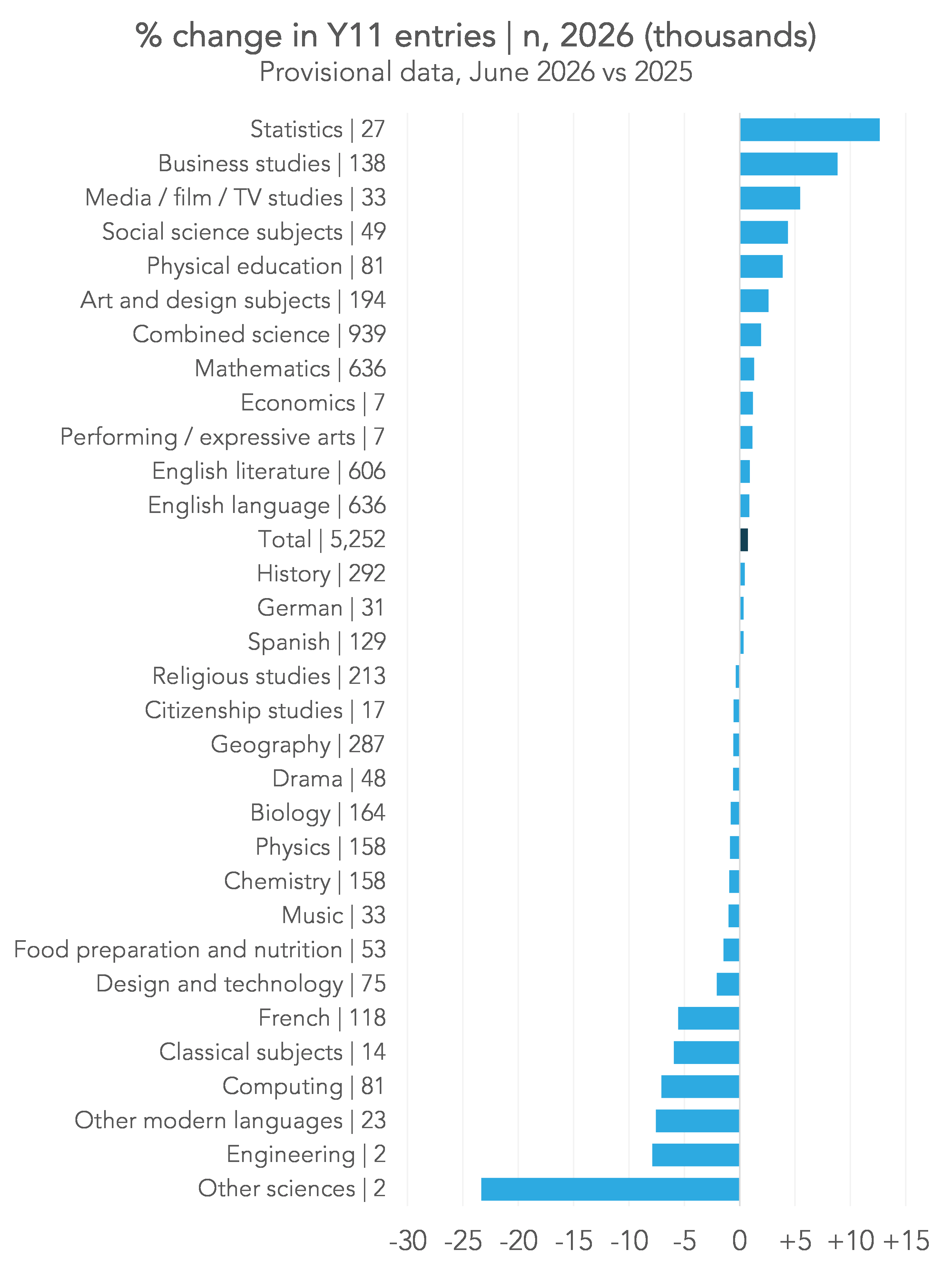
Provisional entries overall increased by around 0.7%. As this is broadly in-line with the estimated increase in the population of 16 year-olds in England (1.2%, according to Ofqual’s release), we don’t think there’s been much change in the average number of subjects taken by each pupil.
Ignoring subjects with small numbers of entries, which are prone to large swings from year-to-year, the subjects with the largest percentage increase in entries are statistics (13%), business studies (9%), and media studies (5%). The increase in entries to business studies is perhaps most noteworthy, happening in the same year as a similarly sized increase in entries to A-level economics, and considering that business studies was already one of the most popular subjects at GCSE.
The subjects with the biggest decrease in entries are other modern languages (-8%, an umbrella term for languages with small numbers of entries, mostly taken by native speakers), computer science (-7%), and French (-6%).
Again, we see a shift away from triple and towards double science, with biology, chemistry and physics all seeing small falls in entries, and double science seeing an increase.
On results day, we’ll be keeping a particularly close eye on any changes in attainment in these subjects, as well as French, German and Spanish, which are awarding results under new specifications for the first time.
Want to stay up-to-date with the latest research from FFT Education Datalab? Sign up to Datalab’s mailing list to get notifications about new blogposts, or to receive the team’s half-termly newsletter.
[1] They might use the term “standard pass” for a 9-4, and/or “strong pass” for 9-5, see e.g. here.
[2]: Note that the provisional entries published by Ofqual combine GCSE short course and full course entries. For the vast majority of subjects this makes no difference, as short courses are no longer available. However, religious studies is an exception, with just under 21,000 pupils entered for the short course last year. The figures we present on results day will be based on full course entries only, so our religious studies numbers may differ from the provisional totals.
Leave A Comment