


How many pupils really are severely absent?
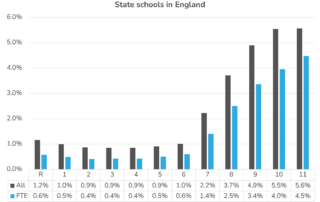
Is it right to say that there were over 170 thousand children who were severely absent in 2023/24?
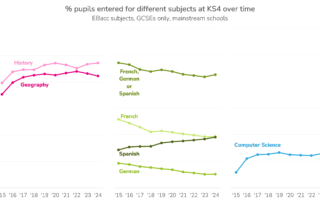
With the publication of the Curriculum and Assessment Review imminent, we look at the extent to which schools offer different subjects at Key Stage 4, and how entry patterns have been changing in the last few years
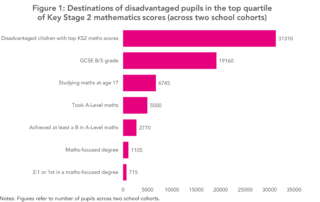
A look at the leaky pipeline for pupils who show potential in maths at age eleven but don't go on to pursue the subject.
Although it is a requirement that pupils who do not achieve grade 4 in English (or maths) at GCSE continue to study English (or maths) post-16 by no means all of them enter a qualification.
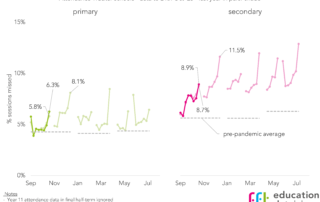
Absence at the start of term is no more predictive of persistent absence than at any other time of year.
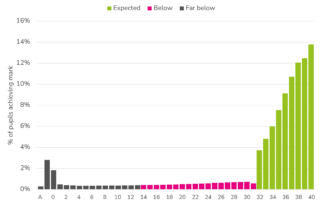
Post-COVID there has been a rise in the percentage of pupils leaving school without a pass (9-1) in GCSE English and a similar figure in maths. Most of these pupils were not entered for examinations.
We look at some of the things DfE should consider when providing schools with comparative analysis of the percentage of pupils reaching a good level of development (GLD) at the end of the Early Years Foundation Stage.
Based on data from 1,500 secondary schools, we take an early look at the pupils who did not achieve a standard pass in English and maths GCSE.
New statutory guidance for schools in relation to recording and managing attendance (and absence) came into effect in September last year. We take a look at the use of codes to record absences in attendance registers.