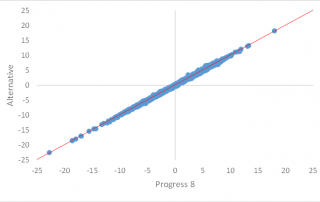



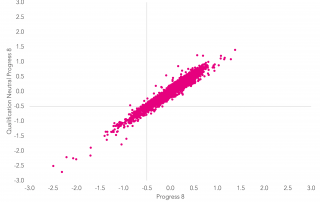
Qualification neutral Progress 8

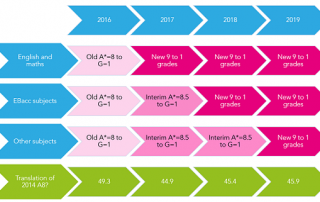
One criticism of the current Progress 8 measure is that the points awarded to some qualifications are more (or less) favourable than to others. There is a risk that any inequality in the way different qualifications are valued incentivises schools to pursue those treated more favourably at the expense of working to improve grades awarded [...]
By |2017-10-23T13:08:55+01:007th December 2016|Exams and assessment, School accountability|

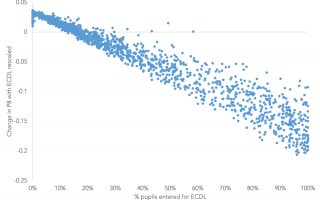
The impact of ECDL on Progress 8 scores

We have written previously about how the points awarded to the European Computer Driving Licence in school performance tables appeared to be out-of-kilter with other qualifications, given the grades achieved by ECDL entrants in GCSEs they took. And Data Educator has subsequently written more on the topic. (To give it its full title, we’re talking about [...]

By |2018-09-27T18:00:06+01:0014th November 2016|Exams and assessment, School accountability|

Provisional KS4 data 2016: Grammar schools reporting fantastic Progress 8 scores? Not so fast…

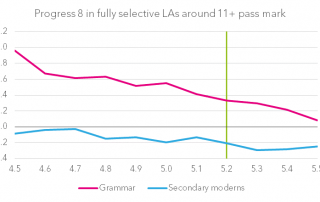
Today’s provisional Key Stage 4 data shows a strong Progress 8 performance from grammar schools, and a negative Progress 8 score for those calling themselves secondary moderns. But the positive results of the grammars seem to more than outweigh the negative results of secondary moderns. So, should we use this data to claim that selection [...]

By |2017-10-23T12:43:53+01:0013th October 2016|Exams and assessment, School accountability, Structures|

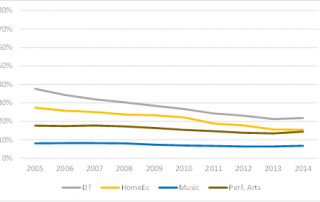
What Progress 8 tells us about how the curriculum has changed in schools

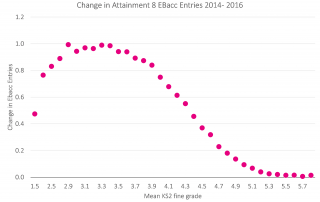
Secondary schools today received provisional Progress 8 data for 2016. This is a significant milestone given the importance attached to Progress 8 in the secondary school accountability framework. The rest of us will have to wait until provisional data is published in October. In the meantime DfE has published some very useful technical information that [...]

By |2016-12-07T12:55:08+00:0026th September 2016|Exams and assessment, School accountability|

Progress 8 is too favourable to grammar schools and understates secondary modern achievement

Progress 8 is the new measure by which secondary schools will be judged. It works by comparing each child’s achievement in eight subjects at GCSE with the average GCSE results for other children who got the same results in exams taken at age 11. The Department for Education designed it to incentivise schools to provide a [...]

By |2017-10-23T13:18:21+01:0016th September 2016|Admissions|

Don’t try to forecast Progress 8!

In our visits to secondary schools this year we are seeing a huge variety of target setting strategies. It is completely understandable that headteachers want a framework for knowing whether year groups are on-track to do well. This isn’t easy with re-scaled GCSEs dribbling on-stream and a hard accountability target – Progress 8 – that [...]

By |2017-03-03T09:50:15+00:0024th February 2016|School accountability|

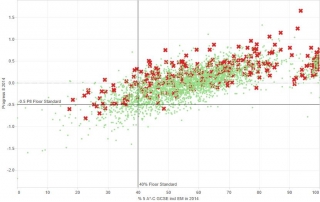
Opting into 2015 Progress 8 would have been an easier route to avoid floor standards for many secondary schools

Secondary school accountability is changing and by 2016 schools will be primarily judged by their Progress 8 score, rather than the proportion of pupils achieving five or more GCSEs at A*-C, incl. English and maths. Progress 8 isn’t perfect (no rank order of schools serving different communities can be), but this is indeed progress. The [...]

By |2017-03-03T09:46:52+00:009th August 2015|School accountability|

The hocus pocus of Progress 8

There are infinite different ways to judge whether pupils at a school achieved more or less than they might have if placed at another school chosen at random. Tom Sherrington has chosen to criticise one – Progress 8 – in his blog and propose another – a comparison of the distribution of attainment by intake and [...]

By |2017-03-03T09:44:48+00:005th May 2015|School accountability|

What will Progress 8 do for the creative subjects?

The changes made by the coalition government to secondary school accountability, such as the EBACC, the Wolf Review and Progress 8, have tended to be met by concern that 'creative' subjects will become marginalised as a result of schools placing greater emphasis on 'academic' subjects. In recent weeks, for example, the TES questioned whether creative [...]

By |2018-11-15T09:54:54+00:0026th March 2015|Exams and assessment|
Go to Top