




Regular readers will know that we’ve been using attendance data to monitor the rate of exclusions and suspensions in schools in advance of official statistics from the Department of Education.
This is largely because of the time lag in the official statistics. Data for the 2024/25 academic year will be published in July. In other words, they are a year behind.
Back in September, we looked at exclusions and suspensions in the whole of the 2024/25 academic year.
This showed that the rate of increase in the exclusion and suspension rates, which has been fairly sharp since the pandemic, was beginning to slow down.
Now with data for the Autumn Term 2025/26 available, we look at whether this is still the case.
Data
Pupils who are permanently excluded or suspended but who remain on the school roll are marked as code E in registers for up to five days. From the sixth (consecutive) day, alternative provision is supposed to be arranged.
Using attendance data for 2024/25 and 2025/26 supplied by 9,000 schools subscribing to FFT attendance tracker, we can summarise rates of absence due to exclusion and suspension for both years.
What we cannot do is distinguish between spells that are due to suspension and spells that are due to exclusion (or more accurately, spells that will result in due course in permanent exclusion).
Comparing our method to published statistics
As usual, we begin by comparing our figures with published official statistics.
The figures we produce are equivalent to the sum of the permanent exclusion rate and the suspension rate, in other words the total number of exclusions and suspensions divided by the total number of pupils. Given that suspensions tend to outnumber permanent exclusions by a rate of approximately 20 to 1 then our figures are mainly of suspensions.
We show our calculated figures for the Autumn Term 2024/25 alongside the published DfE figures in the chart below. This is the most recent term for which official statistics are available.
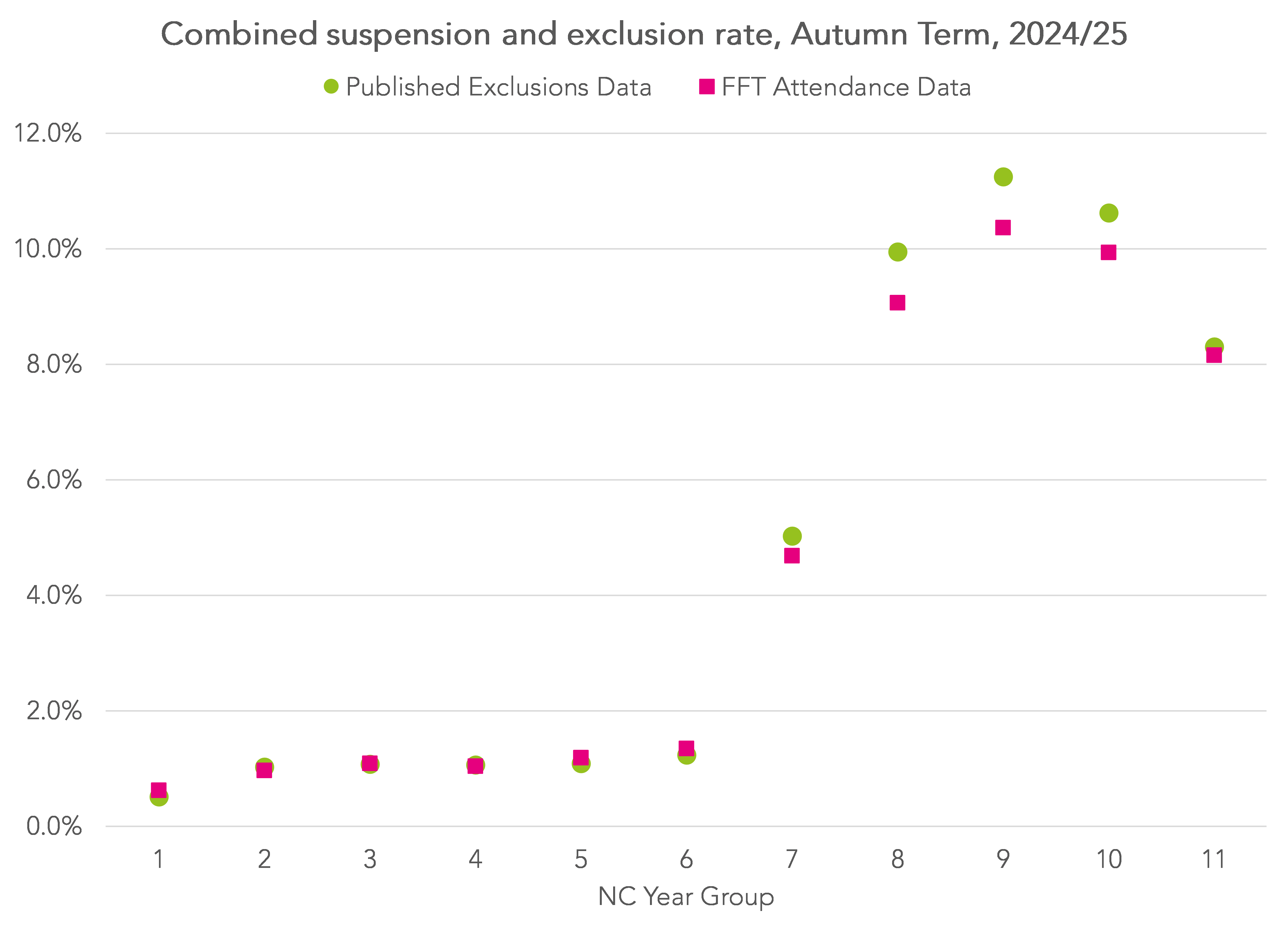
This pattern is typical when we do sort of analysis. Our figures are fairly close to DfE figures but, if anything, are a bit lower, particularly for Years 8 to 10, the year groups with the highest rates. There may be various reasons for this. For example, If a pupil returns from suspension and is suspended again the same day we would count that as one suspension rather than two.
Consequently, our figures for 2024/25 might be slightly under-estimated.
Suspensions in 2025/26
Repeating our methodology for the Autumn Terms in academic years 2024/25 and 2025/26, we see a further fall in the rate of suspensions and exclusions across secondary year groups (7 to 11).
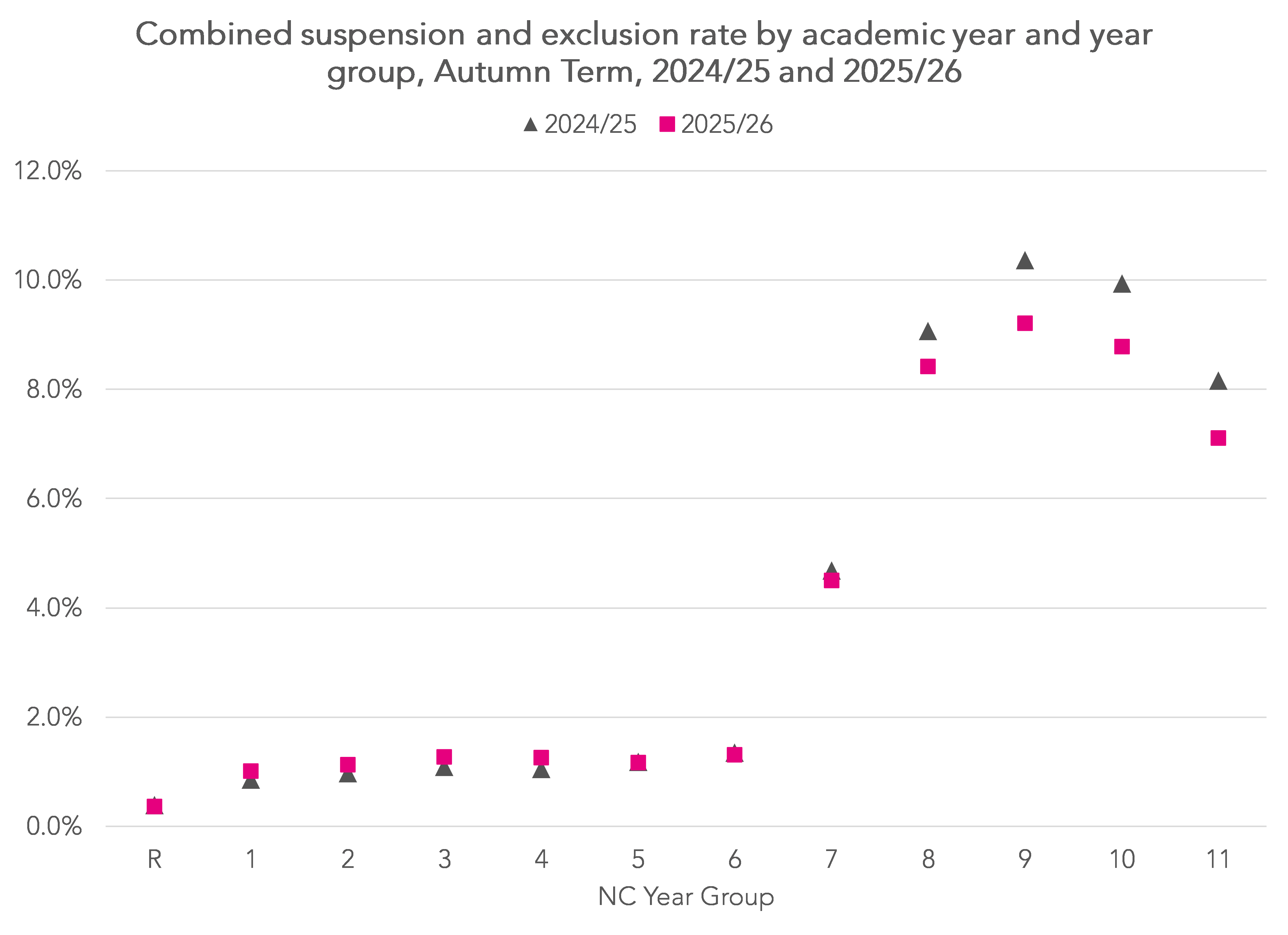
Among the primary year groups, we see a small increase in the combined exclusion and suspension rate of around 0.2 percentage points (pps).
Among secondary year groups, we see decreases for all year groups, particularly those with the highest rates, Years 9 and 10. Rates fell by 1.2 pps.
The suspension rate is the number of suspensions divided by the number of pupils so a rate of 20% does not mean that 20% of pupils have been suspended. Some pupils will be suspended more than once.
But we can also summarise the percentage of pupils who are suspended or excluded at least once.
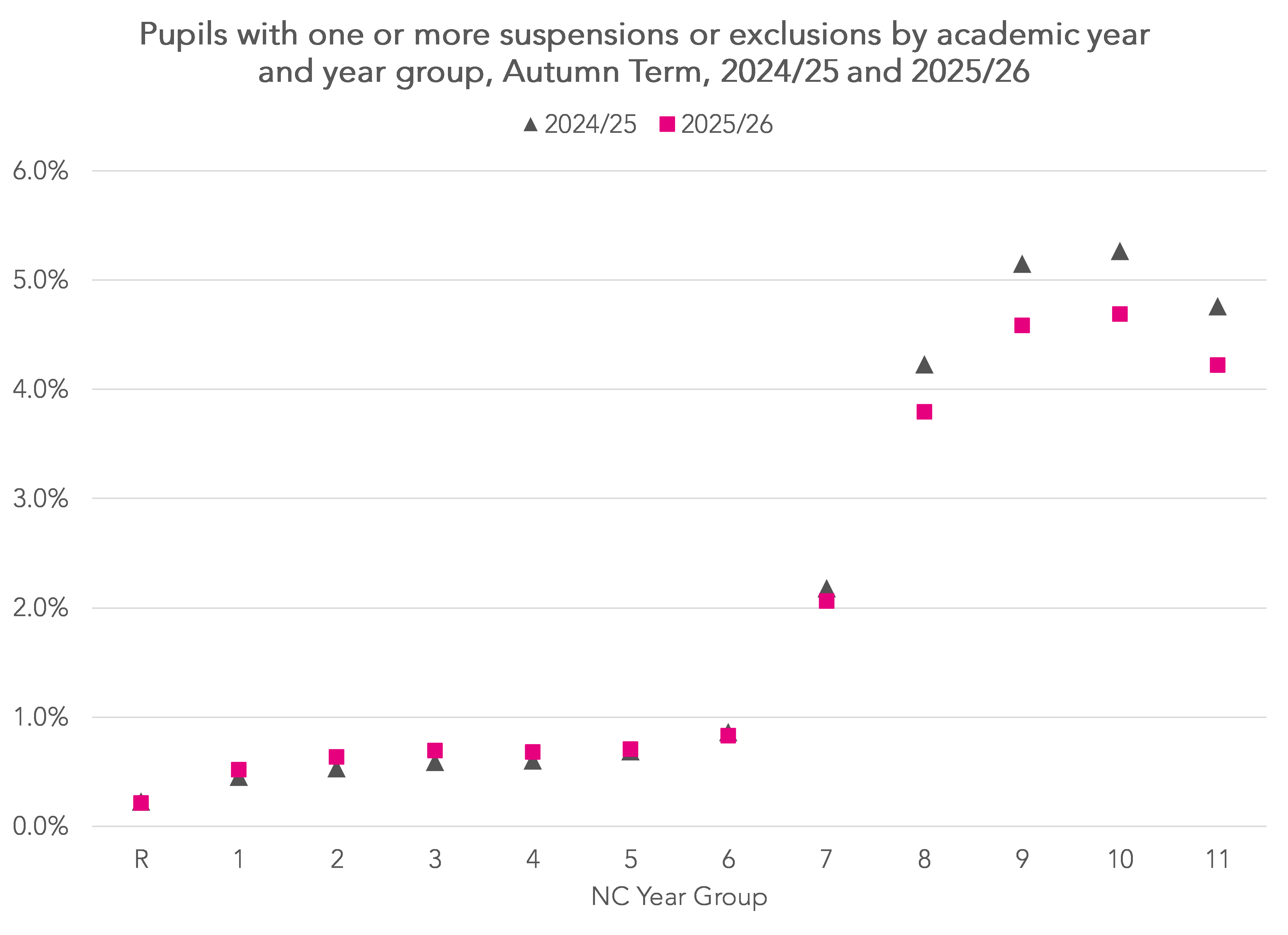
For most year groups, 2025/26 rates were lower than those for 2024/25, slightly higher in primary (years 1 to 4) and slightly lower in secondary.
Disadvantaged pupils
We continue to see stark differences in the percentage of disadvantaged pupils suspended or excluded at least once compared to their peers.
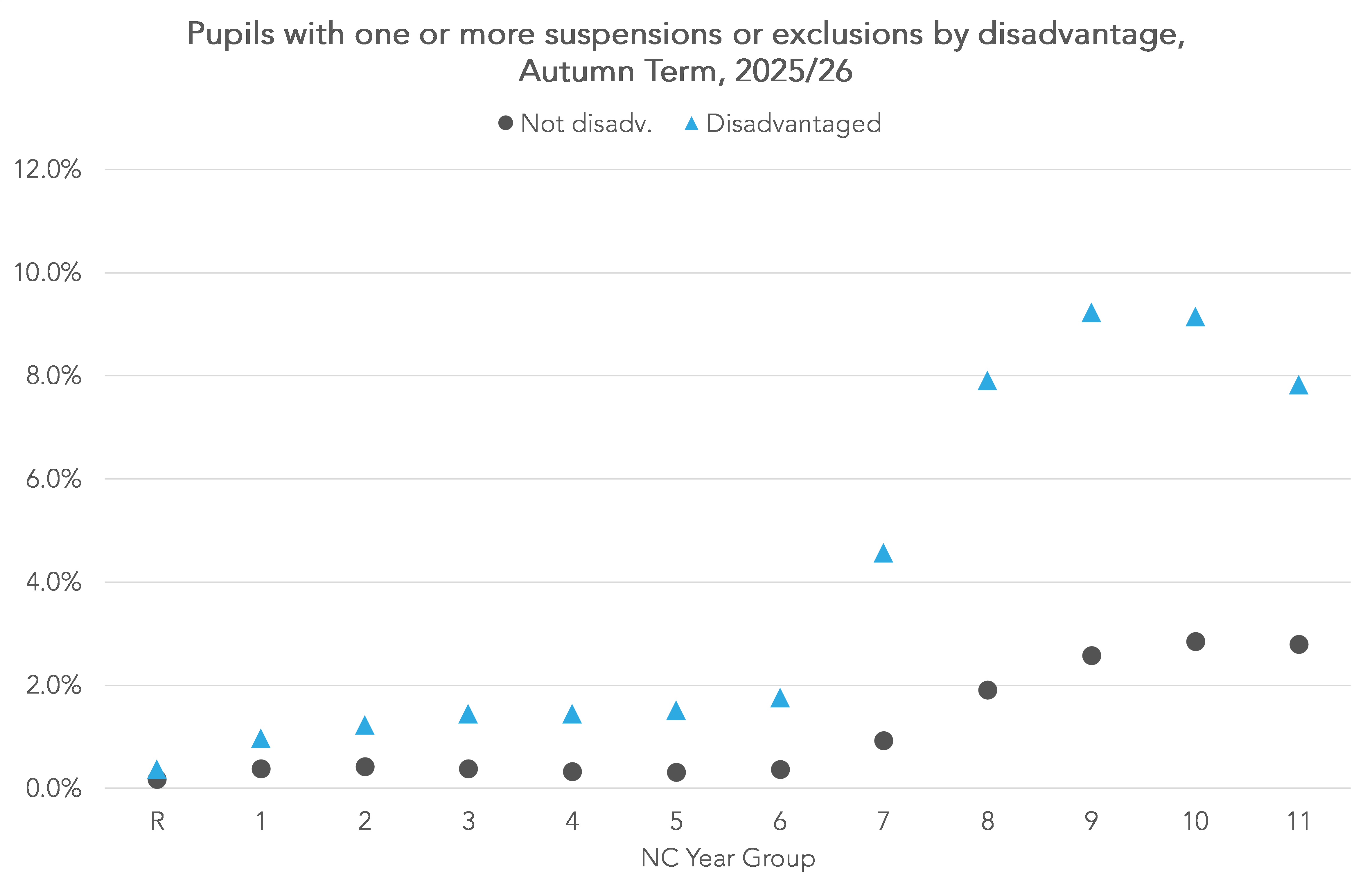
More than 8% of disadvantaged pupils in Years 8, 9 and 10 (around one in twelve) were suspended or excluded at least once in Autumn 2025/26.
Differences are even more pronounced among those identified as having special educational needs (SEN).
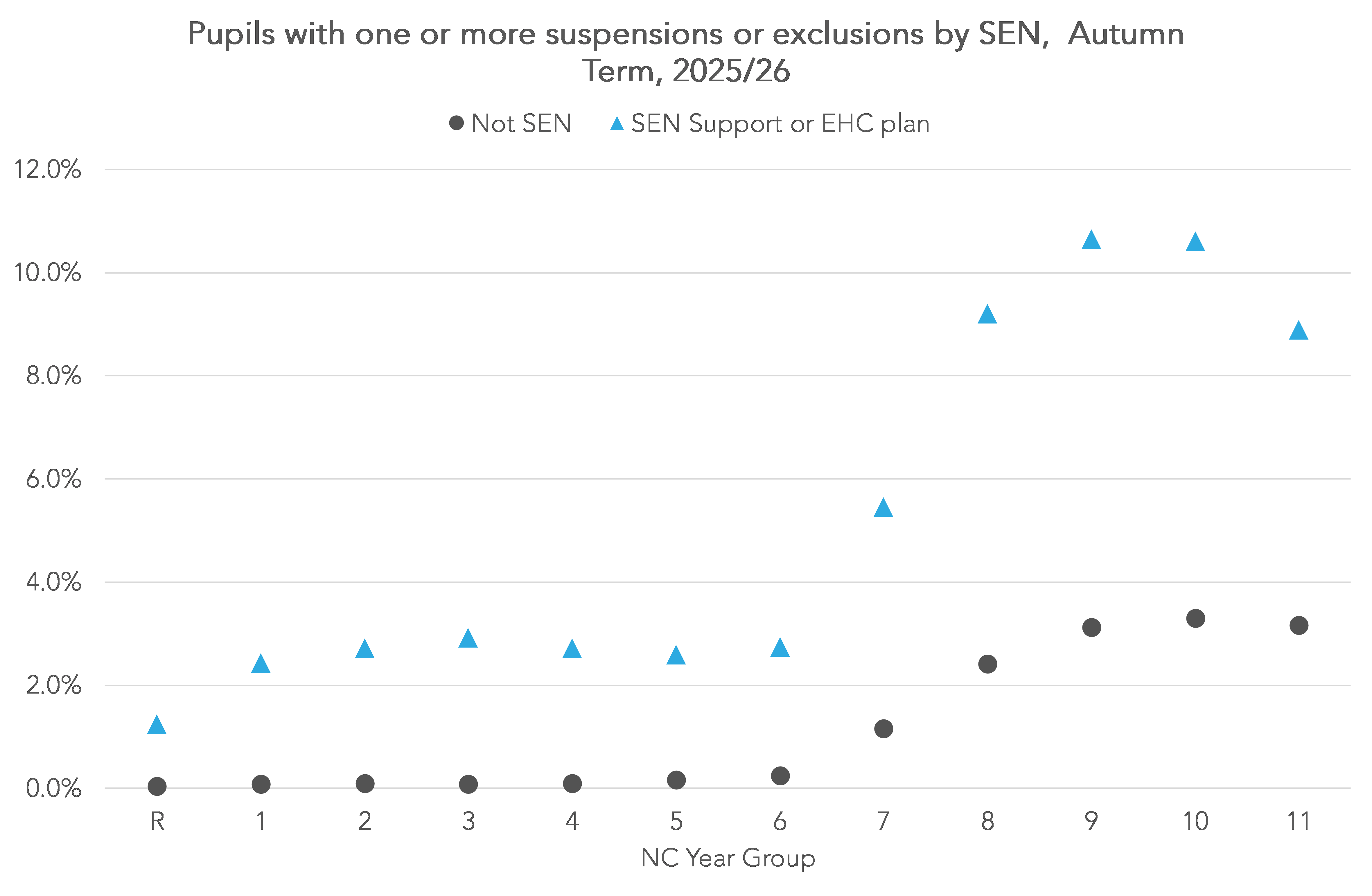
Disadvantage, along with a previous history of social care and a previous history of suspension are the biggest risk factors of exclusion.
Summing up
Published DfE statistics show that the suspension rate fell in Autumn Term 2024/25, having been increasing each term since the pandemic.
Data for Autumn 2025/26 academic year so far suggests that the rate of suspensions is continuing to fall.
But It remains the case though that disadvantaged pupils are disproportionately (far) more likely than other pupils to experience exclusion or suspension.
Want to stay up-to-date with the latest research from FFT Education Datalab? Sign up to Datalab’s mailing list to get notifications about new blogposts, or to receive the team’s half-termly newsletter.
Hi Dave – always interesting to read your analyses. Can I ask a couple of questions. Is the rate of the fall similar for all pupils or is there a difference between the fall in exclusions and suspensions between disadvantaged and non-disadvantaged children? Also, this may be rather complicated, but do you have similar figures for children with SEND or children who are severely absent (miss more than 50% of school sessions)?
Hi Tim. I’ve added in another chart showing the SEN v non-SEN split. Not sure I understand your question about severely absent pupils though- do you mean whether they have a higher propensity to be suspended?