


Are you a teacher interested in data? Come and spend some time with us learning how researchers evaluate schools

There is a small community of people with both experience of our schools and the skills to analyse large scale datasets. We would love to make this community bigger. This summer (starting 3rd August) we are hosting paid interns who have experience of teaching or working with schools to learn how to use the large-scale [...]

By |2018-11-15T09:55:36+00:0011th May 2015|News|

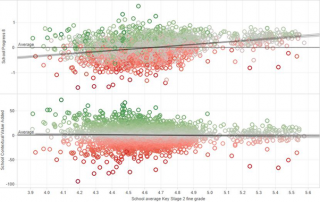
Why do pupils at schools with the most able intakes tend to make the most progress?

In a previous blog, we noted that Grammar schools tended to achieve above average Progress 8 scores based on 2014 data. At first glance, this is a worrying finding. Progress 8 is supposed to offer a fairer basis for comparing schools than measures of raw attainment. Moreover, this effect is not limited to Grammar Schools. [...]

By |2018-02-23T13:05:55+00:005th May 2015|School accountability|

The hocus pocus of Progress 8

There are infinite different ways to judge whether pupils at a school achieved more or less than they might have if placed at another school chosen at random. Tom Sherrington has chosen to criticise one – Progress 8 – in his blog and propose another – a comparison of the distribution of attainment by intake and [...]

By |2017-03-03T09:44:48+00:005th May 2015|School accountability|

The pupil premium group in coastal schools: is their rate of progress really any different to schools with similar intakes?

With attainment in London, Greater Manchester and the Black Country, the focus of City Challenge initiatives, apparently no longer giving cause for concern, the spotlight has shifted to coastal towns and rural areas. The 2014 report of Her Majesty’s Chief Inspector of Schools, for example, drew attention to the problems faced by schools in such areas in recruiting teachers. [...]

By |2018-01-29T17:30:22+00:0027th April 2015|Pupil demographics|

Ready to Read: Closing the gap in early language skills so that every child in England can read well

We created the data analysis for the Save the Children report 'Ready to Read'. Being able to read well is vital for a child's prospects at school and in life. Yet every year, almost 148,000 children leave primary school in England unable to read well. This includes one third of all children growing up in [...]

By |2017-03-03T09:44:32+00:0017th April 2015|Pupil demographics, Reports|

Using Pier-effects to evaluate free schools

Note - this piece was first published on April Fool's Day 2015! The establishment of free schools by the current government aimed to meet a demand for new school places in particular areas and to raise the performance of all schools through increased competition. For researchers, trying to show whether the establishment of a free [...]

By |2017-03-03T09:44:18+00:001st April 2015|Pupil demographics|

What will Progress 8 do for the creative subjects?

The changes made by the coalition government to secondary school accountability, such as the EBACC, the Wolf Review and Progress 8, have tended to be met by concern that 'creative' subjects will become marginalised as a result of schools placing greater emphasis on 'academic' subjects. In recent weeks, for example, the TES questioned whether creative [...]

By |2018-11-15T09:54:54+00:0026th March 2015|Exams and assessment|
Go to Top