


Some things you might not know about our schools – a birthday special
As we celebrate our tenth birthday, we look back at some of the issues we were talking about when Datalab launched, and reflect on some of the other big issues in education today.
We explore new evidence that suggests attending a grammar school isn’t independently related to increased risk of mental ill-health.
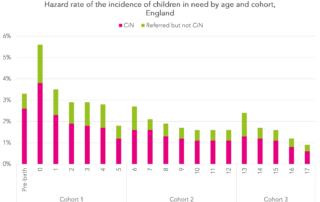
DfE statistics show that on 31st March 2023, 3.4% of all children aged 0-17 were defined as in need. But we estimate that around a quarter of children will be classified as in need at some point before their 18th birthday.
Schools' Progress 8 scores for disadvantaged pupils tend to be correlated with the percentage of disadvantaged pupils in a school's cohort. But this is the case in some regions more than others.
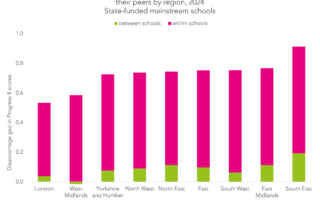
Around 8% of the gap in Progress 8 scores between disadvantaged pupils and non-disadvantaged pupils in 2024 appears to be attributable to the way in which pupils from both groups are shared out between schools
We look at the proportion of schools who send no pupils on to study various subjects at A-Level, broken down by gender.
We look at how likely pupils are to progress to study A-Levels, broken down by gender, ethnicity and level of disadvantage.
We use data from ECHILD to look at how likely high-achieving young women are to become teenage mothers.
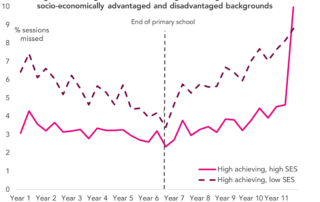
Based on our analysis of attendance registers, rates of exclusions and suspensions in 2023/24 were higher than last year