


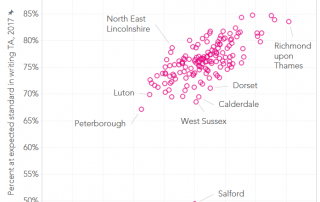
KS2 performance tables 2017: Three things from this morning’s data

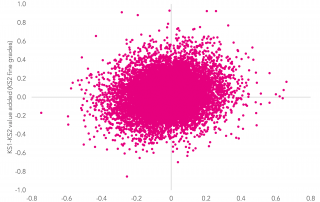
Today’s Key Stage 2 Statistical First Release provides further information on the 2017 Key Stage 2 results which we first wrote about here. This includes school-level data, plus data on the performance of different groups of pupils. There are some interesting differences in progress scores between ethnic groups There is much greater variation in the [...]
By |2017-12-15T15:17:14+00:0014th December 2017|Exams and assessment, School accountability|

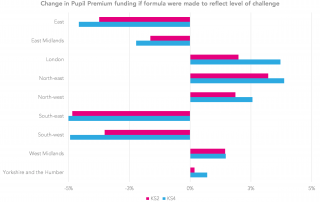
Long-term disadvantage, part four: If Carlsberg made schools…and also designed funding formulae?

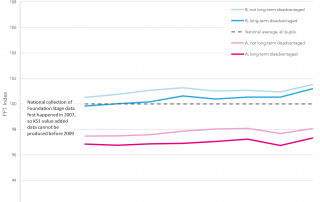
This is part four in a series of blogposts exploring long-term disadvantage. Other posts in the series can be found here. At the start of the summer we showed that there are substantial differences in the attainment and progress of pupils who have been disadvantaged at some stage. The main findings of these earlier posts were [...]

By |2018-09-27T17:32:27+01:008th September 2017|Pupil demographics, School funding|

Provisional KS2 data 2017: Five key points from today’s release

1. The percentage of pupils achieving the higher standard has increased We already knew that the percentage of pupils achieving the expected standard in reading, writing and maths increased from 53% last year to 61% this year. And today’s release of provisional Key Stage 2 data shows that the percentage reaching the higher standard increased [...]

By |2017-12-20T13:23:44+00:0031st August 2017|Exams and assessment, School accountability|

Measuring two-year retention post-16: what does it show?

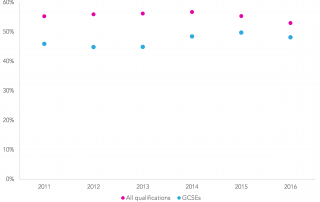
Each year, the government of the day publishes performance indicators about schools and colleges. While ostensibly they provide the public (and particularly parents) with information, and so inform choice, they are also a lever to encourage the system to function in the way the government wants. Indicators come and go as governments change. Plans for [...]

By |2018-09-27T17:36:23+01:009th August 2017|Post-16 provision, School accountability|

Long-term disadvantage, part three: Ethnicity, EAL and long-term disadvantage

This is part three in a series of blogposts exploring long-term disadvantage. Other posts in the series can be found here. The previous post touched on the relationship between ethnicity, disadvantage and KS2-to-KS4 progress. It made a simple distinction, with white British pupils in one group and all other minority ethnic pupils in another group. [...]

By |2017-10-23T12:57:18+01:0028th July 2017|Pupil demographics|

Are more pupils really taking arts subjects?

Schools Week last week published a handy summary of Ofqual’s release of summer 2017 examination entry statistics. It notes that entries in EBacc subjects have risen whilst entries in other subjects have fallen. This raises the question of whether the EBacc is crowding other subjects out of the curriculum. In defence of the EBacc, Schools [...]

By |2017-10-23T12:43:11+01:0023rd June 2017|Exams and assessment, School accountability|

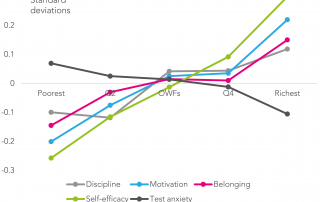
What PISA tells us about pupils from ordinary working families

Last week, we heard a lot from the government about their interest in children from ‘ordinary working families’. (For our initial take on the topic, see here and here.) In its new consultation document, the Department for Education has provided information on the GCSE grades and progress of these children – defined as those not [...]

By |2017-10-23T13:02:25+01:0020th April 2017|Admissions, Exams and assessment, Pupil demographics|

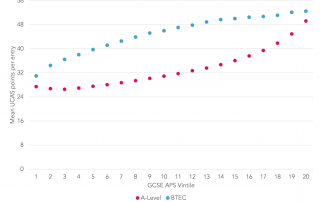
The equivalence of A-Levels and BTECs

New analysis This post was published in 2017. We've subsequently looked at the equivalence of A-Levels and reformed BTECs. Read our updated analysis here. * Updated 3rd April 2017 following helpful feedback from UCAS* Last week, the Higher Education Policy Institute published a report on BTECs and university admissions [PDF]. It recognised that [...]

By |2020-01-13T15:38:25+00:0028th February 2017|Exams and assessment, Post-16 provision|
Go to Top