


Missing Talent: Raising the aspirations and achievement of the 7,000 highly able pupils who fall behind at secondary school

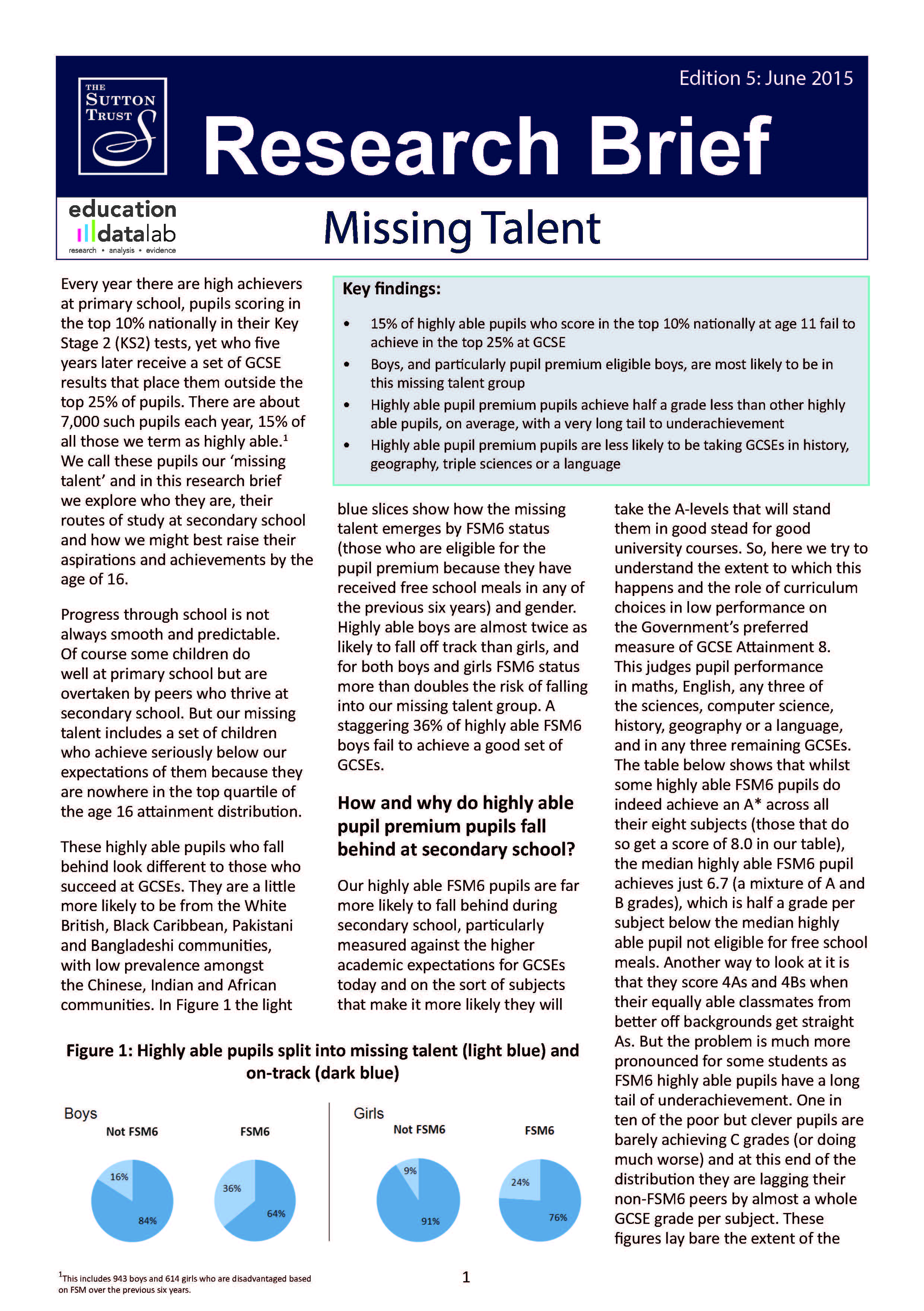
Every year there are high achievers at primary school, pupils scoring in the top 10% nationally in their Key Stage 2 (KS2) tests, yet who five years later receive a set of GCSE results that place them outside the top 25% of pupils. There are about 7,000 such pupils each year, 15% of all those [...]

By |2017-03-03T09:45:58+00:0015th June 2015|Pupil demographics, Reports|

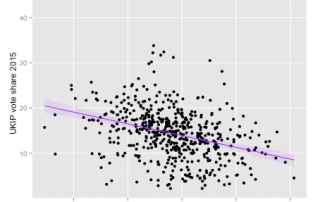
The UKIP voters of tomorrow – Part II

A blog I wrote last week, on the “UKIP voters of tomorrow”, was very popular. In it, I explored the relationship between UKIP vote share in the 2015 General Election and constituency average GCSE performance between 2011 and 2014. There seemed to be a negative relationship between the two measures – constituencies with higher UKIP [...]

By |2017-03-03T09:45:40+00:004th June 2015|Pupil demographics|

A comprehensive schooling system must ensure that all children are able to reach their full potential, even those who are already performing well

Today the Sutton Trust has published Missing Talent, a research brief we wrote on the 7,000 pupils who score in the top 10% nationally in their KS2 tests, yet who five years later receive a set of GCSE results that places them outside the top 25%. The findings show that boys, particularly those from disadvantaged [...]

By |2017-03-03T09:45:33+00:003rd June 2015|Exams and assessment, Pupil demographics, Reports|

Liz Kendall is (almost) right There are enormous differences in children’s school starting points by parliamentary constituency

When MPs quote education statistics, I’m always curious where they got them from and whether they are accurate. Last week, Labour leadership contender Liz Kendall made a speech in Leicester where she mentioned that in Leicester West, ‘children start school on average 15 months behind where they should be in terms of their development’. We [...]

By |2017-03-03T09:45:28+00:0031st May 2015|Pupil demographics|

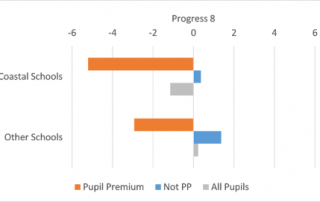
The pupil premium group in coastal schools: is their rate of progress really any different to schools with similar intakes?

With attainment in London, Greater Manchester and the Black Country, the focus of City Challenge initiatives, apparently no longer giving cause for concern, the spotlight has shifted to coastal towns and rural areas. The 2014 report of Her Majesty’s Chief Inspector of Schools, for example, drew attention to the problems faced by schools in such areas in recruiting teachers. [...]

By |2018-01-29T17:30:22+00:0027th April 2015|Pupil demographics|

Ready to Read: Closing the gap in early language skills so that every child in England can read well

We created the data analysis for the Save the Children report 'Ready to Read'. Being able to read well is vital for a child's prospects at school and in life. Yet every year, almost 148,000 children leave primary school in England unable to read well. This includes one third of all children growing up in [...]

By |2017-03-03T09:44:32+00:0017th April 2015|Pupil demographics, Reports|

Using Pier-effects to evaluate free schools

Note - this piece was first published on April Fool's Day 2015! The establishment of free schools by the current government aimed to meet a demand for new school places in particular areas and to raise the performance of all schools through increased competition. For researchers, trying to show whether the establishment of a free [...]

By |2017-03-03T09:44:18+00:001st April 2015|Pupil demographics|

Pupil premium isn’t working… or is it?

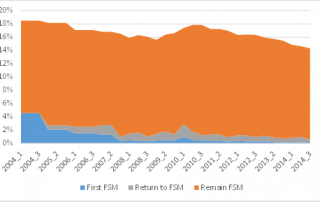
When national results at Key Stage 4 were published last November phrases like "the gap between rich and poor widens" typified headlines in the national press. This was because the gap between the attainment of disadvantaged (often called Pupil Premium) pupils and others in the headline measure of 5A*-C including English and maths had increased [...]

By |2017-03-03T09:43:22+00:0013th March 2015|Exams and assessment, Pupil demographics|
Go to Top