


Long-term disadvantage, part six: Measuring disadvantage in the north

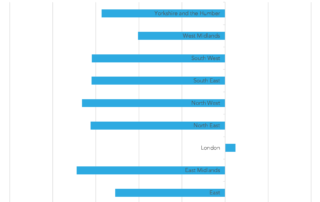
This is part six in a series of blogposts exploring long-term disadvantage. Other posts in the series can be found here. In previous blogposts in this series we have shown that the impact of disadvantage on attainment and progress varies according to the percentage of their time in school that a pupil has been eligible for [...]
By |2018-04-19T14:56:19+01:0023rd February 2018|Pupil demographics, School improvement|

Long-term disadvantage, part five: What explains the gap between London and the north?

This is part five in a series of blogposts exploring long-term disadvantage. Other posts in the series can be found here. We looked recently at the Progress 8 scores of long-term disadvantaged pupils – those who are eligible for free school meals (FSM) for 90% or more of their time in schools – and concluded that: [...]

By |2018-09-27T17:22:42+01:0023rd February 2018|Pupil demographics, School improvement|

Long-term disadvantage, part four: Our friends in the north

This is part three in a series of blogposts exploring long-term disadvantage. Other posts in the series can be found here. Some of you might remember the 1996 TV series in which Christopher Ecclestone plays Nicky Hutchinson. As an impatient politician he argues that “Tomorrow is too late”. The Northern Powerhouse Partnership (NPP) has today issued [...]

By |2018-02-19T18:37:38+00:001st February 2018|Pupil demographics, School funding, School improvement|

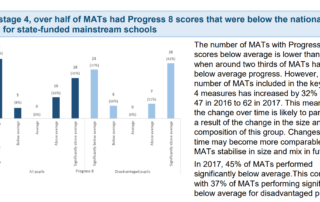
Why is the performance of MATs so extreme?

Answer: It isn’t. So why ask the question? Well, among the glut of statistics published by the Department for Education on Thursday was a statistical first release on the performance of multi-academy trusts (MATs) [PDF]. At the top of the second page was this curious chart. At first glance, this looks rather alarming. It seems to [...]

By |2018-02-02T09:09:22+00:0028th January 2018|Exams and assessment, School accountability, Structures|

Key Stage 4 performance tables 2017: Closing the gap just got harder

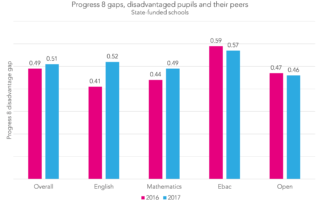
Today’s Key Stage 4 statistical release from the Department for Education shows the gap between disadvantaged pupils and others to be narrowing slightly [PDF]. This is based on the DfE's gap index, which is calculated by ranking pupils according to their English and mathematics grades and then calculating an overall index. It would appear to be [...]

Multi-academy trust league tables 2017: What can we learn from the data? Including a lesson on why we shouldn’t take everything at face value

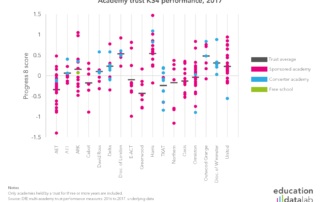
Along with Key Stage 4 and Key Stage 5 league tables, the Department for Education has this morning published multi-academy trust league tables – the second year it has published these in full. This analysis looks purely at the DfE’s Key Stage 4 MAT league tables, focusing on those trusts with more than five secondary [...]

By |2018-09-27T17:23:18+01:0025th January 2018|School accountability, Structures|

Key Stage 5 performance tables 2017: Do minimum standards meet the standard?

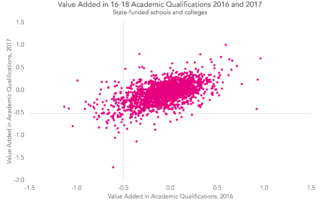
Minimum performance standards for 16-18 Level 3 (A-Level and equivalent) attainment were first introduced in 2016. Separate standards were defined for academic qualifications (primarily A-Levels) and applied general qualifications (primarily BTECs). The standards are based on value added measures that control for pupil attainment at Key Stage 4. For academic qualifications, the minimum standard in [...]

By |2018-09-27T17:23:47+01:0025th January 2018|Post-16 provision|

KS4 performance tables 2017: Everything we know about coasting schools and floor standard schools

The first table in this post was updated at 17.42 on 25 January 2018 after we noticed – of all things – that percentages in the table did not add up to 100. We very much regret the error. Key Stage 4 league tables – performance tables, to use their proper name – have been published this [...]

Provisional KS4 data 2017: North East secondary schools fall further behind the rest of the country

Last year at the Schools NorthEast Annual Summit I was delighted to talk to primary teachers and learn how they had become a high-performing region. Today I had less happy conversation with their secondary colleagues about why they are falling behind at GCSE. As the chart below shows, the North East has always scored poorly [...]

By |2017-10-18T18:06:46+01:0012th October 2017|Exams and assessment, School accountability|

Provisional KS4 data 2017: A round-up

The EBacc continues to be ignored There was a slight fall in the percentage of pupils entered for all five subjects making up the English Baccalaureate (EBacc). Even so, the percentage entered for the science and humanities components actually increased. The fall in the headline EBacc entry rate was entirely due to a drop in [...]

Go to Top